

You’re in the market for more than a jacket. You’re in pursuit of that Holy Grail blazer: the one men respect in a boardroom, but you still feel decidedly like you — feminine and pulled together and powerful. But the dressing room tale is usually one of gaping shoulders, tight hips and fabrics that seem more like armor than apparel. The issue is not your body, it’s that most off-the-rack blazers are constructed on a masculine frame, which leaves you to make the fit work.
This guide moves beyond generic “styling tips” to tackle the root cause: finding a blazer with a feminine foundational cut and then making it perfect for you. We’ll break down the anatomy of a great blazer, from internal construction to final hem, giving you the vocabulary and criteria to make a confident, long-term investment.
The Core Pillars of a Feminine Blazer Cut
Forget trends for a moment. The difference between a blazer that wears you and one that elevates you lies in its foundational structure. Feminine tailoring isn’t about adding ruffles; it’s about proportion and shape.
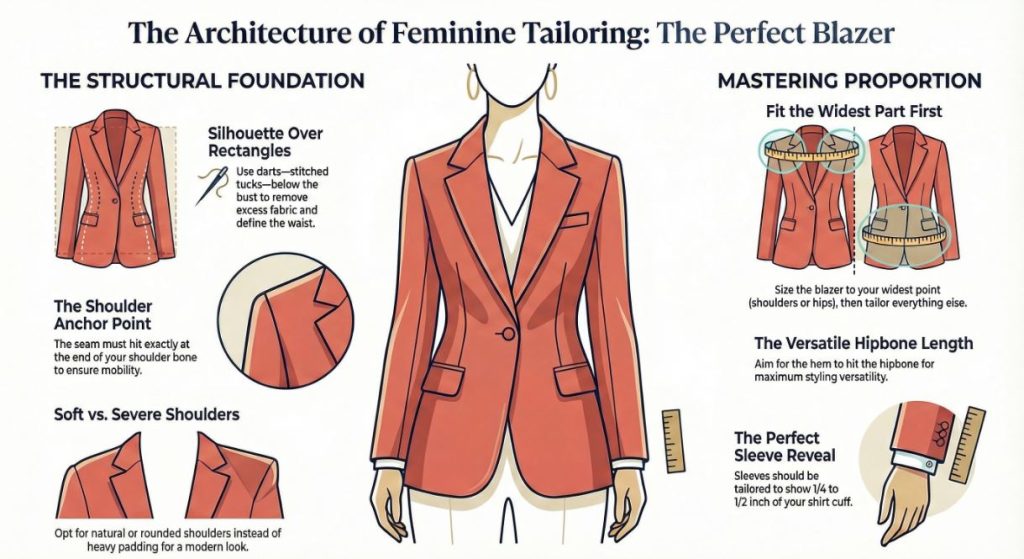
- Silhouette is King (or Queen): The traditional male silhouette is a rectangle. Feminine design is typically about soft edges. Search for darts — those stitched tucks, either below the bust or in the back — which eliminate excess fabric and provide shape and a waist. A waist that gently pegs in and then blossoms at the hips is a telltale sign of a feminine cut.
- The Shoulder Dictates Everything: *This is the anchor point. The seam should lie right at the end of your shoulder bone. Too far out and you look sloppy; too far in, it constricts movement. For a more relaxed style, look for natural or gently rounded shoulders instead of severe, padded power shoulders.
- Proportion Over Size: A perfect blazer fits the widest part of you comfortably (typically shoulders or hips), and then is tailored everywhere else. The length is critical: hitting at the hipbone is versatile, while a longer line can be more elegant. Sleeve length should show about 1/4 to 1/2 inch of your shirt cuff.
Your Step-by-Step Fitting & Selection Guide
Follow this process in the dressing room, with a critical eye and a phone to take notes.
Step 1: The Fabric & Lining Interrogation
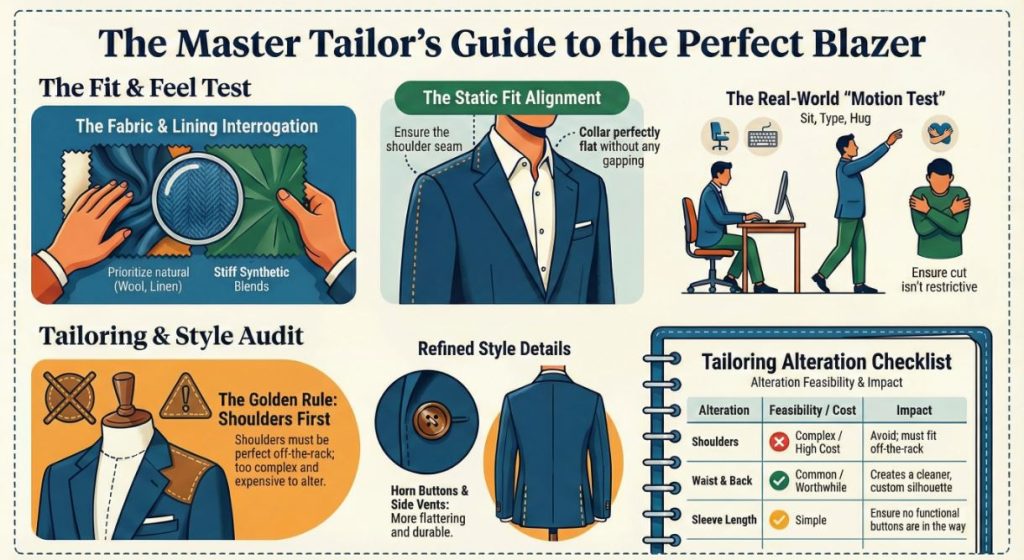
Feel the fabric. High-quality wool, linen, cotton, or fine blends (such as wool-silk) will drape and last longer than stiffer, synthetic ones. Check the lining. A fully lined or half-lined blazer (say, with lining in the sleeves and upper back) will slide on nicely, maintain its shape over time, and feel a little more luxurious. A crappy, static-heavy lining is a bad sign.
Step 2: The “Static Fit” Check (Before You Move)
Button the blazer (the top button only if it’s a two-button style). Stand naturally.
- Shoulders: The seam must sit flush. No divots or pulling.
- Collar: It should lie flat against the back of your neck, with no gap.
- Bust & Waist: There should be enough room without pulling at the button. You should be able to slip a flat hand inside comfortably.
- Hips & Length: Does it skim your hips without cupping under them? Is the length flattering to your torso and pants/skirt?
Step 3: The “Motion Test” (The Real World Check)
Sit down. Raise your arms as if to gesture or type. Hug yourself. The blazer should not ride up severely or feel like it’s going to rip. The button shouldn’t strain. If it fails this test in your size, the cut is too restrictive.
Step 4: The Tailoring Conversation
Identify the one thing that must be perfect off-the-rack: the shoulders. Shoulder alterations are complex and expensive. Everything else is easier. Common, worthwhile alterations include:
- Taking in the waist (via side seams or darts).
- Shortening sleeves (ensure there are no functional buttons too close to the end).
- Taking in the back for a cleaner fit.
- Shortening the overall length (within limits, as it changes pocket placement).
Step 5: The Style & Detail Audit
Now, evaluate the style elements that align with your personal aesthetic:
- Lapels: Slimmer lapels (2-2.5 inches) often feel more contemporary and feminine than very wide ones.
- Buttons: Horn, mother-of-pearl, or covered buttons feel more refined than cheap plastic.
- Pockets: Flap pockets are classic; slit pockets are sleeker. Ensure they lie flat.
- Vents: Center vents offer a clean line; side vents (especially double vents) are often more flattering for curvier figures, as they don’t pull open when you move.
Common Mistakes to Avoid
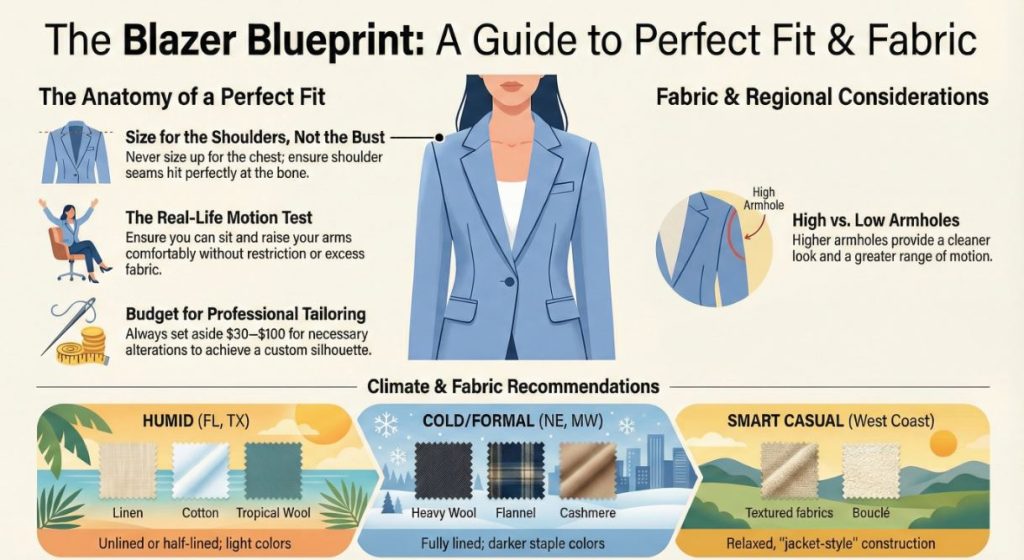
- Buying the Wrong Size to Fit Your Bust: Never size up dramatically just to button over your chest. Buy for your shoulders and have the rest tailored.
- Disregarding Fabric Seasonality: Horn-what wool crepe? and “I mean a lightweight linen” won’t cut it in New England. Take into account your climate and how you intend to use it.
- Ignoring Armhole Height: Higher armholes (as often found in better tailoring) give a wider range of motion and create a cleaner underarm when they might feel tight at the onset. Low arm holes mean there is extra fabric and a reduced range of movement.
- Skipping the Motion Test: A blazer must function in real life, not just on a hanger.
- Following Generic Size Charts Blindly: Sizing varies wildly between brands, especially between contemporary, classic, and European cuts. Always try on or check the detailed measurement guides.
The Feminine Blazer Buyer’s Checklist
Take this with you shopping. A “yes” to most of these means you’ve found a winner.
- Shoulder seams hit perfectly at the end of my shoulder bone.
- I can button it without strain and slip a hand inside comfortably.
- The fabric feels substantial and drapes nicely; it’s appropriate for my climate/season.
- The lining is smooth and of decent quality.
- It passes the motion test (sitting, raising arms).
- The silhouette creates some definition at my waist (via darts or cut).
- The length is flattering to my body proportions.
- The details (lapel width, buttons, pockets) match my style.
- I have a budget that includes an additional $30-$100 for necessary alterations.
Nuance & Regional Considerations
- For Humid Climates (e.g., Florida, Texas): Prioritize natural, breathable fabrics like linen, cotton, or tropical wool blends. Unlined or half-lined blazers are your friend. Lighter colors also help reflect heat.
- For Colder, Formal Northeast/Midwest Cities: Heavier wools, flannels, and cashmere blends provide warmth. Fully lined blazers are standard. Consider a slightly longer length for coverage. Darker colors like navy, charcoal, and black are wardrobe staples.
- For West Coast “Smart Casual” Environments: A relaxed blazer in a textured fabric (like bouclé) or a softer construction (often called a “jacket” rather than a suit blazer) can be more versatile. Think about pairing with denim and sneakers.
The Safety Valve: When to Hire a Pro (a Tailor)
Also, if you find a blazer with the perfect fabric, color, and shoulders , and all it needs is to have the sleeves a simple nip/tuck, it’s worth going back another day with a fresh eye to make sure it can be done before you buy. They can provide a down-and-dirty estimate of what they have to do, on the spot, whether or not modifications are even possible or cost-effective,e given that specific garment.
Frequently Asked Questions (FAQs)
What’s the most important thing to look for in a blazer for a curvy figure?
Prioritize shape and fabric drape. Look for blazers with princess seams or waist darts to define your silhouette. Avoid boxy, unstructured cuts. The fabric must drape softly over curves, not pull. A peplum style or a blazer with a slight flare at the hem can also be incredibly flattering.
I’m petite. How do I avoid being overwhelmed by a blazer?
Scale is everything. Look for shorter jacket lengths that hit at the high-hip. Opt for smaller lapels and narrower buttons to ensure it doesn’t look like you’ve borrowed someone else’s. For the vertically challenged, resist those oversized shoulder pads or ultra-wide leg silhouettes that can cut you off. Short blazers can be great, providing they’re exactly the right length.
Can I get a quality, feminine blazer on a frugal budget?
Absolutely. Focus on fit and fabric over brand name. Explore outlets, consignment stores, or sales from quality mid-range brands. An $80 blazer that costs $50 to tailor will look infinitely better than a $300 blazer that doesn’t fit. Always check fabric content; a wool blend is a great start.
You May Also Ask
What’s the difference between a “blazer” and a “suit jacket”?
A suit jacket is part of a matched set with trousers/skirt from the same fabric. A blazer is more versatile, often with metal buttons, and is meant to be worn as a separate piece with mismatched bottoms. For your first investment piece, a blazer offers more outfit combinations.
How much should I expect to pay for alterations?
Prices vary by city, but general US ranges are: Sleeve shortening ($20-$40), taking in the sides/waist ($30-$60), taking in the back ($40-$80). Always get a quote first.
What’s the one versatile color I should invest in first?
The Navy is the undisputed champion. It’s softer than black, works with every neutral, pairs with denim, and is appropriate for interviews, offices, and evenings out. It’s a true wardrobe workhorse.
Conclusion
Discovering the perfect blazer for feminine tailoring is a task of discipline and patience. It’s about speaking the language of garment construction and not taking no for an answer, but also knowing what fit aspects are nonnegotiable and having a clear image of how it will function in your life. If you concentrate on perfect shoulders (for men and women), a sculpting outline, and fine cloth — and recall the power of the good tailor — what you’re buying is more than a piece of clothing. You’re investing in a cornerstone of your personal style that will deliver confidence and polish for years to come. Start with the checklist, trust your motion test, and build from there.
Disclaimer: This guide is for information purposes only. Advice is subjective, if an individual have a different body type or preferences and fit can differ by people. For substantial adjustments, always consult a professional tailor. Prices and brand references are based on US market research, prices may vary in other regions.