

If the morning scramble to find something to wear is draining your energy before your workday even begins, you’re not alone. The promise of a minimalist closet is alluring, but most guides fall short for the modern professional. They offer rigid lists of “must-haves” that ignore your local climate, body type, workplace culture, and budget. This guide is different. It’s a strategic, adaptable system built not for a Pinterest board, but for your actual life. We’ll move beyond generic advice to give you a clear, actionable plan to build a work capsule wardrobe that reduces stress, saves money, and makes you feel confident.
The core philosophy here is intentional simplicity. A true capsule wardrobe is a curated collection of versatile, high-quality items that all work together. For working women, it bridges the gap between professional polish and personal comfort. The key isn’t owning the fewest items possible, but owning the right items that serve you daily. Forget one-size-fits-all formulas; we’ll focus on a flexible “module” system that you can customize, ensuring every piece you buy has a clear purpose and multiple outfit partners.
The Foundational Audit: Knowing What You Have & What You Need
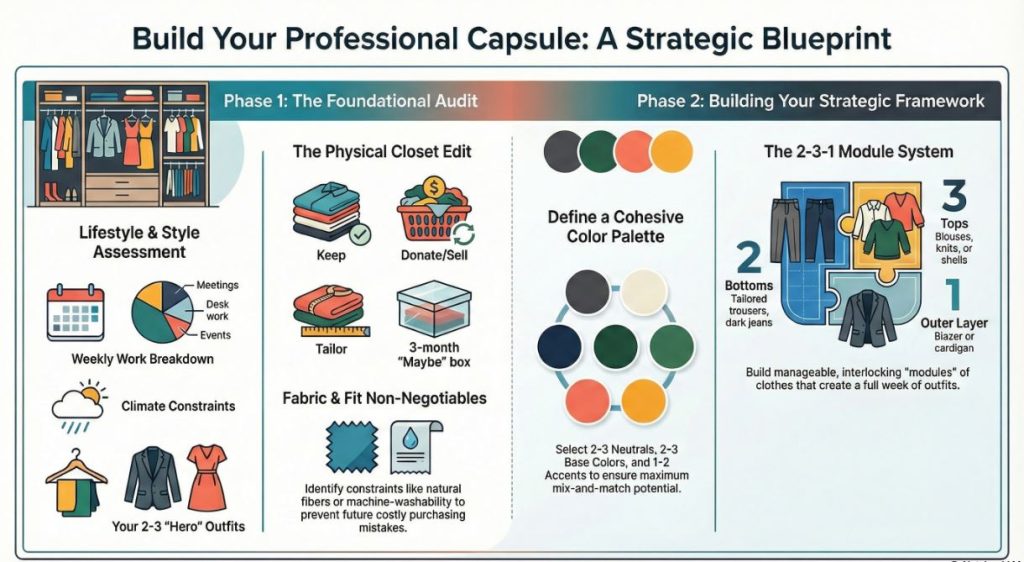
Before you buy a single thing, you must understand your starting point. This two-part audit is the most crucial step for building a budget and avoiding wasteful purchases.
Step 1: The Lifestyle & Style Assessment
Your clothes must serve your life, not an idealized version of it. Grab a notebook and answer these questions honestly:
- Work Breakdown: What percentage of your week is spent in “Business Professional,” “Business Casual,” and “Weekend Casual” attire? Be realistic.
- Climate & Commute: Do you deal with humid Southern summers, windy Midwest winters, or a temperate West Coast climate? Do you walk, drive, or take public transit? This dictates fabric choices and layering needs.
- Personal Uniform: Identify 2-3 outfits you wear repeatedly because you feel great in them. What do they have in common? (e.g., “fitted tops with wide-leg pants,” “midi dresses with blazers”). This is your style core.
- Fabric & Fit Non-Negotiables: Do you overheat in synthetic blends? Need natural fibers? Require machine-washable items? Acknowledging these constraints upfront is liberating and prevents costly mistakes.
Step 2: The Physical Closet Edit
Empty your closet. For each item, ask: 1) Does it fit me well right now? 2) Is it in good repair? 3) Have I worn it in the last year? 4) Does it align with my style assessment?
Create four piles: Keep, Donate/Sell, Tailor, and Maybe. The “Maybe” box goes out of sight for 3 months. If you don’t go looking for something in it, donate it. This process reveals your true wardrobe “heroes” and the gaps you need to fill.
Building Your Framework: Color Palette & Core Pieces
With your audit complete, you can build strategically.
1. Define a Cohesive Color Palette.
A unified palette ensures maximum mix-and-match potential. Start with:
- 2-3 Neutrals: These are your wardrobe workhorses (e.g., black, navy, charcoal, taupe, cream).
- 2-3 Base Colors: Slightly more color, but still versatile (e.g., olive green, burgundy, light blue).
- 1-2 Accent Colors: For personality and pops of color (e.g., rust, cobalt blue, soft pink).
Pull colors from your “Keep” pile and items you love wearing. This creates a palette that feels inherently “you.”
2. Select Your Core Pieces with the Module System.
Instead of a daunting master list, build your wardrobe in manageable, interlocking “modules.” One module is designed to create a week’s worth of outfits for a specific part of your life.
A basic module consists of:
- 2 Bottoms (e.g., tailored trousers, dark jeans)
- 3 Tops (e.g., a blouse, a knit, a shell)
- 1 Outer Layer (e.g., blazer, cardigan)
- 1 Pair of Shoes
- (Optional) 1 Dress
You might build a “Business Casual” module and a “Polished Weekend” module. The magic is that pieces from different modules can often interact, exponentially increasing your outfit combinations.
The Working Woman’s Essential Module: A Business Casual Blueprint
Here’s how to apply the module system for a core Business Casual wardrobe. Consider these categories, not a strict shopping list.
| Category | Item & Purpose | Key Considerations for U.S. Working Women |
|---|---|---|
| Bottoms (Choose 2-3) | Tailored Trousers: The ultimate polish. Look for a flattering, consistent fit. | Many contemporary U.S. brands offer reliable cuts in petite, regular, and tall sizing. Consider weight: wool blends for winter, linen or tropical wool for summer. |
| Dark Wash Denim: For casual Fridays and hybrid offices. A straight or slim leg looks most polished. | Prioritize comfort for all-day wear. Look for high-quality denim with a bit of stretch that retains its shape. | |
| Pencil or A-Line Skirt: A versatile alternative to pants. Hits at or just above the knee is most professional. | ||
| Tops (Choose 3-4) | Silk or Satin Blouse: Elevates any bottom instantly. A classic white or a color from your palette. | Look for machine-washable silk or high-quality polyester that resists wrinkling for easy care. |
| Fine-Gauge Knit Sweater: For warmth and polish. Turtlenecks, crewnecks, and V-necks are versatile. | Fabric is key. Merino wool is temperature-regulating and resists odors, ideal for long days and variable office AC. | |
| Simple Shell or Tank: For layering under blazers and cardigans. In a neutral color. | ||
| Crisp Button-Down: A timeless piece that can be worn tied, tucked, or open as a layer. | ||
| Outer Layer (Choose 1-2) | Structured Blazer: Instantly pulls an outfit together. Can be worn over dresses, tops, and knits. | Opt for a relaxed-fit “soft blazer” for a modern, comfortable feel versus a stiff suit jacket. |
| Knit Cardigan: A softer, cozy alternative to a blazer. A longer, duster style is very versatile. | Cashmere or cashmere-blend offers lightweight warmth and is more accessible than ever. | |
| Dresses (The Ultimate One-and-Done) | Sheath or Shirt Dress: In a solid color or subtle print. Can be worn alone or with layers. | Look for midi-length and sleeves (or plan to layer). Jersey knit or ponte are comfortable, travel-friendly fabrics. |
| Footwear (Choose 2) | Classic Loafers or Ballet Flats: Polished, comfortable, and walkable. | Invest in quality leather that will mold to your foot. Many brands offer wide-width options for a better fit. |
| Clean, Minimalist Sneakers: For commutes and increasingly accepted in casual offices. | Think leather or suede in white, black, or neutral tones. Avoid bulky, athletic styles for a professional context. | |
| The Workhorse Bag | Structured Tote or Satchel: Large enough for a laptop, wallet, and daily essentials. | Leather is durable. Consider organization—internal pockets save time. Focus on functional, timeless design over logos. |
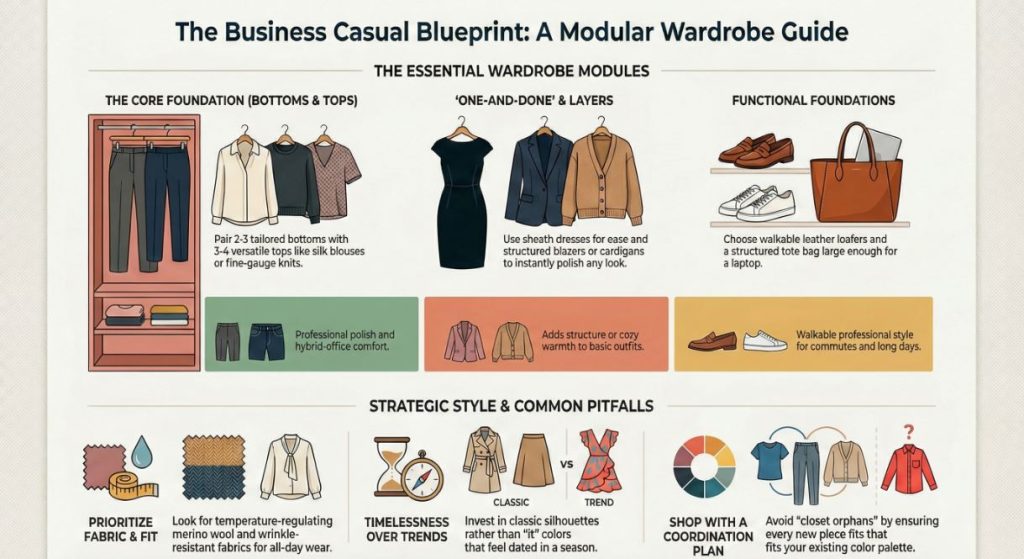
Common Capsule Wardrobe Mistakes to Avoid
- Neglecting Your Climate and Lifestyle: Buying a wool coat because it’s on a “must-have” list when you live in Florida is a waste. Always filter advice through your local weather and daily routine.
- Prioritizing Trends Over Timelessness: The goal is longevity. Avoid ultra-trendy cuts, logos, or “it” colors that will feel dated in a season. Invest in classic silhouettes and use accessories for trends.
- Sacrificing Comfort for Style: If you’re constantly adjusting an item or can’t sit comfortably in it, you won’t wear it. Comfort is a non-negotiable component of professional confidence.
- Shopping Without a Plan: Buying a single cute top with no coordinating bottoms leads to a closet full of orphans. Always shop with your color palette and existing pieces in mind.
The “When to Stop & When to Seek a Pro” Guide
When to Stop: If you feel stressed or overwhelmed, pause and take a break. A capsule is a marathon, not a sprint. Live with your current selections for a month. You’ll learn more from wearing them than from endless planning.
When to Hire a Pro: Consider hiring a personal stylist for a few hours if you’re experiencing a major lifestyle shift (e.g., returning to work post-partum, a big promotion) or feel utterly stuck. A good tailor is a non-negotiable pro for everyone. Spending $20-$40 to alter a $50 pair of pants so they fit perfectly is a smarter investment than buying a new $100 pair of pants.
U.S.-Specific Considerations & Regional Adjustments
- Fabric & Layering is Everything: For the Northeast/Midwest: Invest in a quality wool coat, merino wool layers, and silk long underwear for brutal winters. For the South/Southwest: Prioritize breathable natural fibers like linen, cotton, and lightweight wool. A trench coat is ideal for rainy seasons.
- Pricing Tiers: Build your capsule across tiers. Invest in “high-wear” items (shoes, bag, coat). Save on trendy accessories or basic tees. The U.S. has a robust resale market for acquiring investment pieces at a discount.
- Workplace Culture Varies: A Silicon Valley tech capsule (polished sneakers, high-end athleisure) will differ from a NYC finance capsule (suits, heels). Observe what senior women in your company wear.
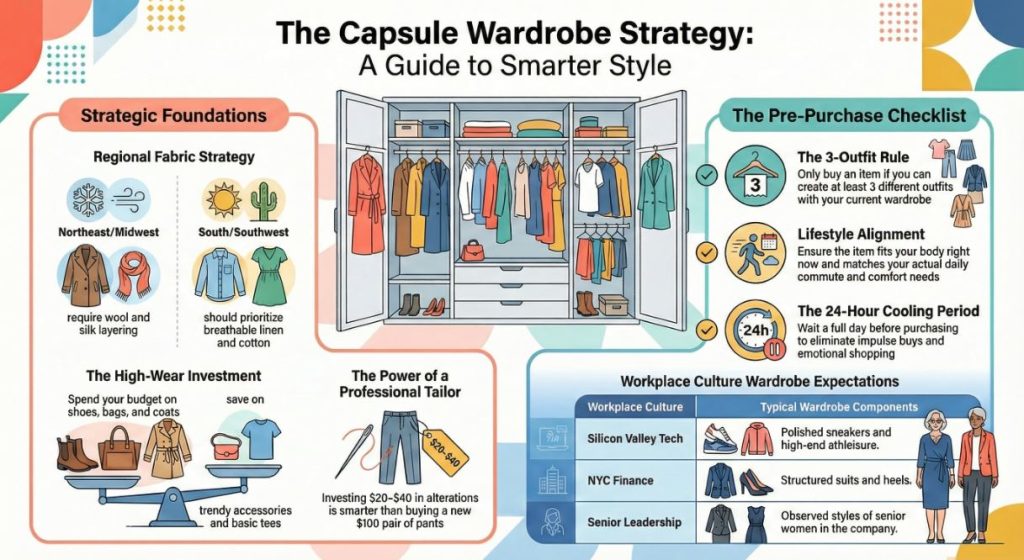
Decision Checklist: Before You Buy Any Item
Ask yourself these questions to ensure every purchase is a win:
- Does it fit my pre-defined color palette?
- Can I create at least 3 different outfits with it using my current wardrobe?
- Does it fit my body well right now, or will it need alterations?
- Is the fabric composition suitable for my climate and comfort needs?
- Does it align with my actual lifestyle (e.g., machine-washable, commute-friendly)?
- Have I waited 24 hours to avoid an impulse buy?
Frequently Asked Questions (FAQ)
There’s no magic number. It’s about functionality, not quantity. A complete wardrobe might include 25-40 pieces (including shoes and outerwear) that span all facets of your life. Focus on building your modules rather than hitting a specific count.
Absolutely. The module system works perfectly here. A suit is a powerful “outfit formula.” Build modules with 2 suit jackets, 2 matching trousers/skirts, and 5-7 interchangeable blouses and shells. You’ll have more than enough combinations for a month.
Adopt a “seasonal core” system. 70% of your wardrobe is a year-round core (e.g., trousers, blazers, silk tops). The remaining 30% are seasonal “swap” items (e.g., a heavy wool sweater and coat in winter, a linen dress and sandals in summer). Store off-season items to keep your closet manageable.
Start exclusively with your closet audit and the “Maybe” box exercise. You’ll likely rediscover great pieces. Then, implement a one-in, one-out rule and focus on filling only the most critical gap with a thrifted or budget-friendly item each season. Quality over quantity always wins.
Conclusion
Building a capsule wardrobe as a working woman is an act of strategic self-care. It’s not about deprivation, but about curation and liberation. By focusing on your personal lifestyle, embracing a flexible module system, and making deliberate choices about color, fabric, and fit, you create a wardrobe that works for you—not the other way around. The goal is to step into your closet and see only possibilities, not problems. Start with the audit, be patient with the process, and enjoy the newfound mental space and confidence that comes from getting dressed with intention.
Disclaimer: This article is for informational purposes only. Individual style, fit, and needs vary. All product mentions are based on general market research and are not sponsored endorsements.