
You know the refrain: that one dream of a perfect little black dress, that will leave you feeling confident and polished for years. But the truth is a fitting room of disappointment — pulls here, gaps there, a silhouette that feels totally off. Standard advice like “pear shape? Wear an A-line!” usually falls flat, though, because it overlooks fabric, proportion, and your personal style. The problem isn’t your body; the problem is a strategy that begins with the wrong particulars.
This guide goes beyond basic body type charts. We’ll offer up a tangible, step-by-step template that accounts for your particular shape, lifestyle, and the niggly little details — say, texture or construction — that transform a basic black dress into your secret weapon. Let’s find the one that not only fits, but feels as if it was made for you.
The Core Principle: Silhouette, Balance, and Fabric
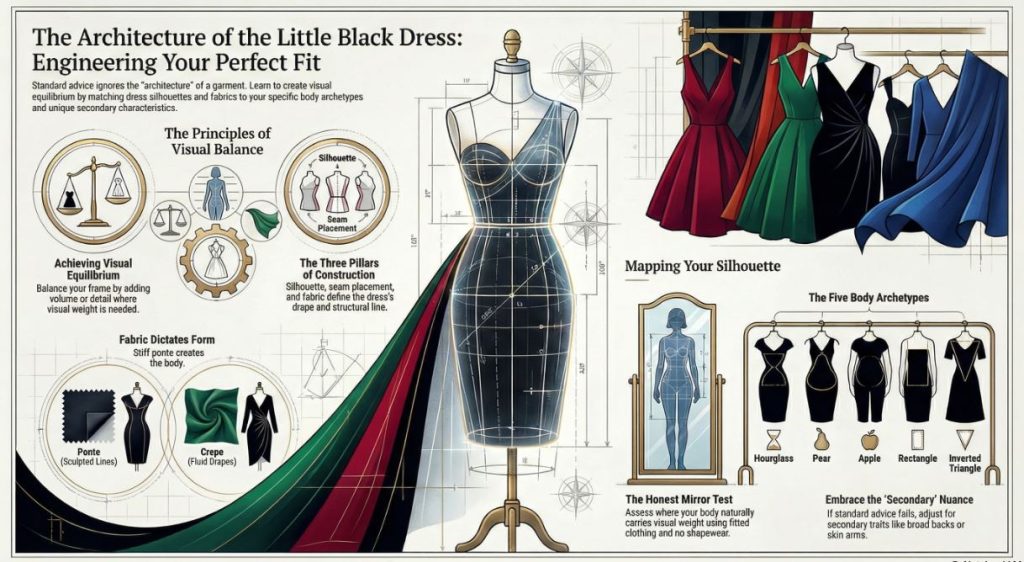
Conceive the perfect little black dress (LBD) as though it were a building: an architect’s play on order and proportion. Instead of downplaying shapes, celebrate them with visual balance. For example, if you have a wider upper body (more of a “V” shape), look for a dress that adds softness or detail to the lower half so you can create proportion.
The key to finding this equilibrium lies in what Ms. Mitchell called visual weight — silhouette (it’s overall shape), seam placement (what your eye follows), and fabric choice (how it shapes drape and structure). There’s the structured ponte knit , which creates a clean, architectural line and a flowing crepe that provides softness — both are classic black dresses, but each shapes different body types in its own way.
Your Step-by-Step Guide to the Perfect LBD
Follow this sequence to make your search targeted and successful.
Step 1: Identify Your Dominant Shape (The Honest Mirror Test)
Look for where your body naturally carries the most visual weight. Wear fitted, non-shapewear clothing for this. The five common archetypes are:
- Hourglass: Balanced bust and hips with a defined waist.
- Pear (Triangle): Hips wider than shoulders.
- Apple (Oval/Round): Weight carried centrally in the torso, with slimmer legs and arms.
- Rectangle (Straight): Bust, waist, and hips are fairly similar in width.
- Inverted Triangle: Shoulders or bust wider than hips.
Why This Often Fails: Most people are a blend. If the classic advice for your primary shape isn’t working, look to your secondary characteristic. Are you a “Pear with a broad back”? An “Apple with slim arms”? This nuance is key.
Step 2: Master the Flattery Formula for Your Shape
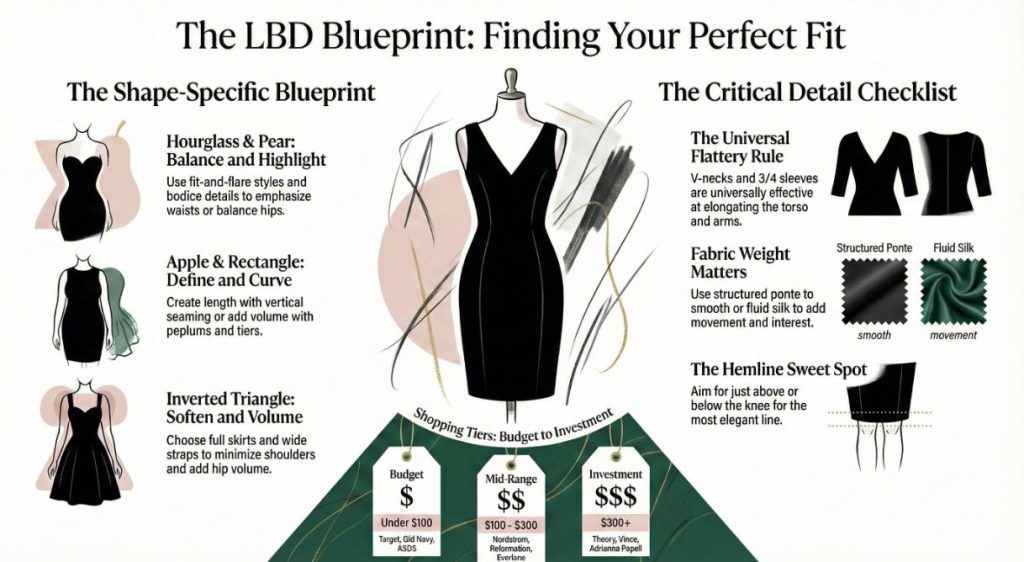
This is where we apply the balance principle. Use this chart as your starting point, not a rigid rule.
| Surplice necklines, wide straps (not thin), and avoid heavy shoulder detail. | Aim To… | Seek These Styles | Focus On These Details |
|---|---|---|---|
| Hourglass | Highlight your defined waist. | Sheath, fit-and-flare, wrap dresses. | Belts, tailored waist seams, V-necks. |
| Pear | Balance hips, highlight upper body. | A-line, empire waist, detailing on the bodice (lace, beading). | V-necks or scoop necks, flutter sleeves, structured shoulders. |
| Apple | Create definition, elongate the torso. | Empire waist, trapped shift, dresses with vertical seaming. | V-necks (deep or shallow), flowy fabrics that skim, 3/4 sleeves. |
| Rectangle | Create curves and definition. | Peplum, belted shirtdresses, dresses with ruffles or tiers. | Details that add volume to bust/hips, color blocking, textured fabrics. |
| Inverted Triangle | Soften shoulders, add volume to hips. | Wrap dresses, A-line or full skirts, details at the hem. | Surplice necklines, wide straps (not thin), avoid heavy shoulder detail. |
Step 3: The Critical Details Most Guides Miss
The right category is only 50% of the win. These details make the difference.
- Fabric is Everything: Heavy shapes (Pear, Apple) tend to shine in medium-weight fabrics that have some structure that smooths you out without sticking to you. Sleeker shapes (Rectangle) with fluid fabrics (charmeuse, crepe) that move. Texture (as in lace, jacquard) can also provide visual interest and camouflage.
- The Neckline Rule of Thumb: V-necks (even shallow ones) lengthen the neck and torso, flattering nearly every figure. It’s the thing about high necklines — they can be so lovely, but tend to look their best on people with longer necks or skinnier torsos.
- Sleeve & Strap Strategy: That short cap sleeve can divide the arm in an unattractive way. 3/4 sleeves are universally flattering. For a wide back, make sure that straps are placed closer to the neck (not on the edge of your shoulder), allowing for better support and a more seamless line.
- The Hemline Sweet Spot: For some, a flattering hemline is the point at which the leg becomes slimmest, usually just above or below the knee. Midi dresses are great for a long line of elegance.
Step 4: Apply the “Where & When” Filter (USA Context)
An LBD is a tool for your real life. Context matters.
- For a NYC Winter Cocktail Party: Opt for a long-sleeve sheath in a warm wool blend. Add tights and boots.
- For a Southern Outdoor Wedding: A knee-length fit-and-flare in breathable cotton sateen or linen-blend is ideal.
- For a West Coast Dinner: A sleeveless, minimalist shift in high-quality modal or silk works perfectly.
- US Shopping Tiers:
- Budget (<$100): Target, Old Navy, ASOS. Look for polyester blends with spandex for recovery.
- Mid-Range ($100-$300): Nordstrom’s in-house brands, Reformation, & Other Stories, Everlane. Better natural fabric blends and construction.
- Investment ($300+): Vince, Theory, Adrianna Papell. Expect luxury fabrics (silk, fine wool) and impeccable tailoring.
Common Little Black Dress Mistakes to Avoid
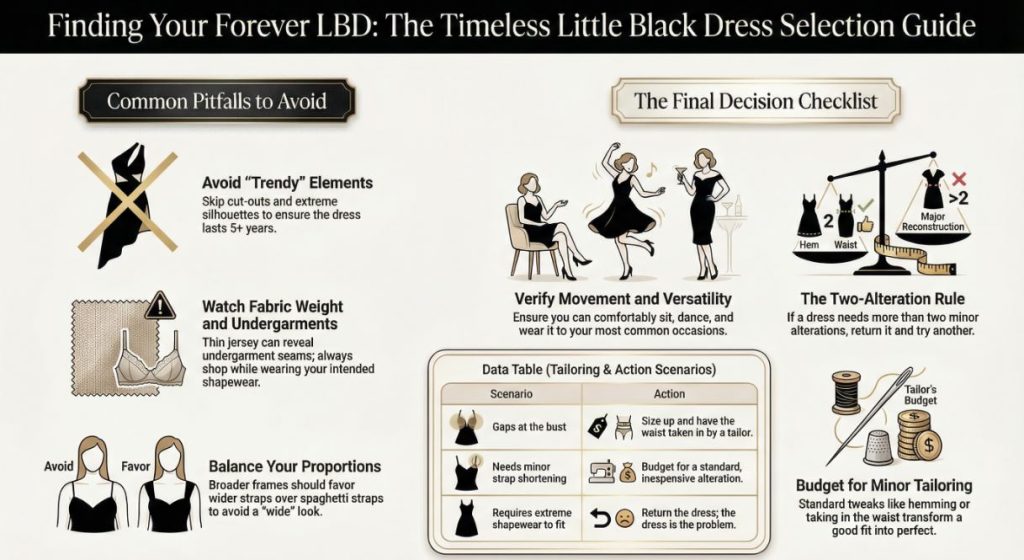
- Choosing the Wrong Fabric Weight: A thin, clingy jersey on a dress meant to skim will highlight every seam of the undergarments.
- Ignoring the “Brigitte Bardot” Effect: Strapless or spaghetti-strap dresses on broader frames can create a visually “wide” look. A wider strap or sleeve provides balance.
- Forgetting Undergarments: Your dress shopping trip must include the bra or shapewear you intend to wear with it. They are part of the garment’s foundation.
- Falling for a “Trendy” LBD: The goal is timeless. Avoid cut-outs, overly extreme silhouettes, or novelty fabrics (like crushed velvet for everyday) unless it’s a secondary, fun option.
Your LBD Decision Checklist
Before you buy, ask:
- Does it follow the flattery formula for my primary (and secondary) shape?
- Does the fabric drape or structure in a way that feels good and looks smooth?
- Do the neckline and sleeves/straps flatter my upper body?
- Is the hemline in a flattering spot for my height and leg shape?
- Can I move, sit, and dance in it comfortably?
- Does it fit my most common dress-up occasion (work events, dates, parties)?
- Is it timeless enough to last 5+ years in my wardrobe?
Nuance & Troubleshooting: The “Safety Valve” Advice
- “What if it gaps at the bust?” This is a sizing issue, not a you issue. Try a size up and have the waist taken in by a tailor—a common and inexpensive alteration.
- “When should I just get it tailored?” Always budget for minor alterations. Taking in the waist, shortening straps, or hemming are standard and transform a good fit into a perfect one.
- “When should I stop and try a new style?” If you need more than two minor alterations, or if you feel you must “fix” your body with extreme shapewear to fit the dress, the dress is the problem. Return it.
Frequently Asked Questions (FAQ)
Is the “little black dress” still a relevant concept?
Absolutely. Its relevance lies in its versatility as a blank canvas. The modern LBD is less about a single, rigid style and more about having a go-to, high-quality black dress that serves as a reliable foundation for your personal style.
How can I make a classic LBD feel current and not boring?
This is where accessories and styling do the work. A classic sheath can go from office to evening with statement jewelry, a bold shoe, or a leather jacket. The dress is the constant; your accessories are the variables.
Should I prioritize comfort or style?
This is a false dichotomy. With the right fit and fabric, you should have both. If a dress is pinching or you’re constantly adjusting it, it’s not the right dress, no matter how stylish it looks on the hanger.
How many LBDs should I own?
We recommend a practical capsule of two: 1) A day-to-night tailored option (like a sheath or shift) for work events and dinners, and 2) A more relaxed or occasion-specific style (a fit-and-flare for parties, a knit dress for travel).
Slip dress or sheath dress—which is more flattering?
It depends on the fabric and cut. A lined, slightly structured slip dress can be incredibly flattering by skimming curves. A sheath dress provides more inherent structure. The key is to avoid unlined, slippery satins that can cling unpredictably.
Can I wear a little black dress to a wedding?
In the US, it’s generally acceptable, especially for evening, formal, or “black tie optional” weddings. To ensure it’s festive, opt for luxe fabrics (silk, lace) and elegant accessories. Avoid anything too casual (like cotton jersey) and always check the couple’s dress code first.
Conclusion
The search for the little black dress is a thinking person’s exercise, not an excuse to panic and search for a magic bullet. You have to know your proportions and accept the impact of fabric and detail, and then bring it all into line with the life you actually live.
By looking past oversimplified body type advice and instead thinking about balance, structure and context, you give yourself the power to select something that offers confidence for years (not just a single night). The aim is not to find your best imitation of someone else, but to find the one that feels, deeply and without question, like you.
Disclaimer: This article is for educational and informational purposes only. It is not a replacement for professional advice or professional styling or tailoring advice. Note: All prices and products are based on Amazon US data, and are available in the US only and subject to change. We may receive a commission on purchases made from links.