
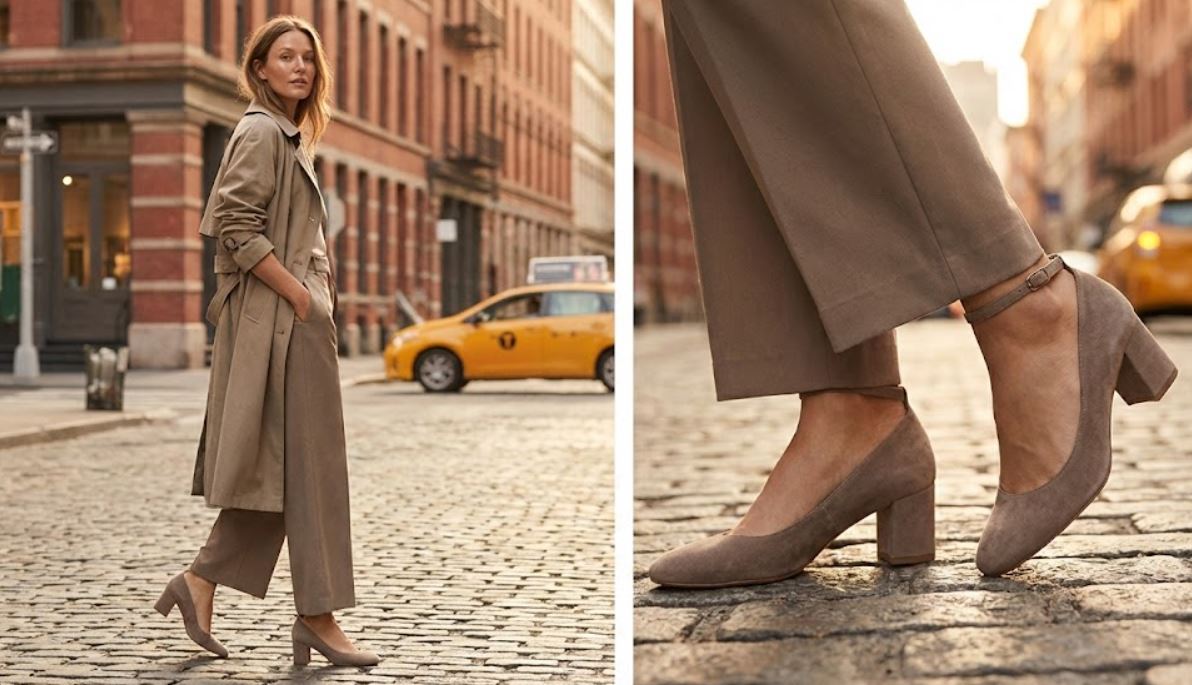
You want a unicorn: heels you can actually walk in that don’t compromise on style. You’ve suffered through the blisters, the aching feet, and the acute discomfort as you teeter to look polished. The advice you’re used to hearing — “just find a lower heel!” —feels like a compromise. It implies that you have a choice between style and comfort.
The problem isn’t your feet. It’s because most buying guides zero in on the heel and ignore the other five factors crucial to real, all-day wearability. There really is no such thing as having true comfort in stylish heels, it’s not a myth after all — it’s a science of fit, engineering and smart styling.
This guide cuts through the noise. This guide helps make sense of it all. We will take those principles and practical experience recommended by podiatrists and translate them into a clear, step-by-step framework. You’ll learn how to evaluate any heel—from a sleek pump to a wedding stiletto—for hidden comfort features, ensuring you walk confidently without wincing.
The Real Reason Most Heels Hurt (It’s Not Just Height)
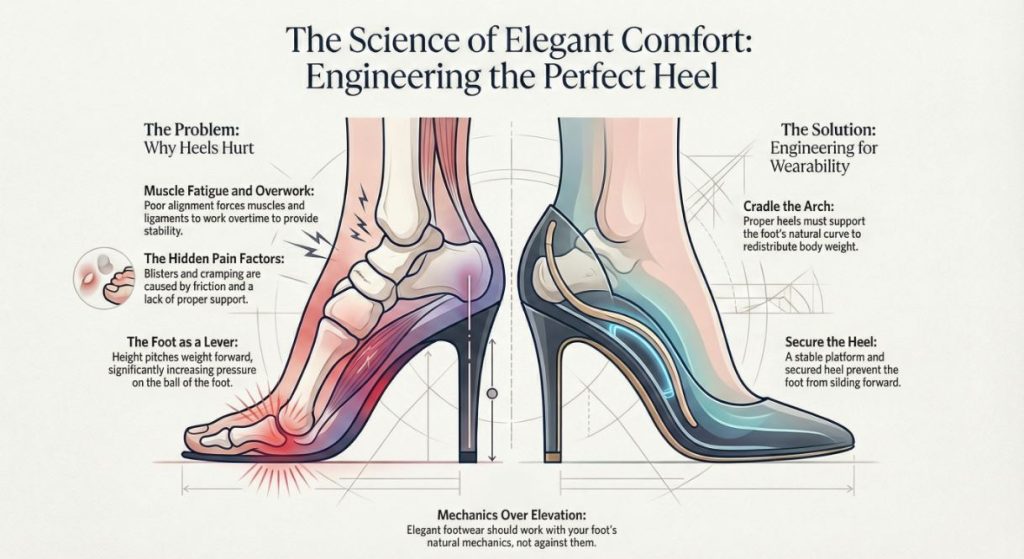
Think of your foot in a heel as a lever. The higher and more forward your weight is pitched, the greater the pressure on the ball of your foot. But height is only one lever. The others are a lack of support, poor alignment, and friction.
An elegant, comfortable heels counterintuitively supports more than it elevates. It should cradle your arch, secure your heel, and provide a stable platform. When these elements are missing, your muscles and ligaments work overtime to stabilise you, leading to rapid fatigue and pain. The goal is to find a shoe that works with your foot’s mechanics, not against them.
Your Step-by-Step Guide to the Perfect Fit
Forget guessing. Use this actionable checklist when shopping, online or in-store.
Step 1: Analyse the Sole & Platform
Look beyond the top of the shoe. The foundation is everything.
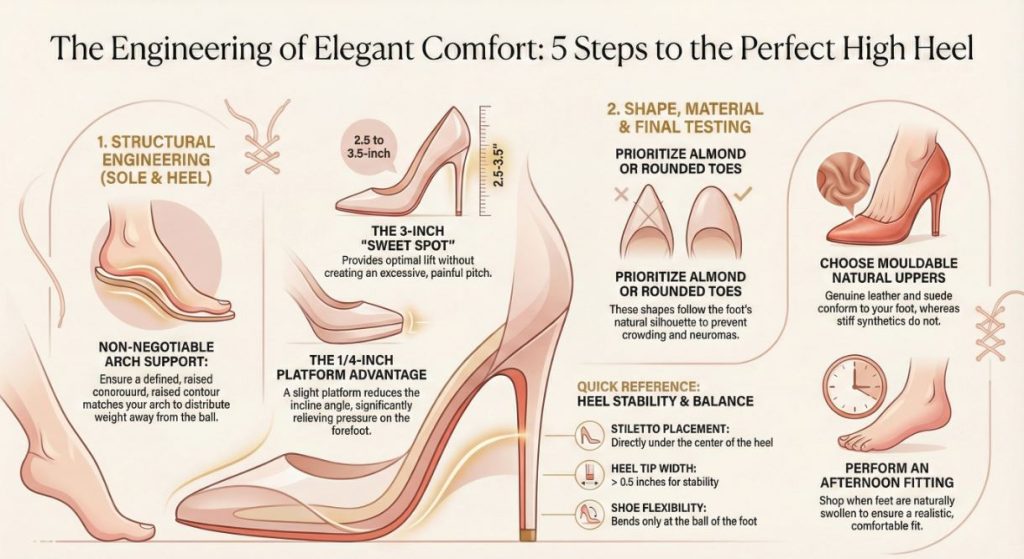
- Arch Support is Non-Negotiable: Run your hand along the inside of the shoe’s sole. It should have a defined, raised contour that matches the curve of your arch, not be flat. This distributes weight away from the ball of your foot.
- Seek a Strategic Platform: Even a slight ¼-inch platform under the forefoot drastically reduces the angle of incline, relieving pressure. For true all-day wear, a concealed ½-inch platform (often found in brands like Vionic or Naturalizer) can be a game-changer while maintaining a sleek silhouette.
- Check Flexibility & Cushioning: The shoe should bend only at the ball of your foot, where your foot naturally flexes. Press on the ball area; it should have some give or padded cushioning.
Step 2: Evaluate the Heel Design & Stability
This is where elegance and engineering meet.
- The Sweet Spot for Height: For sustained comfort, a 2.5 to 3.5-inch heel is often the most manageable. It provides lift without excessive pitch.
- Embrace the Block Heel (It Can Be Elegant): A blockier heel, wider on all sides, is by nature a steadier footing and easier for walking. And don’t count it out — a narrow, blocky heel in suede or satin can seem surprisingly polished.
- The Stiletto Compromise: If you want a stiletto, make sure it sits directly under the centre of your heel to give you balance. A little bit of a thicker tip (more than 0.5 inches) also helps from sinking into grass or grates.
Step 3: Prioritise the Toe Box & Shape
Cramped toes are a primary source of pain.
- Shape Matters More Than You Think: An almond or rounded toe is your best friend. It follows the natural silhouette of your foot’s toes without the extreme taper of a true pointed toe, which crowds the toes and can lead to neuromas.
- “Wide-Fit” is a Secret Weapon: If you feel any lateral pressure, immediately try the wide-fit version of the same style. A better-fitting wide-width looks infinitely more elegant than a standard-width shoe distorting over your foot.
Step 4: Assess Materials & Construction
Cheap materials don’t break in; they break down.
- Look for Soft, Mouldable Uppers: Genuine leather, suede, and some high-tech knitted fabrics will soften and conform to your foot’s unique shape. Patent leather and stiff synthetics rarely do.
- Examine the Lining: A fully lined shoe, especially with a soft leather or microfiber lining, reduces friction and blister risk significantly.
Step 5: The Final Fitting Test
Never buy heels in the morning. Your feet swell throughout the day.
- Stand on an Incline: Ask for a slanted surface in the store or mimic one. Your toes should not jam into the front. There should be about a thumbnail’s width of space at the end.
- Walk on Hard Floor: Listen for a firm “clack,” not a loose “slap.” A secure, snug fit at the heel counter (the back of the shoe) with minimal slippage is critical. Your foot should not slide forward with each step.
Common Mistakes That Derail Comfort
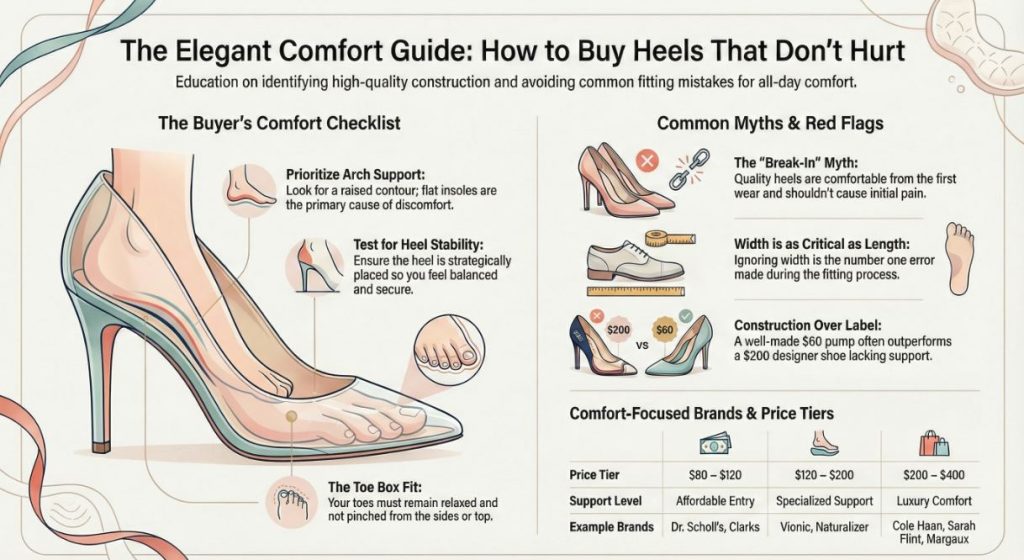
- Buying “To Break In Later”: Comfortable heels are comfortable from the first wear. They may soften, but they shouldn’t cause pain initially.
- Ignoring the Width: This is the #1 fitting error. Size is length AND width.
- Choosing a Completely Flat Insole: As mentioned, arch support is the cornerstone of comfort.
- Prioritising Price Over Construction: A $60 well-made pump with proper support will be more comfortable than a $200 designer shoe with a flat, hard bed.
Your Elegant & Comfortable Heels Buyer’s Checklist
Use this when making your final decision:
- Arch Support: Can I feel a raised contour supporting my arch?
- Toe Box: Are my toes relaxed and not pinched side-to-side or top-down?
- Heel Stability: Is the heel wide enough (or strategically placed) for me to feel balanced?
- Material Quality: Are the uppers soft and likely to mould to my foot?
- Secure Fit: Does my heel stay in place with minimal slip when I walk?
- Walk Test: Can I walk naturally without pain or excessive pressure on the ball of my foot?
Nuances for the US Shopper
- Sizing is Inconsistent: A US 8 in a European-branded shoe (say, Sam Edelman) might not fit the same as a US 8 in a traditional American brand (like Cole Haan). Always make sure to check the brand’s sizing guide and read reviews about fit.
- Climate Considerations: In humid Southern states, search for something breathable (leather, mesh) to ensure that sweat and slippage won’t be a problem. In rainy Pacific Northwest or snowy Northeastern cities, a sleek bootie with a low block heel is both a more practical and elegant option than the standard pump.
- Pricing Tiers: Comfort-focused brands exist at every level. Consider Dr. Scholl’s or Clarks for affordable entry points ($80-$120), Vionic or Naturalizer for specialised support ($120-$200), and Cole Haan, Sarah Flint, or Margaux for investment-level blends of luxury and comfort ($200-$400).
When to Stop: If you experience persistent, sharp pain (not just fatigue) in a specific spot like the ball of your foot, the joint of your big toe, or your arch, the shoe’s geometry is wrong for you. No amount of breaking in will fix a fundamental mechanical mismatch.
Frequently Asked Questions (FAQ)
A: It depends on the “day.” As for an 8-hour workday with a desk or walking (mostly short) as you go on walks outside, yes—if the principles above are followed. For 8 hours of solid standing and walking on hard flooring (a wedding, a trade show), it’s way harder. In such situations, opt for a 3-inch or lower platform heel providing sufficient arch support, and always have a pair of backup flats on hand.
A: While most recommendations are garnered from extensive reviews and consumer testimony, common bridesmaid and bride-approved brands include Margaux (which does invisible comfort with customizable wedding heels), Sarah Flint (covers padded soles you won’t get to see — but will appreciate) and even Betsey Johnson (who knew it was great with platforms and straps). The smartest, chic option is often a low-block heel or wedged sandal.
A: Yes, to a degree. High-quality gel cushions (like from Dr. Scholl’s) placed precisely under the ball of the foot can help. Anti-slip heel pads or full-shoe moleskin liners can reduce friction. For straps that cut in, a strap cushion is essential. However, these are fixes, not solutions—they cannot add missing arch support.
A: More important than many realise. A heavier shoe, often due to a thick sole or heavy platform, can cause leg fatigue faster. Look for shoes that use lightweight materials (like EVA foam in midsoles) without feeling flimsy.
A: A secure heel. If your heel slips out repeatedly, you will unconsciously claw your toes to keep the shoe on, guaranteeing cramps and pain. A snug heel counter is the foundation of stable, comfortable walking.
Conclusion
Getting pretty, comfortable shoes is no accident. It’s about changing the way that you look at – and think about - shoes: Moving from how the shoe looks on a shelf to how it’s engineered to support your foot. When you can consider the arch and platform along with the toe box and fit systematically, you take back control to make informed decisions.
The most elegant shoe in the world is always finally the one that you can walk in with confidence and grace, from first step to last. Stop compromising. Use this framework to find heels that finally deliver on both style and substance.
Disclaimer: This post serves to be informative only, and is based off industry knowledge, product reviews, published news articles, and multiple user submitted experiences. It is not a professional podiatric advice. If foot pain is chronic or you have specific medical conditions, please consult a licensed healthcare professional (such as a pedorthist, orthotist etc.)