
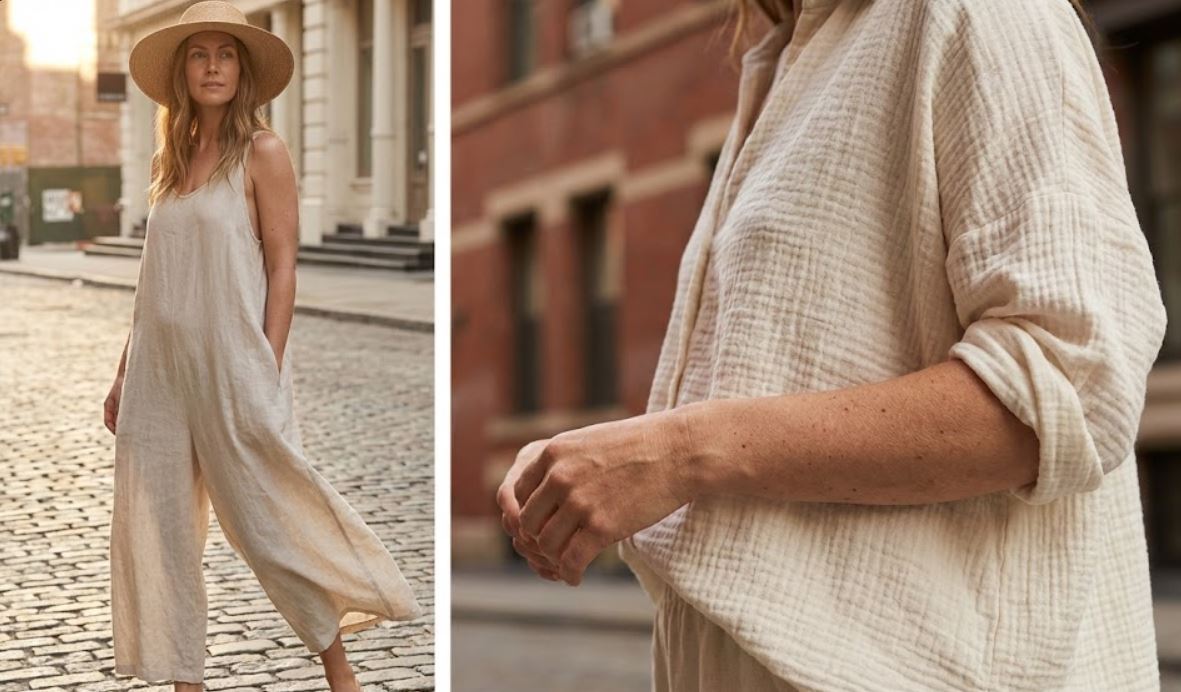
You bought a shirt labeled “linen” or “viscose,” expecting it to float away from your body. Instead, it wrapped around your torso like plastic wrap the moment you stepped outside.
Standard advice tells you to look for “breathable” fabrics. But breathability prevents sweat, not cling. In practice, a garment can be perfectly ventilated and still ride up, stick to your thighs, or generate static that outlines every curve.
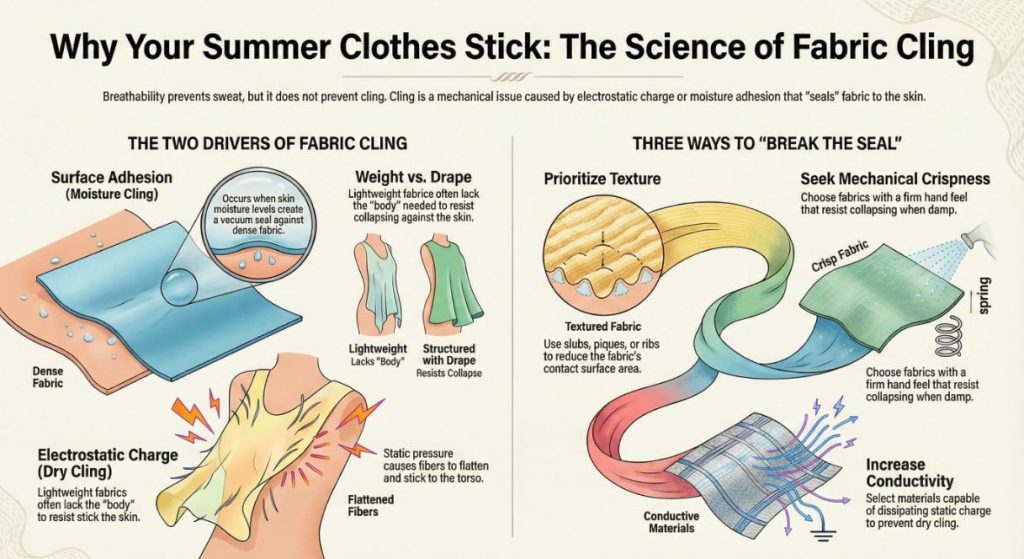
Cling is caused by two distinct mechanisms: electrostatic charge (dry cling) and surface adhesion (moisture cling). Choosing the right fabric requires a strategy for both.
Here is the exact framework we use to select non-cling summer fabrics, validated by textile manufacturers and fit specialists working in US climates ranging from dry desert heat to Gulf Coast humidity.
Why Your “Breathable” Linen Shirt Is Still Clinging
Most shoppers confuse weight with drape. They assume a lightweight fabric automatically equals a non-cling fabric. This is incorrect.
Cling occurs when the fabric’s surface energy is higher than the skin’s moisture level, or when the weave is too dense to allow air to break the vacuum seal between yarn and skin.
The Analogy: Think of two wet sheets of paper. If you place them together, they stick. Fabric does the same thing when it lacks “body” or when the fibers flatten against the skin due to static pressure.
To break the seal, you need one of three mechanical properties:
- Crispness: A firm hand feel that resists collapse.
- Texture: Slubs, piques, or ribs that reduce contact surface area.
- Conductivity: The ability to dissipate static charge.
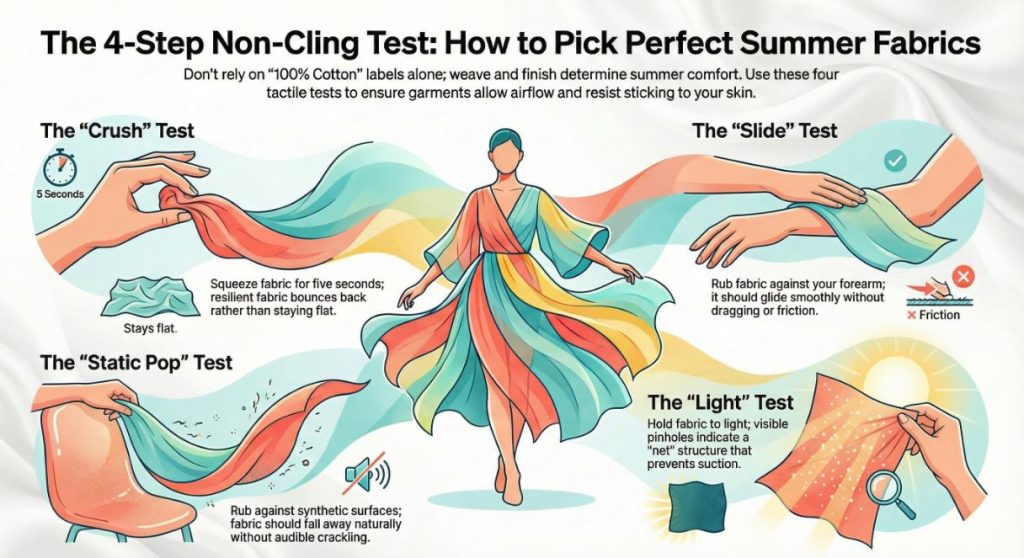
The 4-Step Test for Non-Cling Summer Fabrics
Do not rely on fiber content labels alone. Two garments, both labeled “100% Cotto,n” can perform oppositely. You must evaluate the construction and finish.
Step 1: The “Crush” Test (Assess Resilience)
Pick up a handful of the fabric and squeeze tightly for five seconds. Release.
- Pass: The fabric bounces back with minimal creasing or remains slightly lofty.
- Fail: The fabric stays flat and compressed in your hand.
- Why it matters: Fabrics that stay compressed are limp. Limp fabrics adhere to skin contours. Crisp fabrics tent over the skin, allowing airflow to break the suction.
Step 2: The Slide Test (Assess Surface Friction)
Rub the fabric against the inside of your forearm using moderate pressure.
- Pass: The fabric glides smoothly without dragging your skin.
- Fail: The fabric grabs, tugs, or generates heat through friction.
- Why it matters: High-friction fabrics grab moisture and static. Smooth, tightly twisted filaments (like high-twist cottons or dry-touch polyesters) slide rather than stick.
Step 3: The Light Test (Assess Porosity)
Hold the fabric up to direct sunlight or a bright phone flashlight.
- Pass: You see distinct pinholes of light between the yarns, or the weave has a visible open structure.
- Fail: Light diffuses softly with no distinct holes; the fabric acts as a semi-solid sheet.
- Why it matters: A “sheet” creates suction. A “net” allows air to equalize pressure between the fabric and your skin.
Step 4: The Static Pop Test (Assess Build-Up)
Rub the fabric vigorously against a synthetic office chair or a polyester jacket for 10 seconds. Quickly separate it from the surface.
- Pass: Little to no crackling sound; the fabric falls away naturally.
- Fail: Audible static crackle; the fabric clings to your hand or the chair.
- Why it matters: Static causes fabric to “seek” your skin. Look for natural fibers that have not been stripped of their pectin/wax (e.g., unfinished cotton) or synthetics treated with permanent anti-static finishes.
Specific Fabrics That Pass the Test (And Why Some Fail)
✅ Winners: Low-Cling Construction
High-Twist Cottons (Voile, Seersucker, Organdy)
Unlike standard cotton broadcloth, high-twist yarns are wound tighter. This makes the thread springy. In the crush test, it bounces back. Seersucker’s puckered texture inherently reduces skin contact by 30-40%.
Tencel (Lyocell) with a “Dry Hand” Finish
Standard Tencel is buttery soft, which is a risk factor for cling. However, Tencel processed with a dry-touch or peach-skin finish has a matte, slightly crisp surface. It passes the slide test because it wicks moisture instantly, preventing the sweat-to-fabric glue effect.
Linen (High GSM, Mid-Weight)
Paradoxically, very lightweight linen (under 4 oz) often clings more than mid-weight linen (5-6 oz). Heavy linen has enough stiffness to stand away from the body. Look for linen described as “structured” or “crisp.”
Silk (But Only Specific Weaves)
Reddit sewing communities frequently note that silk fails in heat. They are correct—charmeuse (slippery, shiny) clings to damp skin. Silk shantung, raw silk, or dupioni has irregular slubs. These imperfections reduce the contact area and trap micro-pockets of air.
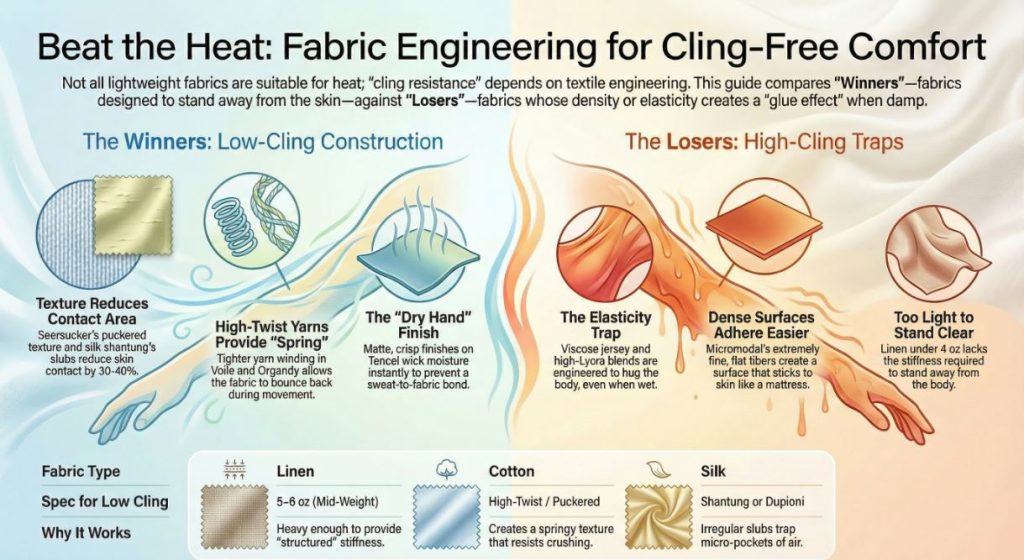
❌ Losers: High-Cling Traps
Viscose/Rayon Jersey
This is the highest-risk category for fabrics in the US summer. While it is cool, it is heavy and elastic. It almost always fails the crush test and will cling to the small of the back and thighs within minutes.
Micromodal
Modal is luxurious, but micro modal uses extremely fine fibers. These create a dense, flat surface that adheres to skin similarly to microfiber sheets clinging to a mattress.
Cotton/Lycra Jersey with High Stretch Recovery
If a fabric snaps back aggressively (high Lycra content), it is engineered to hug. It will continue to hug even when wet.
Common Mistakes (That Cost You Money)
Mistake 1: Buying “Linen Blends” Blindly
Not all linen blends are equal. A linen-cotton blend is usually stable. A linen-viscose blend, however, combines linen’s texture with viscose’s heavy drape. You get the wrinkles of linen with the cling of viscose. Check the tag: if viscose percentage is higher than linen, it will likely cling.
Mistake 2: Assuming “Loose Fit” Fixes Cling
A loose fit helps, but only if the fabric has body. A loose-fitting rayon dress still collapses onto your legs. You need both a relaxed cut and a resilient fabric.
Mistake 3: Over-washing “Crisp” Finishes
Some non-cling performance comes from temporary textile finishes (starch or resin treatments). In humid US regions like the Southeast, these finishes degrade faster. If a shirt passed the test in the store but clings after three washes, it was relying on a temporary topical treatment. Look for fabrics that advertise built-in structure.
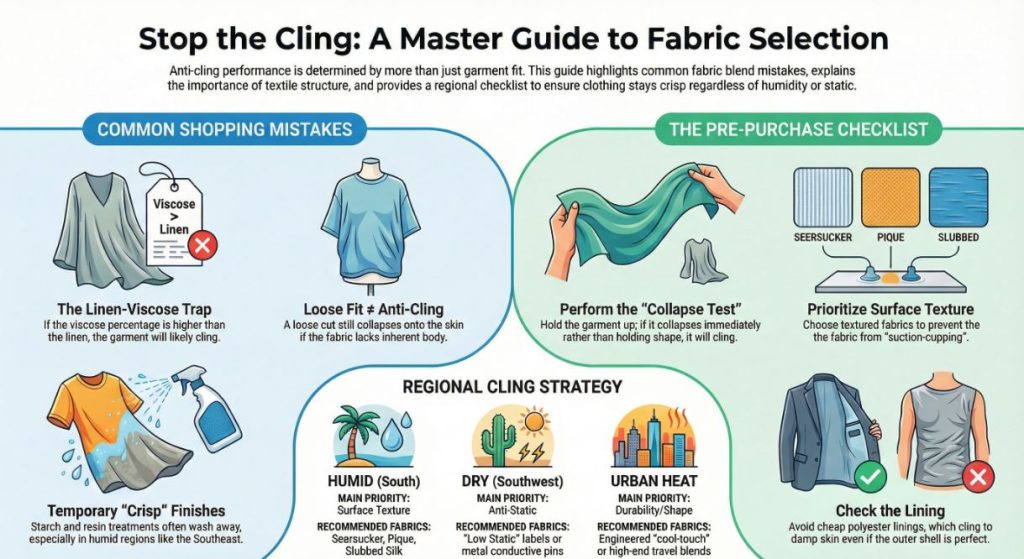
Decision Checklist: What to Check Before You Buy
Use this checklist physically in-store or when a package arrives at your home.
- [ ] Fiber Composition: Is the primary fiber naturally crisp? (Linen, high-twist cotton, Tencel? Or heavy/elastic? Viscose, Modal, Spandex-heavy?)
- [ ] Surface Texture: Is the surface smooth and flat (risky) or textured/piqued (safe)?
- [ ] Weight: Is it too flimsy? Hold it up. Does it hold its own shape or collapse immediately?
- [ ] Color/Dye: Dark, reactive-dyed fabrics often have more chemical residue initially. A quick cold-water wash with white vinegar often removes residual finishing chemicals that contribute to cling.
- [ ] Lining: Is the garment lined in polyester? The shell might be perfect, but a cheap polyester lining will cling to a damp back.
USA Context: Regional Adjustments
The South (Humid): Prioritize surface texture (Seersucker, Pique, Slubbed Silk). Humidity kills crispness. Textured surfaces ensure you aren’t suction-cupping even when the fabric softens at 3:00 PM.
The Southwest (Dry): Prioritize anti-static. Dry heat generates extreme static cling. Look for fabrics labeled “low static” or consider using a safety pin on an inside seam (metal conducts static away) or carrying a dryer sheet to dab.
Urban Heat Islands (NYC/Chicago): Commuters need durability. Lightweight linens crush and lose shape in backpacks. Consider polyester blends only if they are specifically engineered as “cool-touch” or “anti-static.” Standard budget polyester will cling and smell. Higher-end travel brands (Bluffworks, Ministry of Supply) use hydrophilic finishes that mimic cotton’s static profile.
FAQ: Non-Cling Summer Fabrics
A: No. Fabric softener coats fibers with a waxy film. While this reduces static temporarily, it also clogs the spaces between yarns, reducing breathability and increasing sweat adhesion. Use white vinegar in the rinse cycle instead.
A: Usually, yes. “Bamboo” is a marketing term for the source plant, but the processing is almost always viscose or lyocell. Unless it is specifically labeled Bamboo Lyocell (Tencel), it will behave like standard viscose: drapey and prone to sticking.
A: You likely have habotai or charmeuse. These are “dressy” silks intended for evening, not blistering heat. For summer, you need silk with a matte, uneven texture (dupioni, shantung, or raw silk noil).
A: Yes, but they are temporary. Static Guard sprays work for dry cling, but do not fix sweat-cling. For sweat adhesion, a light spritz of unscented hairspray on the inside of the hem (not directly on skin) can add temporary grip resistance, but test on an inconspicuous area first.
A: Wovens are generally safer for non-cling. Knits, by definition, stretch. Once a knit fabric exceeds 15-20% stretch, it is engineered to conform. Look for stable knits (ponte, scuba, or interlock) rather than slinky jersey.
A: Sometimes. Adding a lining in a non-static fabric (cupro or Bemberg) can create a barrier between the outer fabric and your skin. However, if the shell fabric itself is heavy and limp, tailoring cannot change its fundamental weight.
The Conclusion
Do not shop for summer fabrics based on fiber names alone. Shop based on hand feel and resilience.
If a fabric collapses in your hand, it will collapse on your body. If it springs back, it will maintain a respectful distance from your skin. For US summers, prioritize texture, twist, and porosity over generic “natural fiber” labels. Your goal is not just to be cool—it is to be free from the constant adjustment of fabric that refuses to let go.
Disclaimer: For informational purposes only. Individual results may vary based on body chemistry, local humidity, and garment construction.