

You are early, you meet deadlines, and your work product is good or better. But when promotion time rolls around, they break the news that you’ll be passed over in favor of someone else who just happens to look the part a smidge more sharply. It’s an experience that feels humiliating, not to mention time-consuming and pointless — a game of appearances rather than merit.
The conventional saying that you should “dress for the job you want, not the job you have,” is bandied about so much as to be all but meaningless. It’s ambiguous, not useful — and, frankly, at times it can actually be misleading. You coming in, an intern, dressing like the CEO isn’t a sign of ambition; it’s a sign you have poor situational awareness.
This guide goes beyond the clichés. We shall examine the peculiar non-verbal communication of clothing in the American workplace. You’ll get a systematic approach to evaluate your own particular office culture, measure the gap between “here” and “there,” and execute a wardrobe strategy that signals readiness for promotion — without going broke or looking out of place.
The Psychology of the Promotion: Why Your Clothes Matter
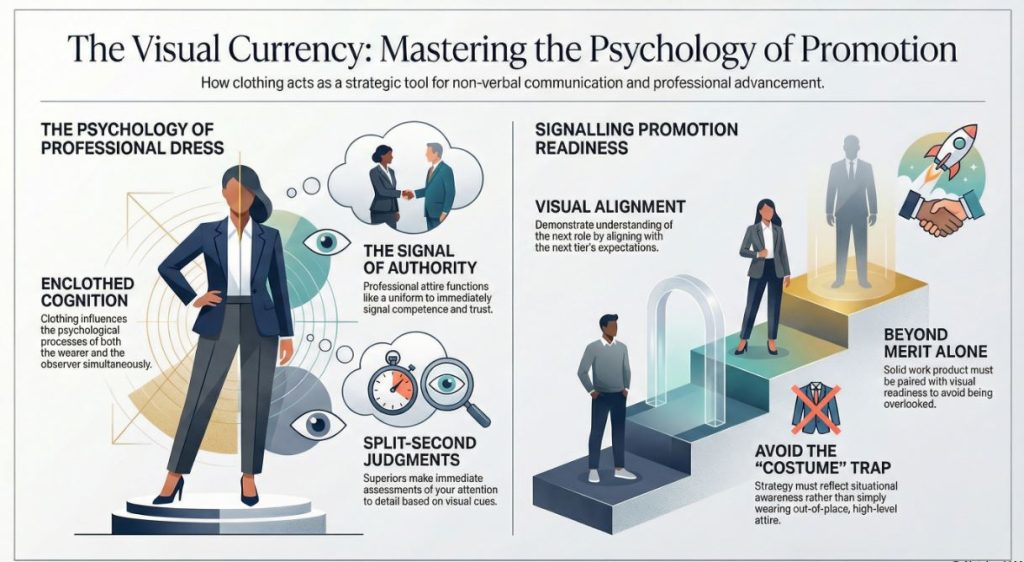
There’s something, after all, called “enclothed cognition” that clothing operates on. This is the notion that what we wear affects the mental operation of both wearer and observer. When you are dressed a certain way, you are more confident and demonstrative. At the same time, your colleagues and superiors look at what you’re wearing and make snap judgments about your competency, authority, and attention to detail.
Consider your outfit like a uniform for the role at hand. A judge wears a robe, a surgeon wears scrubs, and a pilot wears epaulets. These uniforms are not simply for making a visual impression; they communicate authority and trust right away. In the corporate world, there’s less codification about what to wear, but the message is equally powerful.
The goal isn’t to wear a costume. The idea is to make yourself look like you belong in the next level, so they can see that you get what’s expected of that role.
Step 1: Decode Your Company’s Visual Language (The “Recon” Phase)
Before you buy a single item, you must analyze your specific environment. Dressing for a promotion at a tech startup in Austin looks completely different than doing so at a law firm in Boston or a bank in Charlotte.
How to conduct your research:
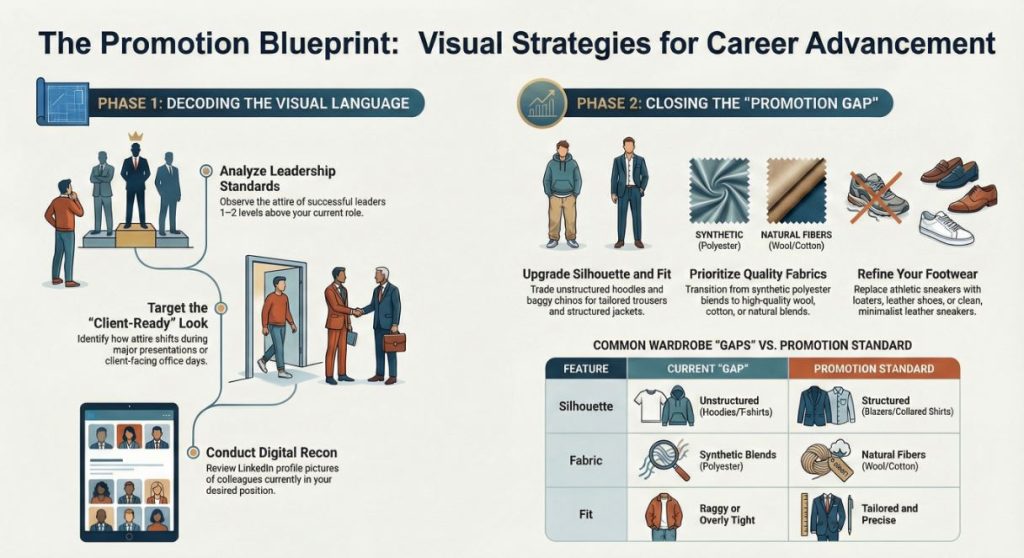
- Look at the Leaders: Who is one or two levels above you? Don’t look at the outliers (the flashy dresser or the notoriously sloppy one). Look at the standard. What are the successful people wearing? Is it pressed chinos and button-downs, or full suits?
- Observe Client-Facing Days: Is there a shift in attire when clients are in the office or on days when big presentations happen? That “client-ready” look is your target.
- Check LinkedIn Photos: Scroll through the company page and look at the profile pictures of people in your desired role. This gives you a curated, professional snapshot of the expected standard.
- Address the Reddit Confusion: It’s a seemingly insurmountable task that can be traced back to the ill-defined phrase “corporate business attire,” as found in endless Reddit threads (just head on over to r/careeradvice). When in doubt, ask a mentor or trusted colleague in the department you hope to join. “Hey, I’m meeting with the leadership team next week – is this more of a blazer-and-slacks room, or are button-downs cool?” is acceptable.
Step 2: Identify the “Promotion Gap”
Once you understand the visual language of the level above you, compare it to your current wardrobe. You aren’t looking for a complete overhaul; you are looking for the delta—the gap between where you are and where you want to be.
Typical gaps might include:
- Fit Issues: Your current clothes are baggy or too tight.
- Fabric Quality: You are wearing a ton of poly/nylon, etc. How cheap does it look? How poorly will it wear? Next-level wears cotton, wool, or high-quality blends.
- Silhouette: You wear relaxed items (t-shirts, hoodies, soft chinos), Brewster says, and the next level upwear structured items (jackets, collared shirts, tailored trousers).
- Footwear: You’re in athletic sneakers; they’re in leather shoes, loafers, or clean, simple leather kicks.
Step 3: The Strategic Upgrade Plan (The “How-To”)
This is where theory becomes action. You are building a capsule wardrobe designed for promotion. The key is to invest in foundational pieces that project maturity and attention to detail.
1. Master the Fit Above All Else
You can spend $50 or $500 on a shirt, but if it doesn’t fit, it will look cheap.
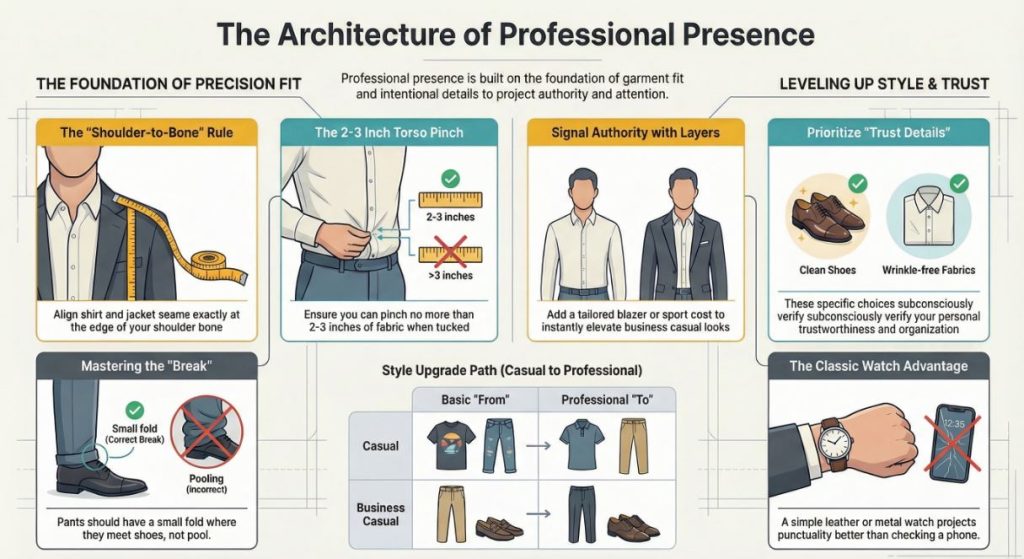
- Shoulders: The seam of the shirt or jacket should sit exactly at the edge of your shoulder bone.
- Torso: Shirts should not billow. You should be able to pinch no more than 2-3 inches of fabric on each side when tucked in.
- Sleeves & Pants: Shirt cuffs should reach your wrist bone. Pants should break (have a slight fold) where they meet your shoe, so that they don’t pool on the floor.
- The Tailor is Your Friend: Off-the-rack clothing is cut for our mannequin. You can get a shirt taken in or pants hemmed at a local tailor for $10–$20 — and that alone will make you look more polished than 90% of your colleagues.
2. Level Up Your Core Uniform
Based on your office environment, upgrade one piece at a time.
- If your office is Casual:
- From: A faded graphic t-shirt and worn-out jeans.
- To: A well-fitted polo shirt (pique cotton) or an Oxford cloth button-down (OCBD) with dark, non-distressed jeans or clean chinos.
- Footwear: Swap athletic sneakers for clean, minimalist leather sneakers (like Common Projects or a more affordable equivalent) or suede chukka boots.
- If your office is Business Casual:
- From: A basic button-down shirt and standard khakis.
- To: Add a tailored sport coat or blazer. Even if you take it off at your desk, wearing it into a meeting signals authority. Upgrade your shirt to one with a better collar roll or a higher-quality fabric. Switch chinos to wool or wool-blend trousers.
- Footwear: Move from loafers to a cap-toe oxford or a refined derby shoe.
3. The “Trust” Details: Grooming and Accessories
Your clothes set the stage, but the details are where people subconsciously verify your trustworthiness. This is a major component of E-E-A-T on a personal level.
- Shoes: Are they clean and polished? Scuffed shoes are the quickest way to undermine an expensive outfit.
- Ironing/Wrinkle-Free: Wrinkles signal disorganization. If you can’t iron, invest in a handheld steamer ($20-30) or use the wrinkle-release setting on your dryer. Send items to the dry cleaner as needed.
- Grooming: Hair should be neat, nails clean and trimmed, and facial hair tidy. This isn’t about conformity; it’s about signaling that you pay attention to the details.
- Watch: A simple, classic watch (leather or metal band) projects punctuality and responsibility far better than checking your phone.
Common Mistakes to Avoid
Even with good intentions, it’s easy to make a misstep. Here’s what to steer clear of:
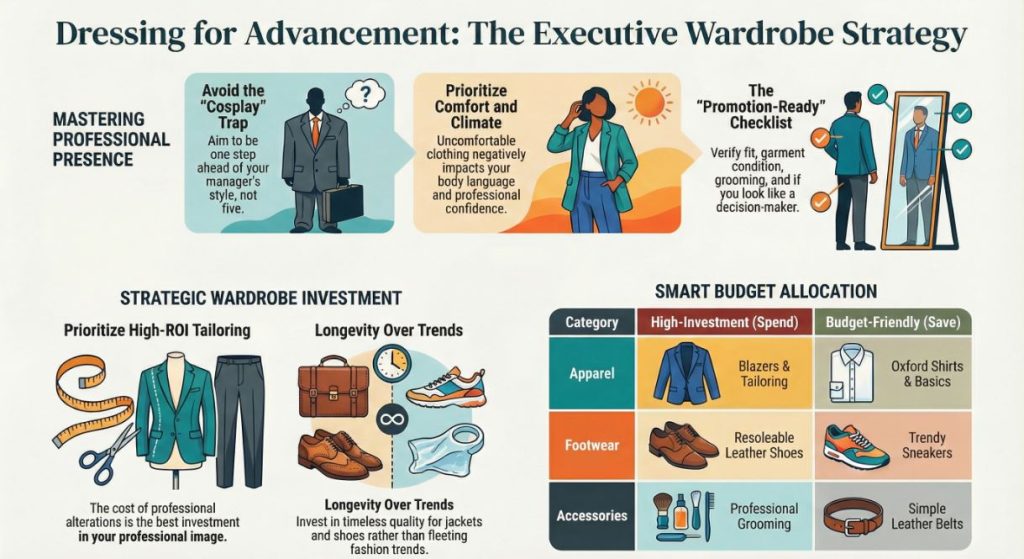
- The “Cosplay” Trap: Don’t show up in a full three-piece suit if your boss wears a sweater and chinos. You will look like you’re going to a job interview elsewhere, not like you’re ready for a promotion. The goal is to be one step ahead, not five.
- Neglecting Comfort: If you buy something that doesn’t fit or isn’t comfortable, you will never wear it. An uncomfortable outfit shows in your body language. Find brands and fabrics that fit your frame and allow you to move.
- Ignoring the Climate: If you work in a humid Southern state (like Texas or Florida), heavy wools and layered suits are impractical. Focus on breathable fabrics like cotton, linen, and lightweight merino wool. In the Northeast, you have more leeway with layering for the cold.
- Thinking it’s a One-Time Fix: Your style should evolve with your career. Re-assess every 12-18 months or after a significant role change.
The Promotion-Ready Checklist
Before a big meeting or a review, run through this checklist:
- Fit Check: Are the shoulders right? Is the shirt not pulling at the buttons?
- Condition: Are there any stains, loose threads, or missing buttons?
- Shoes: Are they clean and appropriate for the setting?
- Grooming: Is everything tidy and intentional?
- The “So What?” Test: Does my outfit look like I belong in the room where decisions are being made?
When to Invest vs. When to Save
- Invest In:
- Shoes: Good leather shoes can be resoled and last for decades.
- Jackets/Blazers: A well-made jacket will hold its shape and look better over time.
- Tailoring: The cost of alterations is the best ROI in fashion.
- Save On:
- Trendy Items: Don’t buy the neon sneakers or the overly distressed jeans for workwear.
- Shirts: You can find excellent quality Oxford cloth button-downs at stores like Uniqlo, J.Crew, or Banana Republic, especially on sale.
- Belt: A simple, quality leather belt doesn’t need to be designer.
Frequently Asked Questions
Visual presence still matters on video calls. Focus on the “torso test.” Opt for a solid-colored, fitted polo or button-down. Make sure your lighting is flattering, and the camera angle is straight on. You can only look nice for 15 minutes of a leadership call, right?
Start with fit. Take your best pair of pants and a shirt to a tailor. Next, buy a great pair of shoes. You can build an entire wardrobe around one quality pair of leather shoes and one well-fitting blazer, mixing them with cheaper basics.
That rule of fit, context, and quality holds true across the board. For women, the particulars vary (dresses, skirts, blouses) but the strategic aim remains consistent: appear as if you belong on the next tier. Notice hemlines, sleeve structure, and the balance between proving you mean business with dress code and showing your true style. The subreddit r/womenEngineers has frequently mulled over the struggle of reconciling practicality and professionalism in male-dominated fields.
You May Also Ask
You will likely feel self-conscious for a day or two. Push through it. You aren’t doing it for them; you’re doing it for the people who decide on promotions. They will notice. If you feel too exposed, add one elevated piece at a time. Start with better shoes, then better pants, then a better shirt.
Yes, color psychology plays a role. Navy blue and charcoal grey project authority and trust. Earth tones (olive, brown) project reliability. Brighter colors can project creativity but can also be distracting. For key meetings, stick to a muted, professional palette.
In the US, business formal typically means a matching suit (jacket and trousers), a dress shirt, and a tie for men, and a pantsuit, skirt suit, or formal dress for women. Business casual is more relaxed: sport coats, blazers, chinos, button-down shirts, blouses, and knee-length skirts or dresses. The lines are often blurred, which is why Step 1 (Decoding your company) is so critical.
Conclusion
Winning a promotion is about performance, but also about perception. Your work should be the story, not your outfit. By carefully curating your wardrobe to bridge the space between who you are now and who you want to become, you remove one potential road block And you communicate, without saying anything at all: I’m ready…I’m capable…and I belong.
Stop thinking of clothes as a superficial expense. Start thinking of them as a tool for your career advancement. Focus on fit, context, and quality, and let your work do the rest.
Disclaimer: The information contained in this article is for educational and informational purposes only and is not intended as a health advice. There are vast differences between industry, company, and geography in workplace cultures and promotion requirements. It’s always best to apply your own judgment or seek the advice of a mentor or HR representative where this advice pertains to you and your situation.