

Did you just spend 20 minutes in front of the mirror? And you changed three times. You’re still not sure if your dress to look Confident or like you’re trying too hard.
The standard advice says you need a tailored blazer, a color analysis, or a $500 investment in “capsule basics.” That advice isn’t wrong—but it isn’t instant.
This article solves the 60-second gap. It focuses on the mechanical and psychological signals your clothes send right now, regardless of what’s currently hanging in your closet. Close the gap between how you want to look and how you feel, and you close the confidence gap.
The Mechanism: Why “Waiting to Feel Ready” Backfires
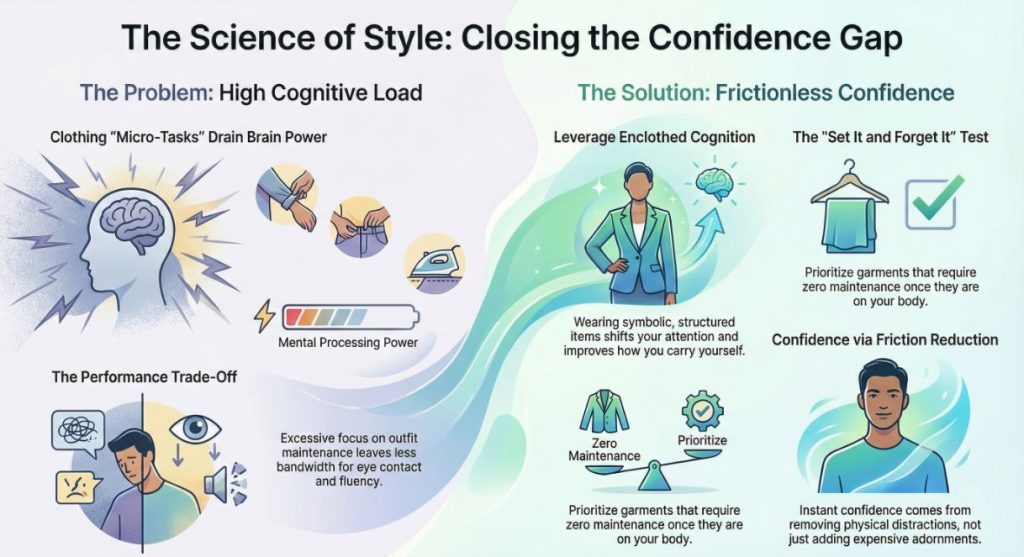
Confidence in clothing isn’t just about aesthetics; it’s about cognitive load.
But when you put on something that needs managing — tugging at a sleeve that’s too short, straightening a seam that’s gone cockeyed, sucking in so a button doesn’t gape between plackets of fabric — your brain assigns processing power to those minitasks. It leaves little bandwidth for eye contact, speaking fluently, and having an open body language.”
The opposite side of the coin is something called enclothed cognition. Slipping on something with symbolic weight — a blazer with structure, trousers that fit just right, a crisp collar — transforms where you focus your gaze and how you exist in the world. You don’t need a lab coat. You need clothes that pass the “Set It and Forget It” test.
Instant confidence is a function of friction reduction, not adornment.
The 5 Instant-Impact Adjustments (Do These Now)
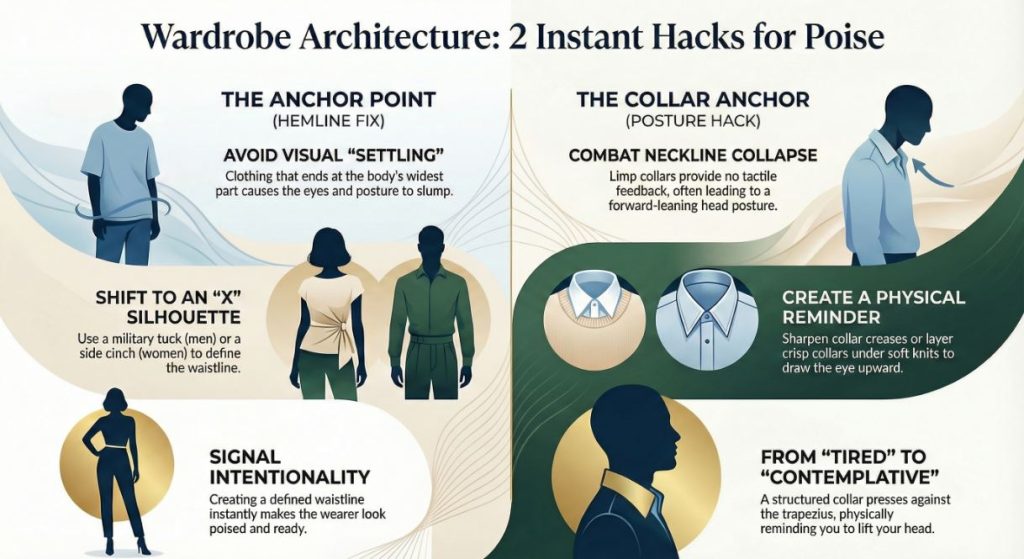
1. The “Anchor Point” Fix: Shift Your Hemlines
The Problem: Clothes that end at the widest part of your body create visual “settling.” A shirt that hits mid-thigh with no break point makes the eye wander down, and the body follows—shoulders round, chin drops.
The 60-Second Fix:
- Men: Do a military tuck if the hem of your untucked shirt hits below the crotch. Fold the remaining fabric down across your lower back, then tuck it into the waistband of your pants. This gives a nice, clean horizontal line right at your waist, and you feel compelled to throw your shoulders back to support the fabric
- Women: If a dress or tunic feels tent-like, add a waist cinch with your non-dominant hand. Grab excess fabric at your side seam, pull back, and tuck it into your waistband or bra band side. This creates an asymmetric drape that signals intentionality, not hiding.
Why it works instantly: You’ve changed your silhouette from “I” to “X” without scissors or sewing. A defined waistline immediately reads as poised and ready.
2. The “Collar Anchor” (Posture Hack)
The Problem: Soft, limp collars (polos, tees, unlined blazers) offer no tactile feedback. When the neckline collapses, your head follows forward.
The 60-Second Fix:
- Structured collars: if you got a jacket or shirt with a stay-up collar denim / leather / fused cotton pop it for like 15 seconds and run your finger on the crease. The result is a physical stop — once you begin to slouch, the collar presses into your trapezius, reminding you to lift.
- Soft garments: Layer a crewneck sweater over a collared shirt, but leave the collar out and crisp. The contrast between soft knit and sharp edge draws the eye upward and stabilizes the neck.
Trust Signal: In practice, this is the difference between looking “tired” and looking “contemplative.” It’s a $0 adjustment.
3. Static Cling Neutralization (Southern/Humidity States)
The Problem: In humid climates (Atlanta, Houston, DC), lightweight fabrics cling to the wrong places—thighs, stomach, rear. This triggers the universal “pick-and-pull” dance, which reads as self-consciousness.
The 60-Second Fix:
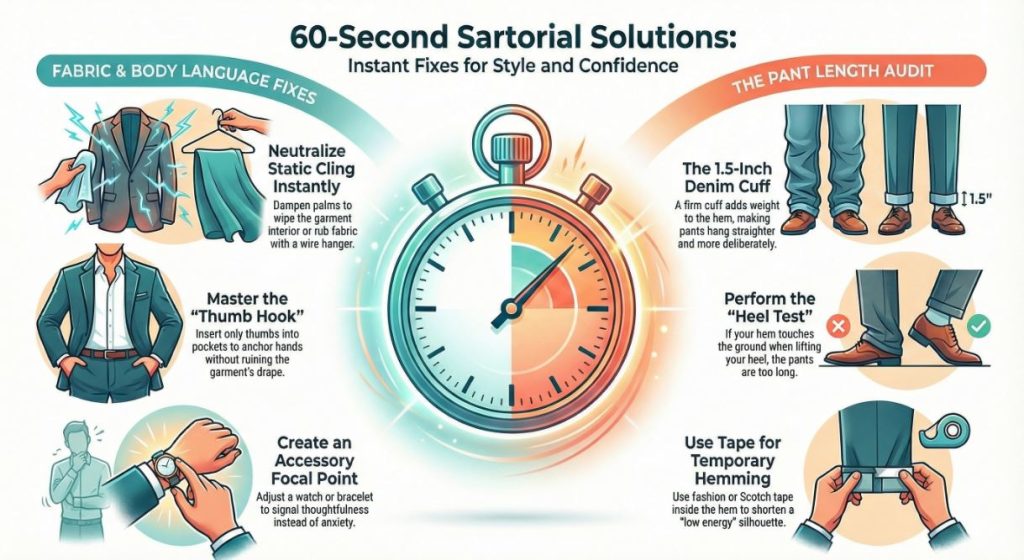
- Immediate: Dampen your palms slightly and run them over the inside of your skirt or trousers (the side touching your skin). Moisture disrupts the static charge instantly.
- Proactive (already in drawer): Keep a wire hanger in your closet. Rubbing the metal hanger along the outside of the garment neutralizes static without water.
Why competitors miss this: Most style advice assumes a controlled environment. Real-world confidence requires managing fabric physics in a 95-degree parking lot.
4. Pocket Discipline (The Idle Hand Signal)
The Problem: Idle hands signal anxiety. But shoving hands deep into pockets pulls the shoulders forward and ruins the drape.
The 60-Second Fix:
- Deep pockets: Use the thumb hook. Only insert your thumbs, leaving fingers outside the pocket. This anchors the hands, opens the chest, and prevents the fabric from buckling at the hips.
- No pockets: If you’re wearing a garment without pockets (common in women’s trousers/dresses), create a focal point with a watch or bracelet. The goal is to give your opposite hand something to touch, not fidget with. Rotating a watch face or adjusting a cuff reads as thoughtful, not nervous.
5. The “Break” Audit (Pants Length)
The Problem: Pants that pool over your shoes (excessive break) visually shorten the leg and create a crumpled silhouette that reads as “low energy.” Pants that hover above the ankle (full length) can feel unintentional if not styled as cropped.
The 60-Second Fix:
- Casual/Denim: Cuff once, firmly. A 1.5-inch cuff adds weight to the hem, making the pants hang straighter. It also exposes the ankle bone, which subtly shifts the proportion to look more deliberate.
- Dress pants: If cuffing is not possible, try the heel test. Stand with shoes on. If the back of the hem kisses the ground when you rise on your heel, it’s too long. “Turn the extra fabric under, then secure with fashion tape or a (Scotch) piece of tape as a temporary 1/2-inch hem.
Common Mistakes (What Avoidance Looks Like)
1. Mistaking “Loose” for “Relaxed.”
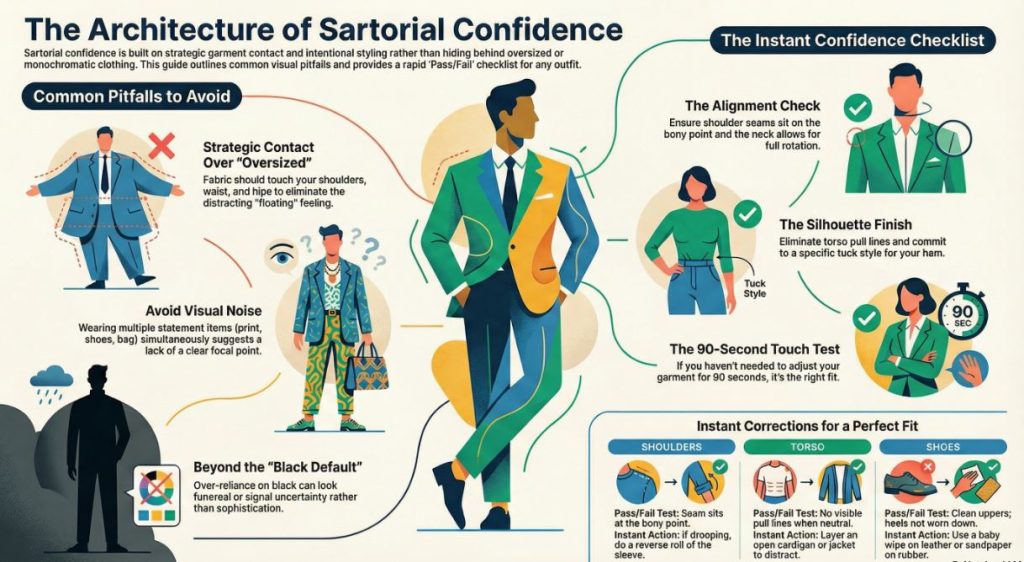
We see this often: men and women gaining confidence after weight changes default to oversized garments to hide perceived flaws. But fabric that doesn’t touch the body actually increases self-consciousness. You never stop feeling the fabric float around you. The fix isn’t tight; it’s strategic contact—shoulders, waist, and hips should register the garment.
2. The “Multiple Statement” Trap
Competitors often advise one statement piece. We agree. However, the mistake is wearing a statement print, statement shoes, and a statement bag simultaneously. This creates visual noise. The viewer doesn’t know where to look, which reads as the wearer not knowing their own focal point.
3. Over-reliance on Black for “Slimming.”
In New York or Chicago winters, full black is sophisticated. In Dallas or Orlando, full black absorbs heat and can look funereal. More importantly, black is the default when unsure. It’s the linguistic equivalent of saying “um.” It doesn’t hurt, but it doesn’t help you stand out.
The “Instant Confidence” Decision Checklist
Use this before walking out the door. Do not pass go until all boxes are ticked.
| If undecided, commit to a full tuck or a half-tuck. No “untucked but bunched.” | Pass/Fail Test | Instant Action |
|---|---|---|
| Shoulders | Seam sits at the bony point, not drooping off. | If drooping, do a reverse roll (roll sleeve hem outward under itself). |
| Neck | You can turn your head fully without fabric choking or gaping. | Unbutton one button. Yes, even that one. Air = ease. |
| Torso | No visible pull lines across chest/back when standing neutral. | If pulling, layer open cardigan/jacket to distract. |
| Hem | Shirts/blouses end at mid-hip or are intentionally tucked. | If undecided, commit to full tuck or half-tuck. No “untucked but bunched.” |
| Shoes | Clean uppers; heels not worn down on one side. | Baby wipe on leather. Sandpaper on scuffed rubber soles. |
| Touch Test | You haven’t adjusted anything in the last 90 seconds. | If drooping, do a reverse roll (roll the sleeve hem outward under itself). |
Nuance & Boundaries: When This Works (And When It Doesn’t)
USA Regional Context:
- Humid South (TX, FL, LA): Structured fabrics (denim, twill, ponte) outperform linens and rayons. Rayon drapes beautifully in an AC-controlled store; in humidity, it adheres and reveals every seam. Look for “cotton-spandex” blends with at least 3% elastane for recovery.
- Northeast (NY, MA, IL): Layering is necessary, but bulk kills confidence. Avoid wearing a puffy vest over a hoodie over a tee—this creates the “Michelin Man” silhouette. Opt for a thin merino base and a structured mid-layer (leather or waxed cotton).
- West Coast (CA, WA): “Casual” here reads as “intentional simplicity.” Over-styling (too many accessories, sharp creases) can actually signal anxiety. If you’re in tech or creative industries, prioritize texture over structure.
The Safety Valve: When to Stop
If you have adjusted the same garment five times in the first hour of wear, it is not the right garment for today. Stop fighting it. Keep a backup item in your car or office—a neutral cardigan, a clean t-shirt, a pair of black trousers. The ability to pivot without panic is the ultimate signal of control.
FAQ (People Also Ask)
Yes, if it alters your posture. A structured shoulder or a supportive waistband forces alignment. Without that physical feedback, the effect fades within minutes.
Fit matters more than cost. A $30 H&M blazer that is hemmed at the sleeve costs $55 total and will look better than a $400 off-the-rack blazer that is too long in the arm. Allocate budget to alterations, not labels.
Focus on necklines and sleeves. A boatneck or wide scoop neck exposes the collarbone, which reads as open and calm. Cuffed short sleeves add structure to an otherwise limp silhouette.
They make you look noticeable, which is adjacent to confidence. However, if you feel self-conscious in bright colors, you will look hesitant. Start with one saturated item away from your face (trousers, skirt, shoes).
The “dead man’s blazer.” A blazer that is too long in the body or too loose in the chest hangs straight down, erasing the V-shape. Men should ensure the blazer’s lapel rolls forward, not lies flat against the chest. This requires a proper chest canvas—look for “half-canvas” construction in thrifted finds.
Remove one thing. If you’re wearing a necklace, earrings, a watch, and a belt, remove the belt or the earrings. Confidence implies you don’t need everything working at once.
Conclusion
You cannot think your way into confidence while your clothes are physically distracting you.
The disconnect between how you want to appear and how you actually feel in your clothes drives avoidance behavior—crossed arms, downward gaze, reduced speech.
Instant confidence isn’t about buying the perfect suit. It’s about silencing the noise: stopping the tug, stopping the pull, stopping the worry that your hem is dragging through a puddle. When your clothes stop asking for attention, you get to speak.
Try one of the five tactical fixes today. Not next season. Not after the shopping trip. Today.
Disclaimer: This article is purely informative and does not replace the in-person consultation with a qualified professional. Results vary depending on body mechanics, climate and garment construction. “Apparel should be comfortable and allow freedom of movement – mobility is everything.