
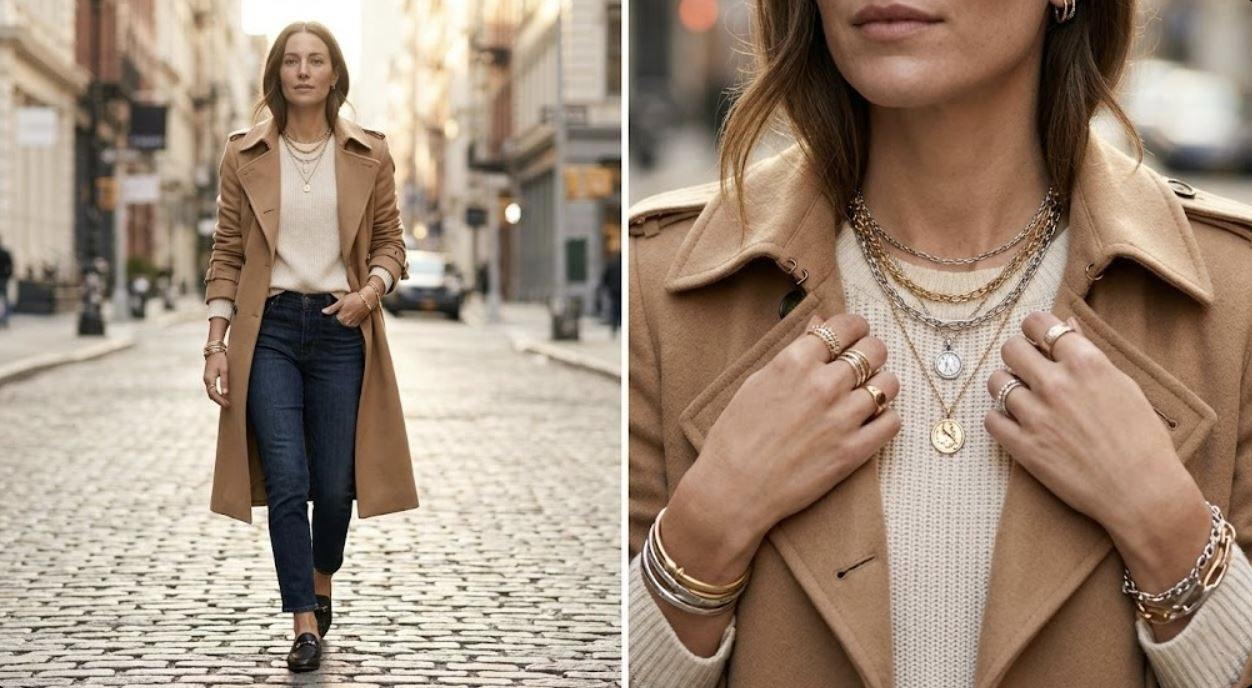
You want to look polished and put-together, but the thought of worrying about layering multiple necklaces or stacking rings is like: Ugh! You’ve probably attempted plating jewelry, and then by the time it is noon, your jewelry’s all tangled, noisy, and uncomfortable. The default advice — “just mix and match!” —isn’t exactly helpful when one is staring at a jewelry box full of sentimental pieces, everyday basics, and the fear of looking cluttered.
This guide is different. We’re heading far, far beyond brand-centric styling to impart the fundamental rules of fresh balance and proportion. We’re not trying to look like a store mannequin, but rather we want something personal and polished that feels as comfortable as our favorite jeans. Because here you’ll be learning a system, not just a trend.
Core Explanation
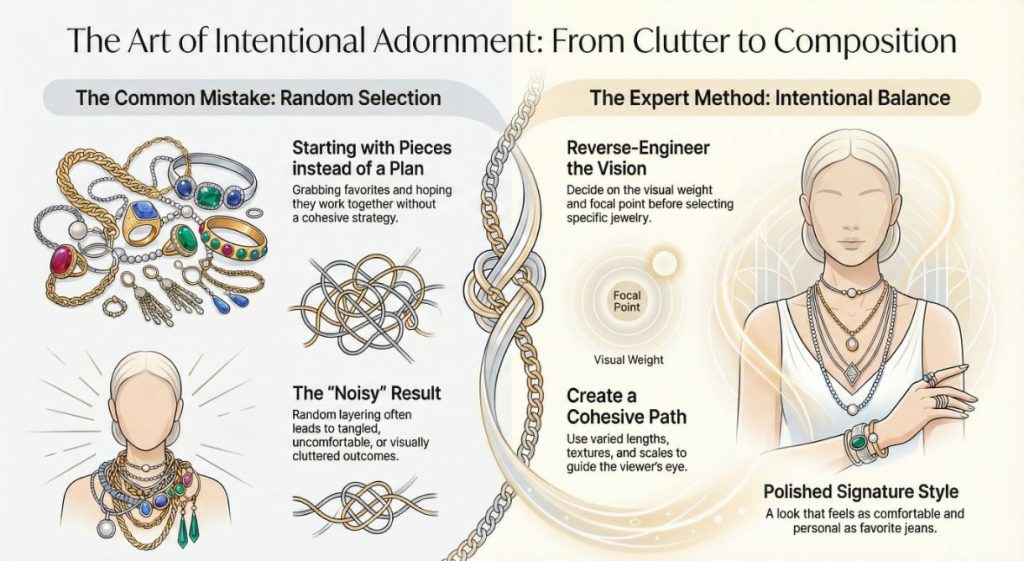
Styling Rule #1: Layering. It’s not how many you stack on, it’s how you do the stacking. It’s about intentional visual balance. And It’s like a good painting: your eye must have somewhere to rest, not chaos. Well-executed layering creates a line or shape on your body that combines lengths, textures, and scales that work together — but not against each other.
The common error is to begin with pieces rather than a plan. You yank on a couple of preferred necklaces and cross your fingers. The expert approach is to reverse-engineer it: You choose the visual weight and focal point first, then select jewelry that makes it so.
The 5 Rules of Effortless Jewelry Layering
1. Master the Length Hierarchy (The Golden Rule)
Your layers need clear, distinct stopping points to avoid a crowded look.
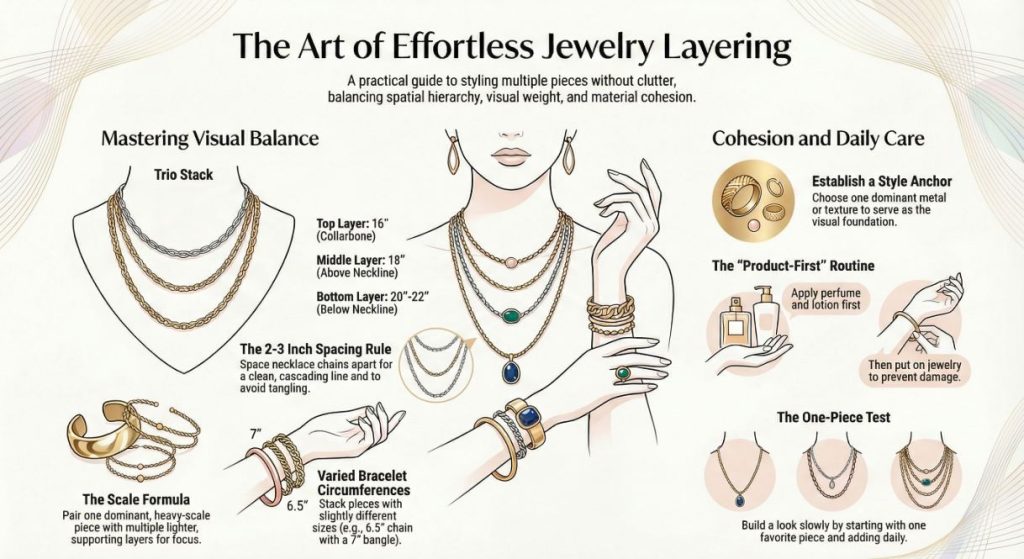
- For Necklaces: Space your chains 2-3 inches apart. A classic trio starts at 16″ (collarbone), 18″ (above the neckline), and 20″-22″ (below). This creates a clean, cascading line.
- For Bracelets: Stack with varied sizes. Pair a delicate 6.5″ chain with a 7″ bangle. On the same wrist, keep pieces close but not identical in circumference.
- Common Mistake: Wearing multiple pendants or chains of nearly identical length. They will clash and tangle constantly.
2. Establish a Dominant Texture or Metal
Cohesion is key. Choose one element to be your anchor.
- Option A: Metal as Anchor. Wear primarily gold, silver, or rose gold. You can introduce one piece in a different metal as an accent (e.g., a two-tone piece or a single silver ring in a gold stack).
- Option B: Texture as Anchor. Build around a common theme like hammered finishes, cable chains, or diamond accents. Mixing a rope chain, a bezel pendant, and a flat herringbone chain can feel disjointed.
- Pro-Tip for the Hesitant: If you’re new to mixing metals, use a piece that contains both, like a bangle with gold and silver links, to bridge the gap seamlessly.
3. Play with Scale, Not Just Size
“Scale” refers to visual weight. A thin, solid choker has more visual weight than a long, airy pendant.
- The Formula: Dominant Piece (Heaviest Scale) + Supporting Pieces (Lighter Scale).
- Example: A large 20mm pendant necklace set with a16″ dainty chain and an 18″ simple bar necklace. “We focus on the pendant, and then all of the simpler pieces surround it.
- Common Mistake: Layering on many statement pieces of the same size (like a big pendant, massive hoops, and a chunky cuff). It’s just no longer a polished look — it is visual noise.
4. Prioritize Comfort & Practicality for Everyday Wear
Polished shouldn’t mean prickly or high-maintenance.
- Clasps are Key: Use secure lobster clasps for heavier pieces. For multiple necklaces, consider uniform clasp types to prevent them from hooking onto each other.
- Mind the Weight: Your dominant piece can have weight, but ensure supporting layers are light. Heavy stacks on wrists can impede typing; long, heavy pendants can pull and distort necklines.
- Climate Consideration: In humid Southern states, opt for less skin-contact layering (e.g., a longer necklace over a blouse) to prevent irritation. In all climates, apply perfume and lotion before putting on jewelry.
5. Start Simple and Add Slowly
Your layered look doesn’t need to be built in one morning.
- The One-Piece Test: Wear a single necklace you love. Notice where it falls. Tomorrow, add a shorter or longer piece. Build your comfort over days.
- The Sentimental Layer: That delicate heirloom ring? It’s a perfect supporting piece. Layer it with a simple, contemporary band. This honors the piece while integrating it into your modern style, addressing the hesitation to wear precious items.
Decision Checklist: Before You Walk Out the Door
Ask these questions to audit your layered look:
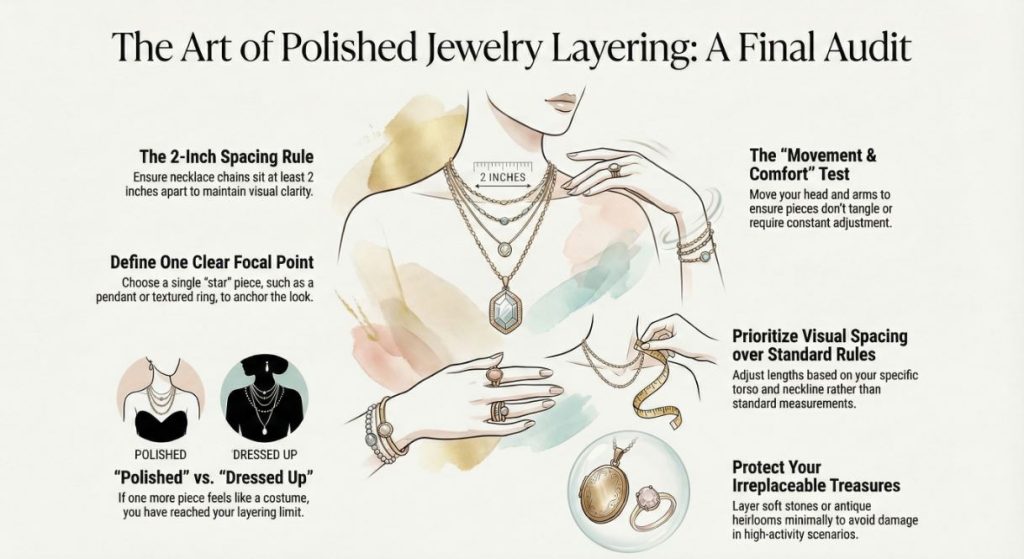
- Lengths Spaced? Are my necklace chains at least 2 inches apart?
- Focal Point Clear? Is one piece (a pendant, a textured ring) obviously the star?
- Metals Cohesive? Do I have one dominant metal family, or a deliberately mixed-metal connector?
- Movement Managed? If I move my head and arms, do pieces catch or tangle excessively?
- Comfort Checked? Can I work, drive, and live my day without constant adjustment?
Nuance & Boundaries
- When to Stop: If adding one more piece makes you feel “dressed up” rather than “polished,” you’ve reached your limit. Polished layering should feel like a natural extension of you.
- Body Type is a Guide, Not a Rule: The standard length advice works for most, but adjust for your torso and neckline. A 16″ choker on one person may sit at the collarbone on another. Always prioritize the visual spacing on your body.
- Safety Valve – Valuables & Heirlooms: For extremely rare, soft (like pearls), or irreplaceable antique pieces, consider layering them minimally or not at all in high-activity scenarios. Sometimes, the most polished choice is to let a single treasure shine.
FAQs
Absolutely. It’s a modern, personalized look. The key is to do it intentionally, not accidentally. Use the “dominant metal” rule (e.g., 70% gold, 30% silver) or connect them with a piece that contains both metals.
Proper length spacing is 80% of the battle. The remaining 20% comes from using similar chain weights and secure clasps. A tiny drop of clear nail polish on the clasp thread can also prevent screws from loosening.
Rings and bracelets. They are less committed than necklaces and easier to balance. Start with a simple band and add one statement ring, or a watch with one delicate bracelet.
There’s no magic number—it’s about visual balance. However, for a truly polished, everyday look, three is often the sweet spot. It provides enough variety without overwhelming.
Yes. Focus on lighter-weight chains (like flat curb or serpentine chains that lie flush), ensure back clasps are smooth, and consider laying pieces over a shirt collar instead of directly on skin.
Yes, this is the hallmark of a personal style. A delicate vintage heirloom pendant can hang alongside a simple, modern chain from a contemporary brand. Focus on the finish and scale, not the price tag.
Conclusion
A layered jewelry style that feels polished, not bulky. It’s the mindful space around pieces, the carefully selected focal point — and more than all, a commitment to personal comfort. Forget copying a rigid trend. Use these five rules as your guide, begin with the pieces you love and wear now, and cultivate your signature style one well-considered layer at a time. Instead, the best look is the one that seems natural, effortlessly you.
Disclaimer: This is an informative and style guide only. Jewelry care and wearing Jewelry is personal, and it should be treated that way for each piece. Always close clasps before wearing valuables, and be careful of activity when adorning precious pieces.