

We’ve all seen the advice: “Buy a blazer.” “Wear all black.” “Just get it tailored.” While these tips aren’t wrong, they often leave out the most critical part of the equation: the “why” and the “how” on a realistic budget.
Standard advice fails because it assumes you have a discretionary fund to replace your wardrobe or a tailor on every corner. It also ignores the anxiety that comes with trying to look polished while navigating the pitfalls of fast fashion—pilling fabric, poor fit, and clothes that look worn after two washes.
This isn’t a guide to getting people to think you spent a lot of money. It’s learning the particular signifiers of quality and elegance. By paying special attention to Fit, Finish, and Restraint you can compile a collection of clothing that signals sophistication without needing the price tag too do the same.
The Foundation: Why Some Clothes Just “Look” Cheap
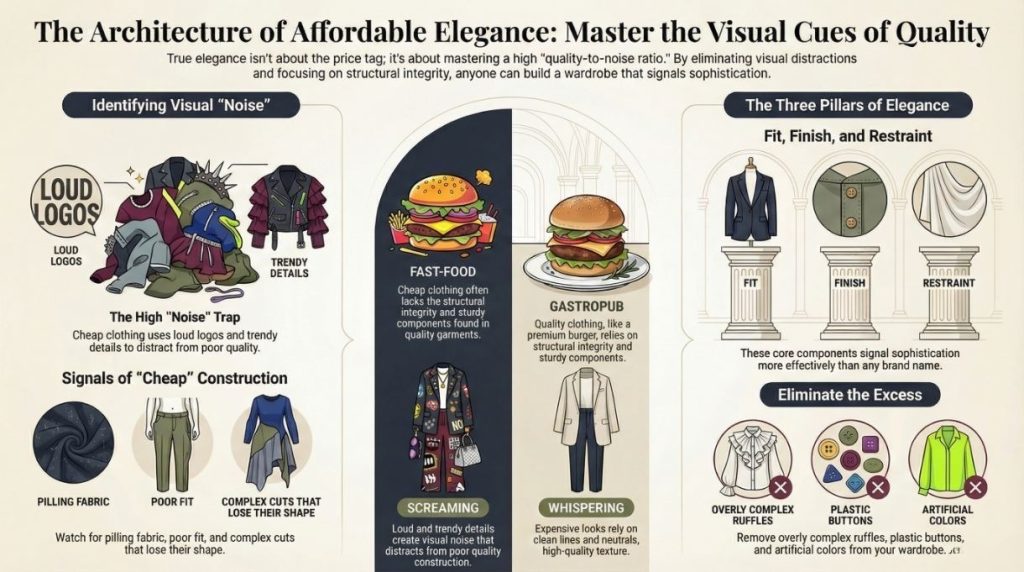
Before we get to the steps, it’s important to know what your eye is actually seeking. But when we deem an outfit “expensive,” we are unconsciously recognizing a high quality-to-noise ratio.
- The Mechanism: Cheap clothing either screams for attention with loud branding, unnecessarily complicated cuts, or trendy details (gigantic ruffles; plastic buttons). Expensive clothing whispers. It is based on clean lines, strong form, and the natural lustre of materials.
- The Analogy: It’s like comparing a good burger to a gastropub burger. The fast-food version is full of artificial colors and falls apart (like cheap fabric). The upscale one is made with good beef on substantial (but not tough) bread that holds up. (like quality fabric and structure).
Our goal is to eliminate the visual “noise” and focus on the core components that signal quality.
1. The Tailoring Illusion (Even for Thrift Store Finds)
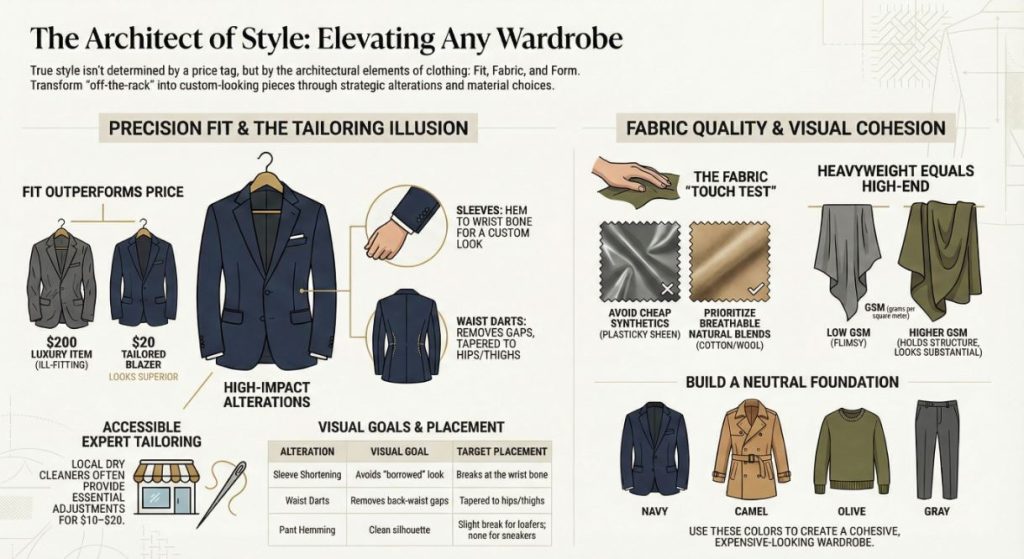
Fit is the absolute biggest thing that makes an outfit look deliberate or not. You can pick up a $20 blazer at Target, but if the shoulders fit perfectly and the sleeves are just right, it will look 10 times as good as a $200 off-the-rack blazer that is two sizes too baggy.
The High-Value Alterations:
You do not need a full custom tailor for every seam. Focus on the “high-impact” fixes that cost $10–$20 at a local dry cleaner.
- Sleeve Shortening: If the sleeve covers your knuckles, it looks like you’re wearing borrowed clothes. Hem them to break at your wrist bone.
- Hemming Pants: Break your pants based on your shoe. A slight break (a small fold at the ankle) for loafers, or no break for sneakers.
- Taking in the Waist: Many of us buy pants to fit our hips or thighs, leaving a gap at the waist. A simple dart in the waistband (often less than $15) makes ready-to-wear pants look custom-made.
Common Mistake: Assuming tailoring is only for rich people. In the US, local dry cleaners and independent seamstresses (often found in older strip malls) offer very affordable rates for simple adjustments.
2. The Fabric Dictatorship: Touch Before You Buy
You cannot tailor your way out of bad fabric. Polyester can be practical, but in its cheapest form, it has a plasticky sheen and traps odor and heat. In the humid Southern states or during a NYC summer commute, cheap synthetics will cling, sweat, and look disheveled by noon.
What to Look For:
When shopping (thrift or retail), touch the fabric. Does it feel rough or sticky? Avoid it.
- The “Expensive” Blends: Look for fabrics with a decent percentage of natural fibers. Cotton, linen, wool, and silk breathe better and drape more elegantly.
- For example, A shirt that is 60% Cotton / 40% Polyester will usually hold its shape and resist wrinkles better than 100% cheap cotton, while still feeling breathable.
- The Weight Test: Generally, heavier fabrics look more expensive. A t-shirt with a high “GSM” (grams per square meter) will hold its structure and look substantial, rather than flimsy and see-through.
USA Context Check: In colder climates like the Midwest or Northeast, a thick 100% cotton hoodie or a wool-blend coat from a thrift store will look infinitely more expensive than a thin, trendy acrylic blend jacket from a fast-fashion mall outlet.
3. The Color Palette: The Power of Visual Restraint
If you look at a high-end brand’s website (like Theory, Vince, or Rag & Bone), you’ll notice a limited color palette. They aren’t trying to be rainbows. They are selling cohesion.
The Neutral Foundation:
Building a “capsule” around neutrals allows your eye to focus on the texture and cut of the clothing, rather than clashing colors.
- Core Neutrals for US Wardrobes: Navy (more versatile than black for many), Camel/Khaki, Olive, Cream, and Gray.
- The “Expensive” Accent: If you love color, use it strategically. A burgundy sweater or a forest green top works best when paired with the neutrals listed above.
Common Mistake: Buying a bright, trendy color in a cheap fabric. A neon yellow polyester blouse screams “fast fashion.” A cream cashmere-blend sweater whispers “quality.”
4. The “No Wrinkles” Rule: The $0 Luxury Upgrade
Wrinkles are the universal sign of “I just grabbed this off the floor.” It signals a lack of care, which directly contradicts the perception of expense.
The Steam vs. Iron Debate:
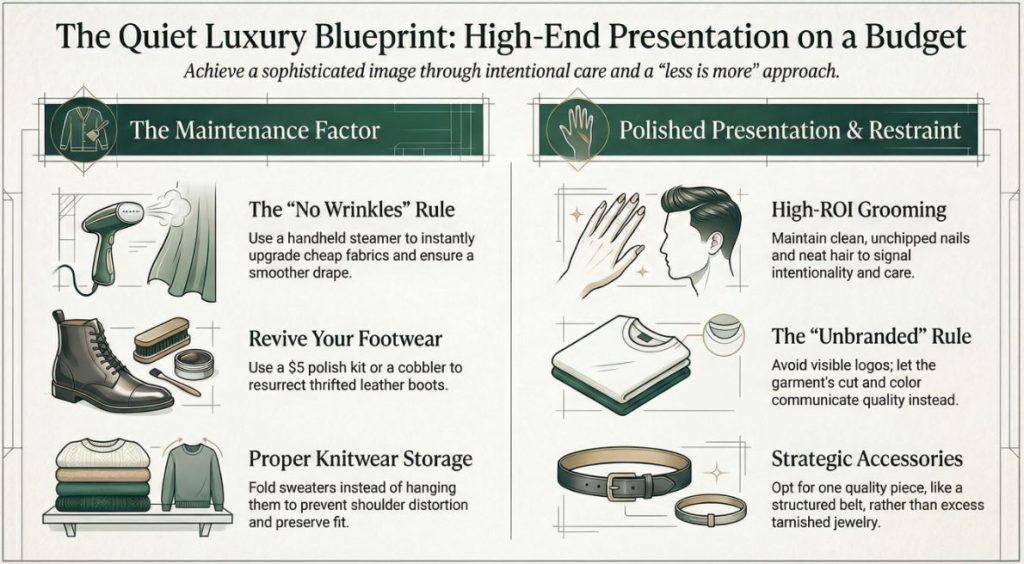
In a recent Reddit discussion, users noted how a cheap dress looked “homeless” until it was steamed. A handheld steamer ($20–$30 on Amazon) is a better investment than a new pair of shoes. It instantly removes the “brand new from the plastic bag” look and relaxes the fibers for a smoother drape.
The Folding Trick: If you can’t iron, learn to fold knitwear properly. Hanging sweaters can stretch them out at the shoulders, distorting the fit. Folding them neatly signals that you value the garment.
5. Grooming: The Frame Matters More Than the Art
You can be wearing a $15 thrifted dress, but if your hair is greasy or your nails are chipped, the brain registers “unkempt,” not “frugal.” Looking expensive requires the whole package to be intentional.
The High-ROI Details:
- Nails: Clean, shaped, and either buffed naturally or painted with a solid color (no chipping). You don’t need a $50 manicure; a $5 drugstore polish applied carefully works.
- Shoes: This is a major gap in competitor articles. Worn-out heels or scuffed sneakers ruin the illusion instantly. A $5 shoe polish kit or a trip to a cobbler for new heel taps can resurrect a $20 thrifted pair of leather boots.
- Accessories: Less is more. Instead of a pile of tarnished fashion jewelry, wear one quality piece. A simple silver or gold-tone watch (even a $40 Casio or Timex) looks intentional. A structured leather belt (even faux leather that looks real) defines your waist better than a flimsy fabric one.
6. The Art of Restraint: Avoiding Logos and Trends
Logos are the opposite of quiet luxury. When you pay to be a walking billboard for a brand, it often signals that you are seeking validation from the logo itself.
The “Unbranded” Rule:
Stick to clothes without visible brand names. Let the cut and color do the talking.
- For Men: Avoid giant logos on polo shirts or hoodies.
- For Women: Avoid handbags with the brand name stamped all over the hardware.
Decision/Buyer Checklist: The “Expensive” Test
Before you buy any item (new or thrifted), run this mental checklist. It must pass at least 3 of these 4 checks to be worth it:
- The Fabric Check: Does it have a high percentage of natural fibers or a substantial weight? (No flimsy, see-through material).
- The Button Check: Are the buttons plastic and flimsy, or do they feel solid? Are there loose threads hanging off? (Skip it if yes).
- The Seam Check: Hold it up to the light. Are the seams straight? Is the pattern (like plaid) matched up at the seams? (Mismatched patterns = low quality).
- The Versatility Check: Does this item go with at least 3 other things currently in your closet? If you have to buy a new outfit for this outfit, it’s not a budget-friendly win.
Nuance & Boundaries: When the Rules Bend
- Climate Reality: In states like Florida or Texas, 100% linen is a wrinkled mess in seconds. The linen-cotton blend will help keep you cool and look crisp longer. Wool (and also flannel) may be a possibility, but consider that in the very cold and dry climates we often have locally, it is possible to get away with wool and thicker layers, which naturally drape more effectively.
- The “Mom” Factor: If you have young kids, looking “expensive” might mean investing in machine-washable fabrics and dark, forgiving colors. It’s about practicality meeting style.
- When to Stop: If maintaining a “polished” look is causing you financial stress or anxiety, stop. The goal is confidence, not perfection. A genuine smile and good posture will always outrank a designer label.
FAQs
Yes, but selectively. Focus on “hard” items like denim (with 100% cotton or a serious blend) and basic t-shirts (note the weight and neckline). Skip to-the-moment pieces or anything with heavy embellishment; the latter can often read as cheap in lower-priced manufacturing.
Monochromatic outfits (head-to-toe one color, like all navy or all cream) look inherently sleek and elongated. For two-tone outfits, stick to classic pairings: navy and camel, gray and black, olive and cream.
Only buy clothes that fit your largest part (shoulders or hips). Tailor the rest. For a basic wardrobe refresh, identify your 5 most-worn items. If they don’t fit perfectly, invest in tailoring those first. It’s a higher ROI than buying 5 new cheap items.
Absolutely not. In fact, a clean, polished white leather sneaker (like a simple Adidas Stan Smith or Veja) with a tailored outfit is a modern hallmark of “stealth wealth.” The key is that the sneakers must be clean.
Avoid anything with obvious “gold plating” that has worn off. Stick to silver-tone or gold-tone metals that are uniform. Keep it simple. Tarnished jewelry looks cheap instantly; clean your jewelry regularly with a polishing cloth.
For a budget, it’s better to have a few “high-quality” foundational items (a good pair of jeans, a structured jacket, leather shoes) and supplement with inexpensive, simple tops. The foundation pieces do the heavy lifting.
Conclusion
The point isn’t to look expensive on the cheap — it’s about what your clothes are saying about you. When you prioritize fit over brand, fabric over quantity, and grooming over trends, the world will read it that you are intentional and self-possessed.
Forget the din of fast fashion churn and burn. Follow these seven rules, and you will discover that the most luxurious thing to wear isn’t a logo — it’s quiet confidence.
Disclaimer: This content is subject to general support regarding, fashion and lifestyle but not personal finance for educational purposes only. Results of the individual may vary according to figure body type,There maybe a slight difference due to manual measurement. Never use garment care instructions from the manufacturer.