
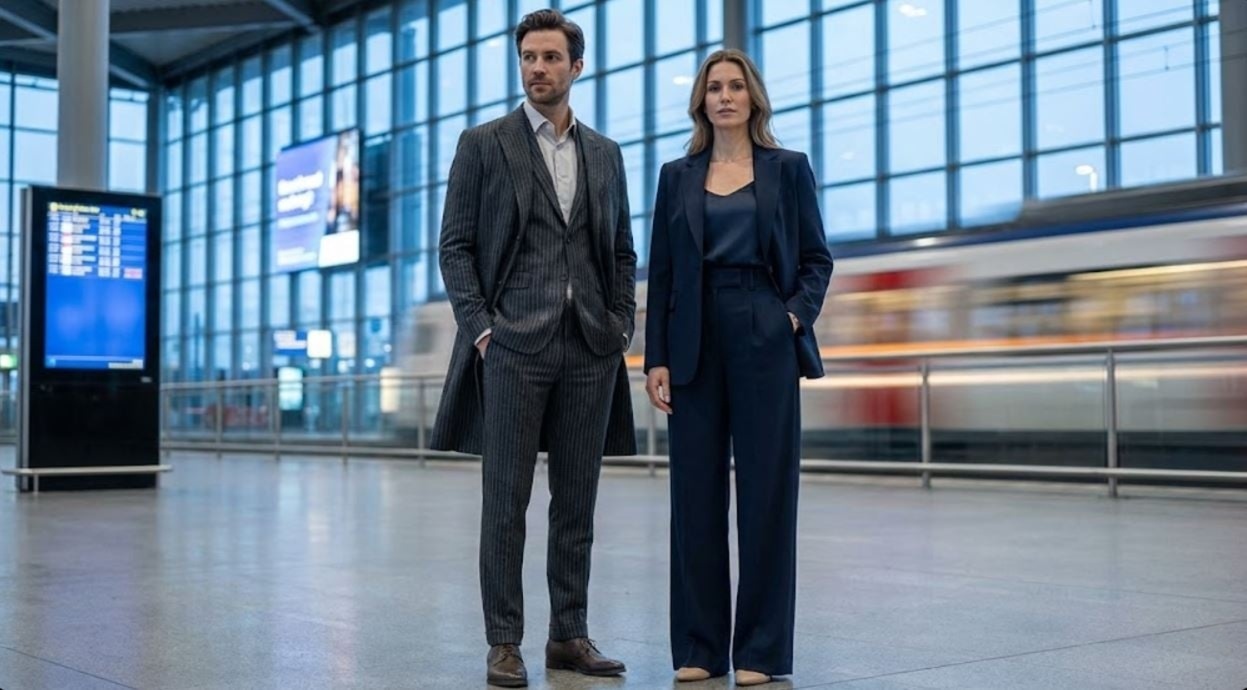
If you’ve ever stood in front of a mirror, tugged at a hemline, and wondered why the outfit doesn’t feel “right,” you’re not alone. The problem isn’t your height; it’s the visual line.
Most advice on dressing to look taller fails because it focuses on absolutes (“always wear vertical stripes!”) without explaining the why. The result is a closet full of rules, but no understanding of how light, fit, and color interact to trick the eye.
This guide moves beyond generic lists. We will break down the specific visual mechanics of why some outfits make you look truncated while others create a seamless, elongated line. Whether you are 5’2″ or 5’11” and looking to maximize your presence, these are the principles that professional stylists use to balance proportions.
The Visual Science: Why Some Outfits Make You Look Shorter
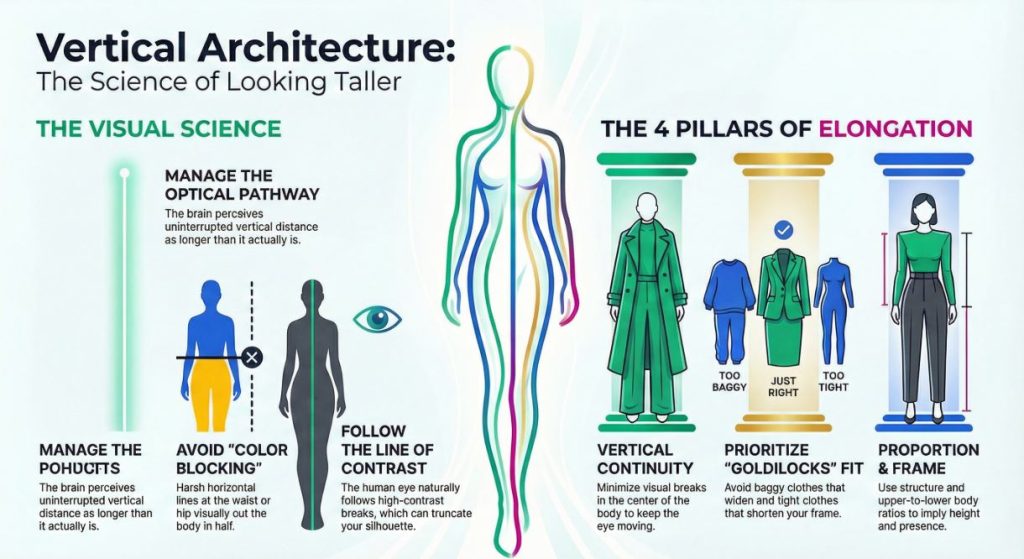
To understand how to look taller, you must first understand what makes you look shorter. The human eye naturally follows lines of contrast.
When you wear a dark top and light pants, your eye stops at the harsh horizontal line at your waist or hip. This “color blocking” visually cuts your body in half. Conversely, when the eye can travel smoothly from your shoulder to your shoe without interruption, the brain perceives that vertical distance as longer than it actually is.
The goal isn’t to physically change your height, but to manage the viewer’s optical pathway.
The 4 Pillars of an Elongated Silhouette
Before we get into specific wardrobe items, these four pillars govern every decision you make. If a trick violates one of these, it will likely make you look shorter.
- Vertical Continuity: Minimize visual breaks in the center of your body.
- Fit Over Size: Baggy clothes widen you; tight clothes shorten you. The “Goldilocks” fit is key.
- Proportion Management: Managing the ratio of your upper body to your lower body.
- The Frame: Using structure to imply height, even if you don’t have it.
Step-by-Step: How to Engineer a Longer Look
1. Mastering Monochrome (The #1 Trick)
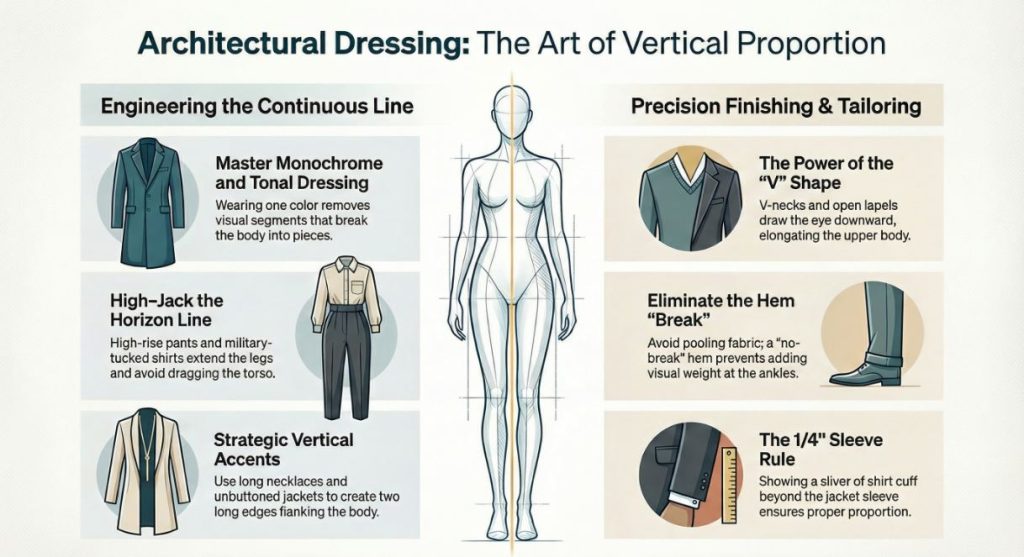
Wearing one color from head to toe is the most effective way to create a continuous vertical line. It removes the “stop sign” contrast that breaks the body into segments.
- How to do it: Choose a neutral base like Navy, Charcoal, Black, or Camel. If head-to-toe black feels too severe, experiment with tonal dressing—pairing a light grey sweater with dark grey trousers. The slight variation adds depth but preserves the continuous line.
- The Exception: If you wear two colors, ensure the stronger contrast happens at your neck (face) or feet, not at your waist.
2. The “High-Jacking” the Horizon Line
Where your clothing visually “starts” matters.
- For Tops: Tucking in your shirt creates a defined point. However, a sloppy tuck can add bulk. Use the “military tuck” (pulling excess fabric slightly to the back) to keep the front flat. If you prefer untucked, the hem must hit no lower than the top of your hip bone. Anything longer drags the torso down, making legs look short.
- For Pants/Jeans: A higher rise (the distance from the crotch to the waistband) visually extends the legs. Low-rise pants shorten the torso but truncate the legs, making you look stockier.
3. Visual Lengthening with V-Necks and Lapels
The neckline dictates the vertical line of your upper body.
- Crew Necks: Halt the eye at the collarbone across. This can make short necks or substantial builds appear to have broad shoulders, and make the torso seem momentarily shorter.
- V-Necks and Plunging lapels: Form a downward arrow. This directs the eye down the middle of your chest,mostrare torace, and in doing so elongates your torso. A well-cut jacket with a clean notch lapel does the same work as a deep V-neck sweater.
4. The Pant Hem: The “Break” is Crucial
This is where many outfits fail. Excess fabric pooling on your shoes (a “full break”) shortens the leg by adding visual weight at the ankle.
- The Fix: Aim for a “no break” or “quarter break” hem.
- Men: The hem should lightly graze the top of your shoe with a slight indentation in the fabric.
- Women: Cropped pants are risky. If worn, they must be narrow at the ankle to show a sliver of skin, which extends the line into the foot. Wide-crop pants cut off the leg.
5. Strategic Use of Vertical Details
You don’t need pinstripes to create a vertical line. Look for subtler cues:
- Long necklaces that hang past the collarbone.
- Seams down the center back of a jacket.
- Unbuttoned cardigans or jackets creating two long vertical edges on either side of the body.
- Pointed-toe shoes (for women) that extend the line of the foot.
6. Sleeve Length: The Tell-Tale Sign
Sleeves that are too long signal “off-the-rack” and visually shorten the arms, which throws off the whole body’s proportion.
- The Rule: Your shirt cuff should show about 1/4″ to 1/2″ of fabric beyond your jacket sleeve. For casual wear, the sleeve should end at the wrist bone, never covering the base of the thumb.
Common Mistakes: When Good Intentions Go Wrong
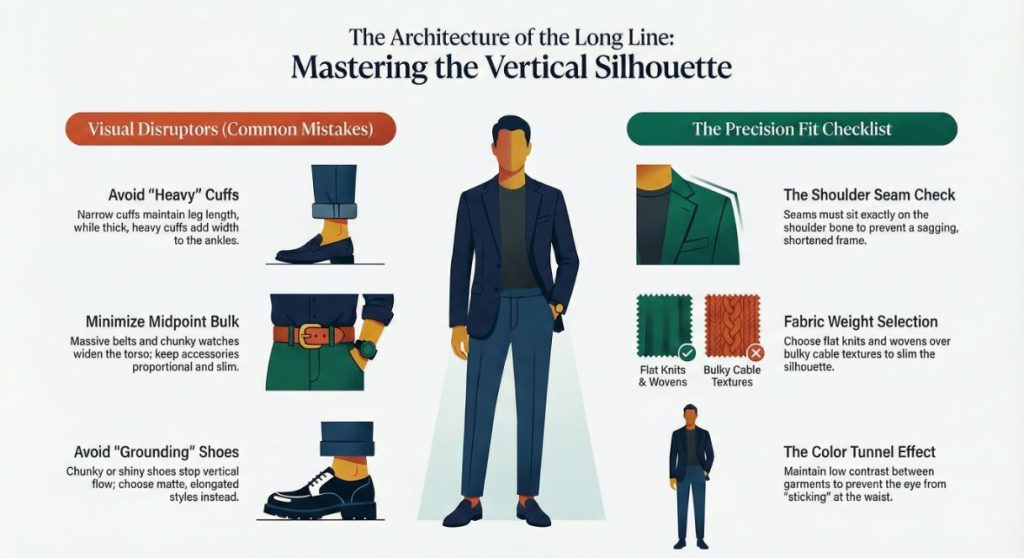
- The “Flood” Effect: Cuffing pants too high to show off ankles can look intentional, but if the cuff is thick and heavy, it adds horizontal bulk. Keep cuffs narrow.
- Over-sized Accessories: A massive belt or a chunky watch adds bulk to the midpoint of your body. Keep accessories proportional and close to the body.
- Horizontal Stripes: They aren’t actually banned. A single, thin horizontal stripe on a sweater can be fine. The danger is multiple, thick stripes that create a “barcode” effect, widening the torso.
- Shiny Shoes: In men’s fashion, shoes that are too chunky or shiny attract attention to the feet, grounding the eye and stopping the vertical flow. A matte, elongated shoe keeps the line moving.
Decision Checklist: What to Look for When Shopping
Use this checklist when trying on clothes to ensure you are buying for the “long line”:
- The Shoulder Check: Does the shoulder seam sit exactly at your shoulder bone? (Sagging off = shorter appearance).
- The Tuck Test: If you tuck the shirt in, does it billow out? (If yes, size down or try a slim fit).
- The Color Tunnel: Close your eyes, then open them and look at the outfit in the mirror. What is the first thing you see? (If it’s your waist/belt, the contrast is too high).
- The Pant Length: Standing barefoot, does the back of the pant hem hit the top of your heel? (If it’s lower, you need a hem).
- The Fabric Hand: Does the fabric have too much bulk? (Thick cable knits add 10 lbs visually; flat knits and wovens are slimmer).
Nuance: Adapting to Context (USA Edition)
- The Humidity Factor (South/Coastal): In humid states like Florida or Texas, lightweight linen and cotton are essential. However, these fabrics wrinkle easily. Wrinkles create vertical lines? No—they create texture and shadow, which adds “noise” to the outfit. In humid climates, prioritize wrinkle-resistant blends to keep the line clean.
- The Commute Factor (Urban): If you are commuting by subway in NYC, your pants will ride up. Ensure your socks are a complementary color to your pants (not a stark contrast) so that when your pant leg rises, you don’t create a “sliced” look at the ankle.
- The Cold Factor (Midwest/Northeast): Bulky coats are the enemy. Look for longline coats (ending mid-thigh or just above the knee) with a tailored fit. A puff jacket adds horizontal volume, shortening your silhouette significantly.
When to Stop: The Tailoring Limit
You can push the principles of illusion only so far. There is a point where you must accept that the clothes are not right for your body type.
- When to see a tailor: If the shoulders are perfect but the sleeves run long—buy it and visit your local tailor for hemming. It’s loose in the waist but fits in the thigh—purchase and hem.
- When to walk away: If the shoulder seams are hanging off your frame, or the rise of the pants is so short that they pull at your crotch. Structural problems (shoulders, yoke, rise) are costly to alter and frequently unfeasible.
Frequently Asked Questions
Not exactly. Monochromatic dressing makes you look taller. If you wear a black turtleneck with light grey pants, the contrast cuts the line. The color black is just a tool for continuity; the magic is in the matching, not the color itself.
They physically add inches, which is different from an optical illusion. However, they can be combined with these tricks. If you use lifts, ensure your pant length is adjusted to account for the lifted heel so the fabric doesn’t look too short.
Yes, but with caution. A double-breasted jacket means a wider block of fabric. For this to work, the jacket must be impeccably tailored and cropped (in other words, covering your seat but not your thighs) and buttoned up for a solid color block.
Your goal is to lower the visual waistline to lengthen the legs. Wear pants with a higher rise. Avoid shirts with high-contrast patterns at the hem. Match your belt to your pants, not your shirt, to avoid highlighting the waistline.
No. Fit is more important than size. A well-fitted outfit on a larger frame creates a clean cylinder (long line), whereas a tight outfit creates bulges (horizontal lines). The goal is a smooth silhouette.
It can, if done wrong. Rolling sleeves into a thick, tight cuff just below the elbow creates a horizontal band. A better technique is the “master roll” or “Italian roll,” which is looser and creates a longer, tapered line up the forearm.
Conclusion
Dressing taller is not about being something you’re not. It is about getting rid of visual roadblocks that halt the eye.” By literally connecting the dots of color and fit at the shoulders and hems, while controlling your contrast lines, you become powerful in a way that is sharp and by intent.
Begin with one principle this week — say, black and white or checking the length of your pant hems — and work up from there. The goal is a cohesive, confident look where the clothes serve the body, not the other way around.
Disclaimer: For informational purposes only. Individual results may vary based on body shape, proportions, and personal style preferences. Always consult with a professional tailor for permanent alterations to garments.