
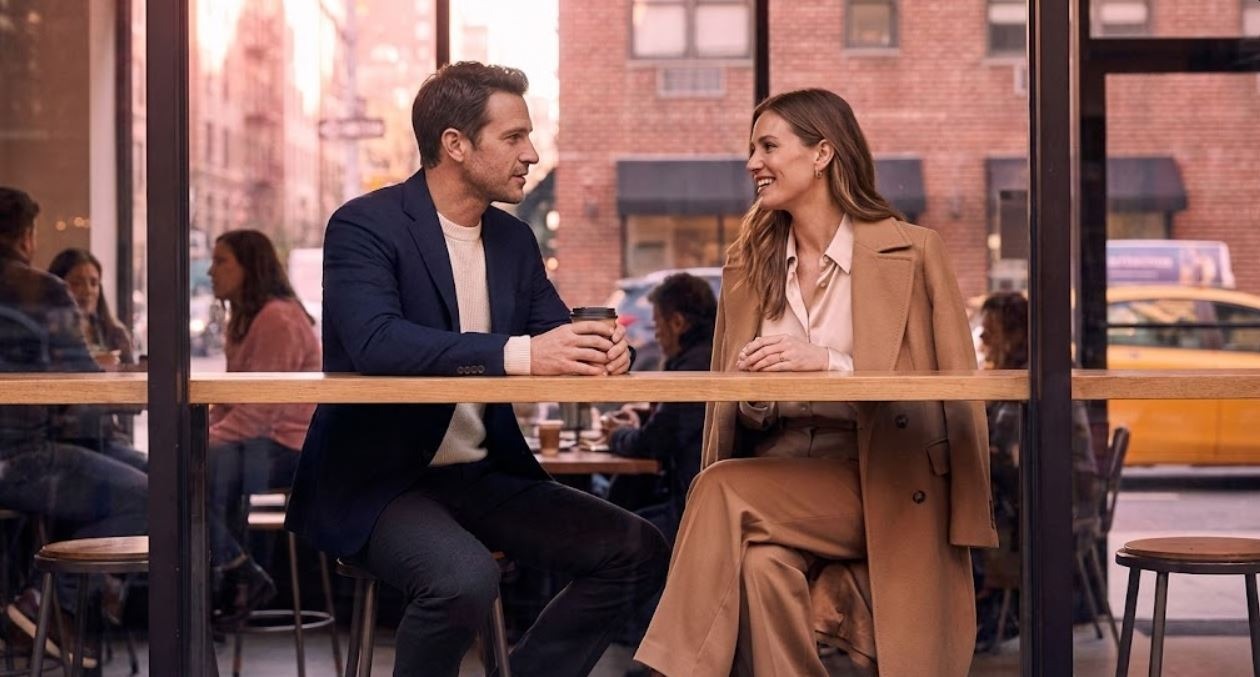
You have seven seconds to get someone’s first impression. Posture and a firm handshake are critical, but you’re saying something with what you put on before you even open your mouth. The concern precipitates: Am I being too formal? Too casual? Does this shade of red make me seem tired?
Sobaning added that standard advice tends to fail for being either too vague (“just be yourself”) or too specific (“wear a navy suit”), and nothing in between. It disregards your body type, the situation, and the nuanced psychology of how clothing speaks. This little guide gives you a practical way to choose clothes that represent who you are and what you want to say, so that look and feel prepared and real.
The Psychology of the Seven-Second Summary
Before diving into your closet, it helps to understand what’s happening in the observer’s mind. This isn’t about vanity; it’s about communication. Clothing acts as a visual shortcut, signaling three things immediately:
- Competence: Does this person seem capable and organized?
- Trustworthiness: Do they appear reliable and approachable?
- Status (in context): Do they fit the social or professional environment?
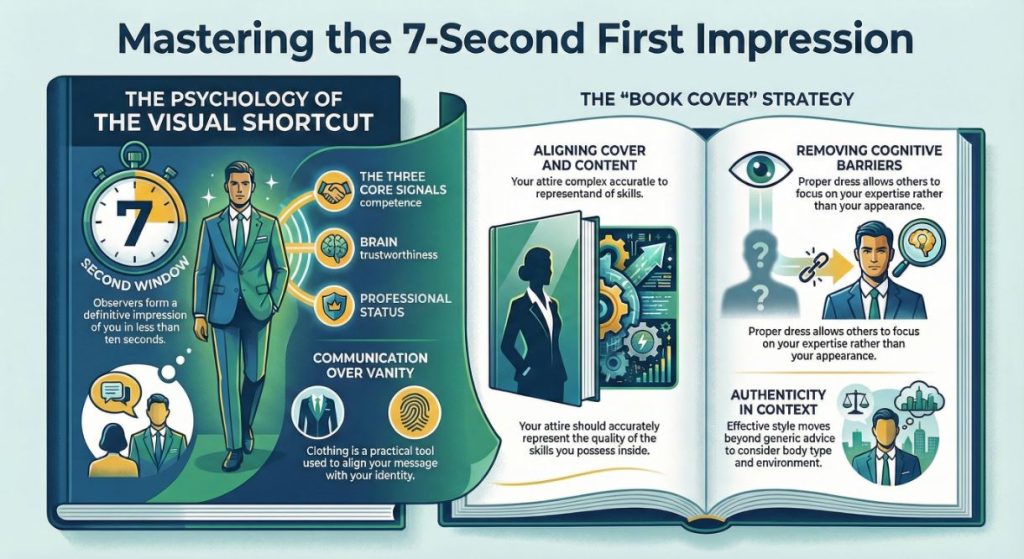
Think of your outfit as the cover of a book. You want it to represent the quality of the content inside accurately. If you show up to a client presentation in a wrinkled t-shirt, you’re forcing them to work harder to trust your expertise. A well-chosen outfit removes that barrier, allowing your personality and skills to take center stage.
How to Choose Your Outfit: A 5-Step Framework
This process moves beyond random selection. It’s a strategic method you can apply to any situation, from a job interview to a casual brunch.
Step 1: Decode the Context (The 3 Cs)
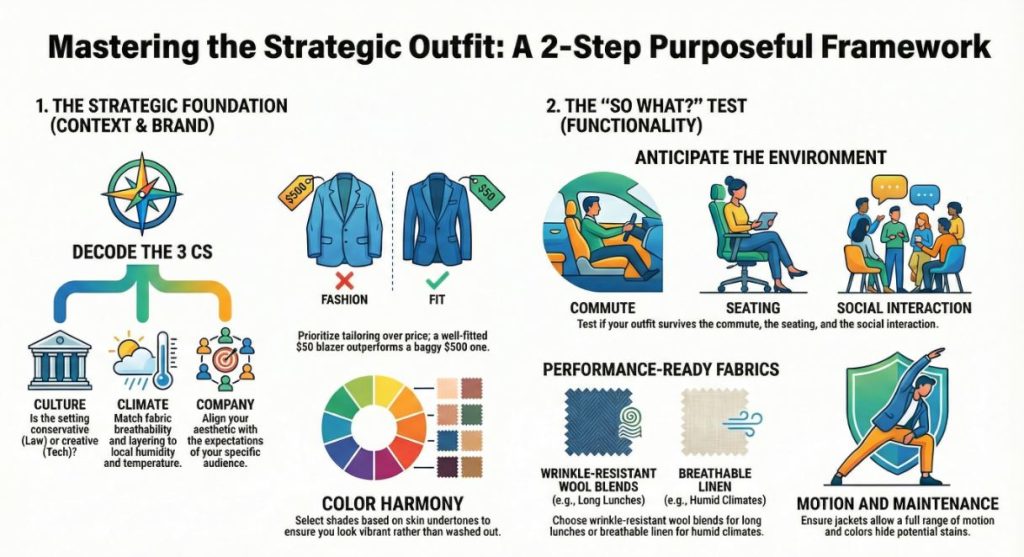
The biggest mistake people make is dressing for themselves, not the situation. Analyze the event using these three filters:
- Culture: Is this a conservative law firm or a trendy tech startup? A first date at a Michelin-star restaurant or a hike?
- Climate: Do you wear a wool suit for ten blocks in the humid New York summer? You’ll be all flushed and hot-looking. For those of us living in the humid South, breathable fabrics like linen or good-quality cotton are really non-negotiable. Layering is important for handling the temperature shifts of this dry southwestern climate.
- Company: Who are you meeting? A could-be connection, a next boss , or your partner’s parents for the first time? You should be basing your decision on what they expect.
Action Step: Before you choose anything, on a piece of paper, write three words that describe how you want to be perceived at this particular event. (e.g., “Professional, Approachable, Detail-Oriented” for an interview; “Relaxed, Put-Together, Fun” for a date).
Step 2: Identify Your Personal Brand Pillars
Your clothes must fit your physical form and your personality. An outfit that looks amazing on a mannequin can look awkward if it doesn’t suit you.
- Fit Over Fashion: This is non-negotiable. A $50 blazer that’s been taken in on the shoulders and waist will always look better than a $500 off-the-rack blazer that fits your body like a garbage bag.
- For Men: Your jacket shoulders should line up with your own, and your pants should have a nice break (the light creasing where the pants meet the shoe). You should see a half-inch of shirt cuff.
- For Women: Darts and seams should lie flat without pulling. The waistline of pants or skirts should sit comfortably at your natural waist or hips without digging in. If you’re between standard sizes, tailoring is your best friend.
- Color Harmony: Every color doesn’t suit everyone. Know your undertones (cool, warm, or neutral) so that you can know which shades make you look awesome and which do not. If you have a warm skin tone, for example, an olive green jacket would probably suit you better than steel blue.
Step 3: Build for Function (The “So What?” Test)
An outfit must perform. This is where many well-intentioned looks fall apart. Imagine the scene and test your outfit against it.
- The Commute: If you are biking to a meeting, can you switch shoes, or do you need a shoe that is both walkable and professional? (e.g., a bare leather loafer vs. a stiletto).
- The Venue: Are you out with a date in a small, low booth? Opt for a skirt you can wear without it riding up, and a shirt that is not overly starched to be uncomfortable. You may also want to reserve pure linen for a shorter business luncheon and instead go with fabrics — wool blend or ponte knit — that won’t wrinkle.
- The Conversation: Will you be gesturing? A good range of motion is key in a jacket. Will you be eating? Just put on a different shirt” does not apply unless you’re okay with wearing that sauce stain all day. If you have poor table manners and do not like to wear your food, avoid white shirts or opt for something in a darker color where spills and stains are easier to forgive.
Step 4: The Psychology of Color and Texture
Once the practicalities are handled, use color and texture to send the right subconscious signal.
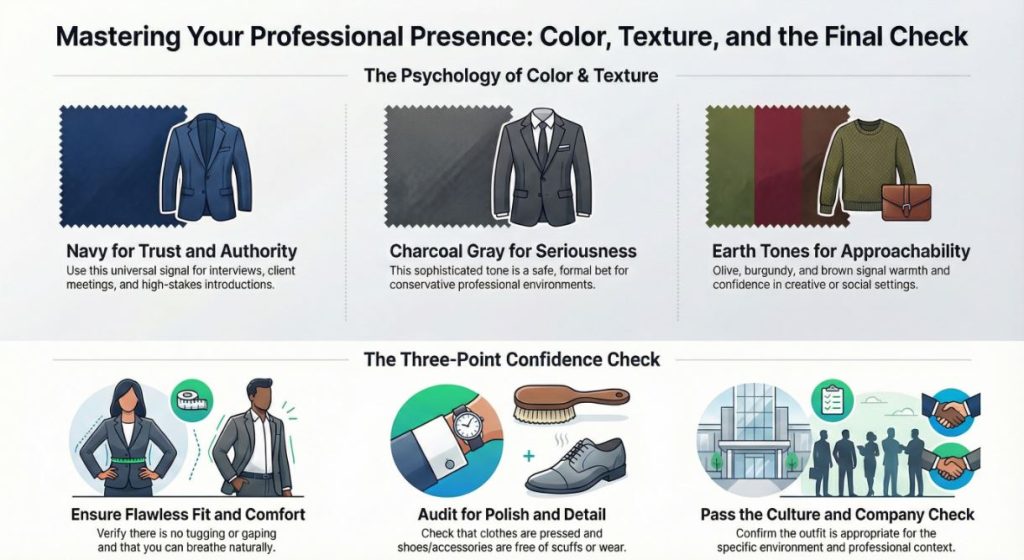
- Navy: The universal signal of trust, authority, and reliability. Perfect for interviews, client meetings, and meeting parents.
- Charcoal Gray: Communicates seriousness, sophistication, and formality. A safe bet for conservative environments.
- Olive, Burgundy, and Brown Earth tones: Indicate a sense of approachability & warmth, and confidence. Great for dating and creative offices.
- Black: Can be strong and sophisticated, but in certain situations (like the South or Midwest during the day), it can come off harsh or funereal. It is often best at night.
- Texture: On an all-black look, texture is a visual treat. A cable-knit sweater with wool trousers, or a silk blouse with a tweed blazer, says “thoughtful,” not scream-y.
Step 5: The Five-Point Confidence Check
Before you walk out the door, do a final scan.
- Does it fit? No tugging, pulling, or gaping.
- Is it appropriate? Does it pass the “Culture” and “Company” check from Step 1?
- Is it comfortable? Can I sit, stand, and breathe naturally?
- Is it clean and pressed? Wrinkles and stains signal carelessness immediately.
- Are the shoes and accessories right? Scuffed shoes or a beat-up bag can undermine an otherwise great outfit. This is where you prove your attention to detail.
Common Mistakes That Derail First Impressions
Even with good intentions, it’s easy to make a misstep. Here’s what to watch out for:
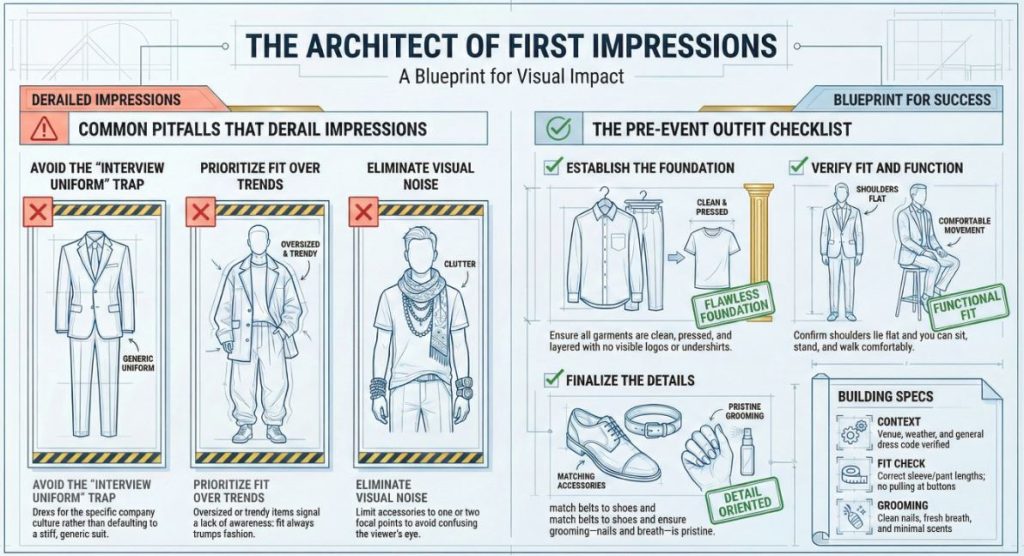
- The “Interview Uniform” Trap: Wearing a suit to a casual startup interview makes you look like you don’t get the company culture. You will seem stiff and out of place. Instead, aim for “elevated casual”: dark jeans, a blazer, and clean sneakers or loafers.
- Over-accessorizing: A chunky watch, a thick bracelet, a bold necklace, and a pocket square together create visual noise. The goal is to guide the eye, not confuse it. Choose one or two main pieces.
- Prioritizing Style Over Fit: That trendy oversized blazer might look cool on Instagram. However, if it overwhelms your frame, it shows that you don’t get how clothes should fit. Fit always matters more than trend.
- Ignoring Grooming: Your clothes are the frame, but you are the picture. Messy hair, chipped nail polish, or a strong scent can leave a lasting impression, regardless of how good your outfit looks.
Your First Impression Outfit Checklist
Use this checklist when planning an outfit for any key event.
- Context Verified: I know the venue, the weather forecast, and the general dress code.
- Intention Set: I’ve picked 2-3 words to describe the impression I want to make.
- The Foundation:
- Garments are clean, ironed/steamed.
- Undershirt/layers are appropriate (no visible logos or V-necks showing under a tie).
- Fit Check:
- Shoulders lie flat.
- Sleeve and pant lengths are correct.
- No pulling at the buttons or waist.
- Function Check:
- I can sit, stand, and walk comfortably.
- Shoes are appropriate for the weather and the venue.
- Details:
- Belt matches shoes (in a pinch, close is better than clashing).
- Accessories are minimal and intentional.
- Breath is fresh, nails are clean.
Nuance & Boundaries: When Your Best Effort Isn’t Enough
It must be noted that clothes are strong, but they aren’t magic. If you’re going on a date with someone who has already decided they don’t like you, no outfit is going to fix that. But an alluring attire can’t make you look bad, your outlier of a skill set would be the reason.
When to hire a pro: If you have a high-stakes, life-altering moment coming up (executive-level job interview, televised appearance), or going through a total style reset because of a body change — hiring a personal stylist/image consultant for a one-time consultation is a good investment. They offer impartial feedback that the mirror can’t give you.
Dealing with social anxiety: If the idea of being judged on what you wear is too much to handle, then get your outfit ready the night before. Take the decision fatigue out of the equation. When you see your reflection in the mirror, stop searching for imperfections. Find one thing that you truly like. This way, you will be thinking confidently instead of being anxious.
Frequently Asked Questions
Yes. Color psychology is a well-documented phenomenon. While individual preferences vary, colors consistently evoke certain feelings. For example, blue is widely associated with trust and stability, which is why it’s so popular in corporate and political settings. For a first date, avoiding aggressive colors like bright red (which can signal dominance) in favor of softer tones might make you seem more approachable.
Your uniform is your base. The first impression then hinges entirely on fit and grooming. Have your uniform tailored—it makes a massive difference. Ensure it’s impeccably clean and pressed. Your shoes, hair, and overall hygiene become the primary signals of your professionalism and self-respect.
The “dressy casual” uniform works in almost any undefined situation. For men: dark wash, well-fitted jeans or chinos, a solid color Oxford cloth button-down or a fine-gauge knit polo, and clean leather sneakers or desert boots. For women: dark, tailored trousers or a midi skirt, a silk shell or a nice knit top, and either loafers or low block heels. It’s polished but not pretentious.
Focus on finding good fabrics and clean lines. A well-chosen blazer or fitted cardigan over non-denim trousers, like wool, cotton twill, or ponte, will create a polished look for work. Crisp button-down shirts, silk blouses, and stylish leather shoes or flats will elevate your appearance beyond casual.
Pay attention to fit and quality, not brand. Thrift stores and online consignment stores are often better sources of quality fabric and construction at a much more affordable price. Invest your dollars in tailoring and not designer labels—a $15 blazer from the thrift store, tailored to fit for $20 will look a whole lot better than a $150 off-the-rack blazer from a mall store.
Conclusion
Picking an outfit that you want to make a good first impression in needn’t be about transforming into someone else. It’s not about deceiving, but strategically sharing your best self with a new audience. By deciphering context, prioritizing fit, and making your clothes work as well as they look, you don’t have to guess and wring your hands. We don’t want perfection here; we want clarity. When your clothes match the situation and who you are, then you can let yourself off the hook — forget about it all — and concentrate on what really counts: the human connection right in front of you.
Disclaimer: For reference only. Style tips are just a guideline. Adjust them to fit your comfort level and your situation.