

You’ve saved up for something special. You walk into the store, try on the piece with the recognizable monogram, and feel… like a walking billboard.
That’s the problem with conventional luxury today. The logos have gotten louder while the quality has gotten quieter. You’re paying premium prices to advertise for someone else, and the result often feels hollow rather than empowering.
Here’s what most style advice gets wrong: true luxury isn’t about recognition—it’s about resonance. It’s the difference between announcing your arrival and being remembered long after you’ve left.
This guide cuts through the marketing noise to show you exactly how to build a wardrobe that signals sophistication through substance, not symbols. You’ll learn the practical differences between logo-heavy dressing and understated elegance, plus actionable steps to transition your closet starting this week.
Decoding the Spectrum: Three Approaches to High-End Style
Logo-Dominant Fashion: The Billboard Effect
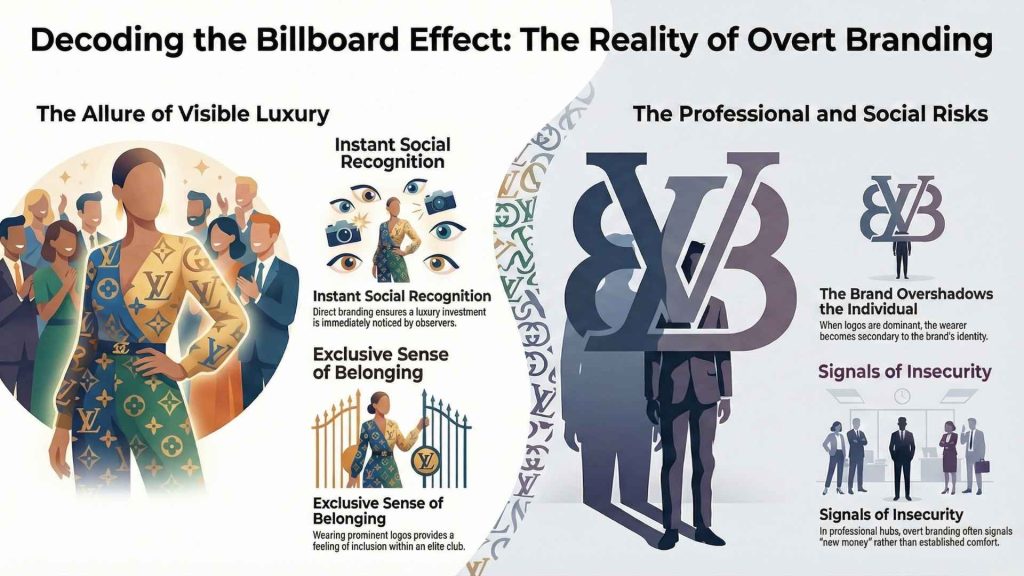
Walk through any American mall or city center, and you’ll see it: handbags stamped with repeating initials, sweatshirts featuring brand names spelled out in giant letters, belts with hardware the size of a license plate.
This approach isn’t inherently wrong. It’s direct, recognizable, and for some, provides a sense of belonging to an exclusive club. The appeal is understandable—you want your investment to be seen.
But there’s a cost. When the logo does all the work, you become secondary to the brand. The outfit wears you, not the other way around. And in professional settings, especially in cities like Boston, Chicago, or San Francisco’s financial district, overt branding can read as trying too hard—a tell that signals new money rather than established comfort.
Bold Elegance: When Personality Takes Center Stage
Before we explore quiet luxury, let’s acknowledge a middle path. Bold elegance uses distinctive cuts, vibrant colors, or architectural shapes—but without relying on logos to communicate value.
Think of a sculptural cashmere coat in cobalt blue from a lesser-known designer, or a structured dress whose interest comes from draping rather than prints. This approach says, “I know what works on my body, and I’m not hiding behind anyone’s monogram.”
This style requires more confidence because you’re not borrowing credibility from a recognizable name. You’re betting on your own eye. For many women transitioning away from logos, this serves as a comfortable stepping stone.
Quiet Luxury: The Art of Understatement
Quiet luxury is what happens when quality becomes its own statement. The fabrics are exceptional—virgin wool that drapes perfectly, silk that catches light like water, cashmere so fine it feels liquid. The construction is impeccable: hand-finished hems, perfectly matched patterns, hardware with satisfying weight.
But here’s the defining characteristic: nothing screams, everything whispers.
A quiet luxury piece might come from a heritage brand with centuries of history, but you’d never know it from looking. The label stays inside. The value reveals itself gradually—in how the garment holds its shape after eight hours of wear, in the compliments you receive on “that beautiful coat” rather than “that Gucci coat.”
The Fundamental Difference: Mindset Over Monogram
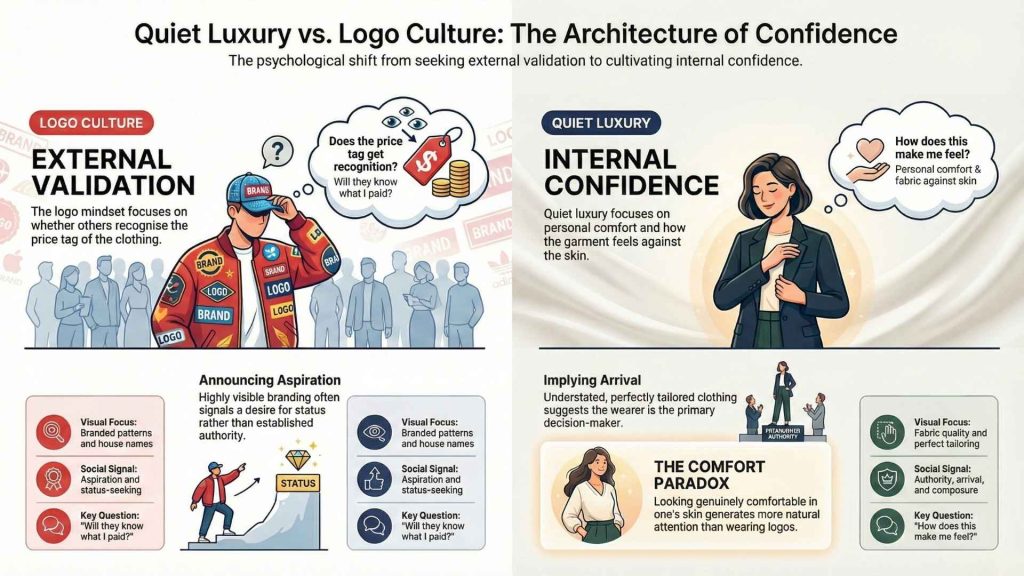
The gap between logo-driven and quiet luxury isn’t really about clothing—it’s about psychology.
The logo mindset asks: “Will others recognize what I paid for this?”
The quiet luxury mindset asks: “How does this make me feel when I wear it?”
One seeks external validation. The other cultivates internal confidence. And interestingly, the second approach often generates more of the first. When you look genuinely comfortable in your skin—when your clothes fit perfectly and move with you rather than against you—people notice. They just won’t know exactly why.
This isn’t theoretical. Consider two women at a business dinner in New York. One wears a head-to-toe logo ensemble from a famous Italian house. The other wears an unlabeled navy blazer in superfine wool, a white silk blouse, and tailored trousers with a perfect break over Italian leather loafers. Who seems more likely to be the decision-maker at the table?
The logo-dependent outfit announces aspiration. The understated one implies arrival.
The Allure—and Trap—of the Visible Brand
Let’s be fair to logos: they serve a purpose. For younger professionals building their careers, a recognizable piece can feel like armor—a way of saying “I belong here” before you have the track record to prove it. There’s nothing wrong with that strategy as a temporary measure.
The problem comes when logos become a crutch. When you can’t assess quality without a recognizable name. When you choose the handbag with giant hardware over the one with better leather because you’re afraid no one will notice your investment.
There’s also the practical consideration of regional climate. In humid Southern states like Georgia or Louisiana, logo-heavy coated canvas bags (common from major luxury houses) trap heat against your body and don’t breathe. Meanwhile, an understated leather tote from a small workshop adapts to your shoulder, develops patina over time, and won’t leave you with a sweaty side during an Atlanta summer.
In colder climates like Minnesota or Michigan, the difference shows up in insulation. A logo sweatshirt might cost $800 but offer the same warmth as any mid-range fleece. A quiet luxury cashmere sweater, by contrast, might cost more but keep you genuinely warm at 15 degrees with just a silk base layer underneath.=
How to Build Your Quiet Luxury Wardrobe: A Practical Guide
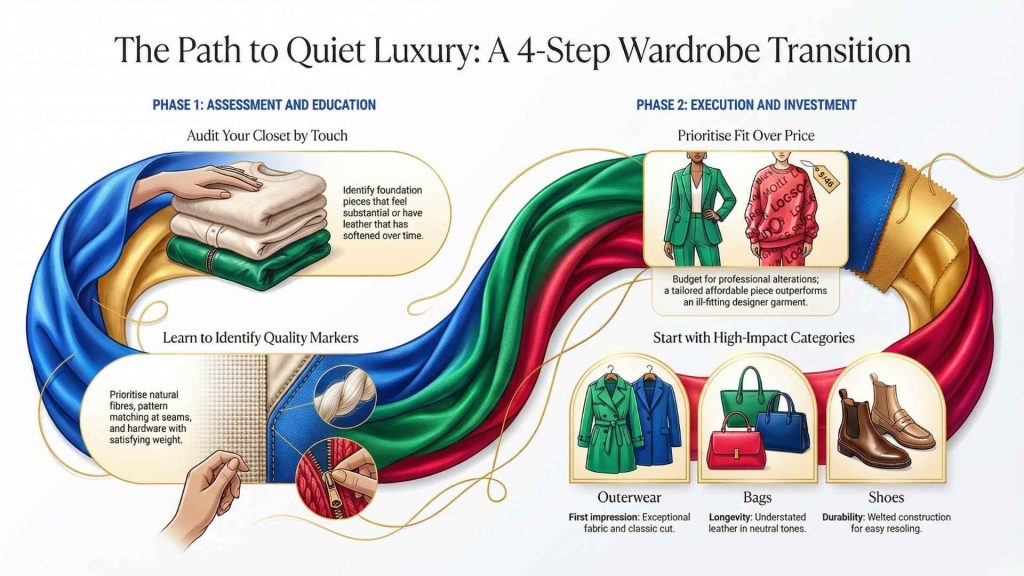
Transitioning away from logos doesn’t require discarding everything you own. It means becoming more intentional about future purchases. Here’s a step-by-step approach:
Step 1: Audit by Touch, Not Label
Go through your closet and handle each piece. Which ones have fabric that still feels substantial? Which bags have leather that’s softened beautifully over time? Which items do you reach for instinctively, regardless of brand?
These are your foundation pieces. They’re already practicing quiet luxury—you just haven’t noticed.
Step 2: Learn the Quality Markers
Before your next purchase, educate yourself on what actually makes something well-made:
- Fabric composition: Natural fibers (wool, silk, cotton, linen, cashmere) age gracefully. High-quality synthetics have their place for specific functions, but all-cotton t-shirts from heritage mills outperform logo versions with poly blends.
- Construction details: Look for pattern matching at seams, reinforced buttons with shank attachments (not just sewn through), and linings that aren’t puckering.
- Hardware weight: Pick up a potential bag and feel its zipper pull. Cheap hardware feels hollow. Quality hardware has satisfying heft and moves smoothly.
Step 3: Prioritize Fit Over Everything
A $200 blazer altered to your exact measurements will look better than a $2,000 off-the-rack piece. Find a tailor you trust—ask at higher-end department stores for referrals if needed. Budget for alterations on every significant purchase.
Step 4: Start with High-Impact Categories
If you’re replacing logo pieces gradually, begin with items that get the most use:
- Outerwear: A coat is the first thing people see. Choose exceptional fabric and classic cut.
- Bags: One understated leather tote in black or brown will serve you for decades.
- Shoes: Look for welted construction (which allows resoling) rather than glued soles.
- Knitwear: Cashmere or merino in neutral colors layers under everything.
Common Mistakes to Avoid
- Confusing minimalism with quality: A plain t-shirt from a fast-fashion brand isn’t quiet luxury—it’s just plain. The difference is in the fabric weight and construction.
- Buying logo pieces in “stealth” colors: A black Gucci bag with subtle branding still carries the message; you’re just making it harder to read. Either commit to unbranded or accept that you’re still in the logo space.
- Ignoring provenance: American heritage brands like Alden shoes, Filson bags, or individual craftspeople on platforms like Etsy often deliver better quality than European luxury houses at similar prices.
Your Quiet Luxury Buyer’s Checklist
Before any significant purchase, ask:
- Does this piece rely on a logo for its appeal?
- Would I still want this if no one recognized the brand?
- Is the fabric content at least 70% natural fibers?
- Can this be repaired (resoled, re-heeled, altered) rather than replaced?
- Does this work with at least three existing items in my closet?
- Am I buying this for how it makes me feel, or how I think others will perceive me?
When to Invest, When to Save
Quiet luxury doesn’t mean every item costs a month’s rent. Smart allocation means spending where it matters and saving where it doesn’t.
Invest in:
- Coats and jackets (they frame your entire silhouette)
- Bags (daily use demands durability)
- Shoes (poor footwear ruins an otherwise elegant look)
- Knitwear (cheap wool pills and loses shape)
Save on:
- Trend pieces (anything you won’t wear in three years)
- Base layers (quality cotton tees from reliable mid-tier brands)
- Gym wear (technical fabrics perform similarly across price points)
4Rue Sophie’s Approach: Understated Design as Identity
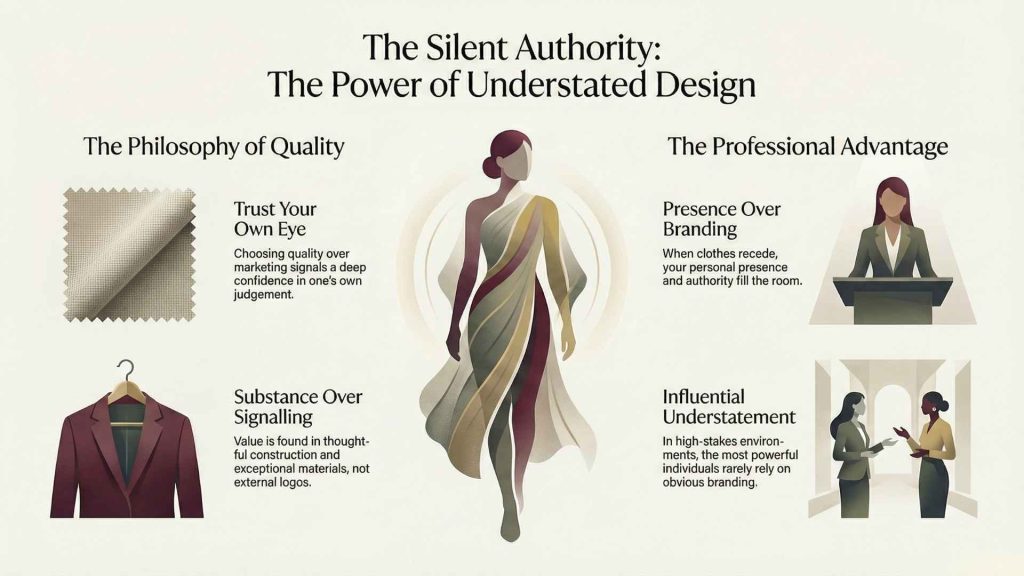
For the modern American woman building a serious wardrobe, the goal isn’t to disappear—it’s to be remembered for the right reasons. This philosophy shapes how we think about every piece we create.
When you wear something with thoughtful construction and exceptional materials—without relying on external branding to announce its value—you’re making a statement about your own confidence. You’re saying, “I know enough to recognize quality, and I trust my own eye more than I trust a marketing department.”
This becomes particularly powerful in professional contexts. In cities like Washington D.C., where signaling status is practically a sport, the most influential women rarely wear obvious branding. They understand that when your clothes announce themselves, you become secondary. When your clothes recede, your presence fills the space.
The Confidence That Needs No Label
Ultimately, the shift to quiet luxury reflects a deeper truth about style: it’s most powerful when it points to the person wearing it, not the person who made it.
Women who’ve made this transition report the same experience. They stop worrying whether their bag is “current season.” They stop scanning other women’s outfits to compare labels. They start receiving compliments on their “eye” and their “style”—not their purchases.
That’s the real luxury. Not the absence of logos, but the presence of self-assurance so complete that you don’t need to borrow credibility from anyone else’s name.
Start small. Next time you’re considering a purchase, ask yourself the questions from the checklist above. Feel the difference between reaching for a piece because of what it says versus how it makes you feel. Your wardrobe—and your confidence—will thank you.
Frequently Asked Questions
Not exactly. While old money aesthetics often favor understatement, quiet luxury is accessible to anyone who prioritizes quality over branding. It’s a philosophy of consumption, not a social class.
They won’t—at least not immediately. But they’ll notice how well your clothes fit, how the fabric moves, and how put-together you look. The compliments shift from “nice bag” to “you always look so elegant.”
Absolutely. A logo belt with an unbranded dress, or a recognizable handbag with a minimalist coat, creates balance. The goal isn’t purity—it’s intentionality.
Look at heritage brands like Alden (shoes), Filson (bags and outerwear), and individual artisans on platforms like Etsy or at American craft fairs. Many small designers produce exceptional quality without mass-market branding.
Follow care labels strictly, but generally: dry clean wool and silk sparingly (air them out instead), use shoe trees for leather footwear, store bags stuffed with acid-free tissue, and address repairs immediately before damage worsens.
It can be, but not necessarily. A logo canvas bag might cost $2,000 while a handcrafted leather tote from a small maker costs $1,200. You’re paying for materials and construction rather than advertising and licensing.
Disclaimer:This article is for informational purposes only and reflects general style guidance. Individual preferences, body types, and budgets vary—choose what works for your unique situation.