
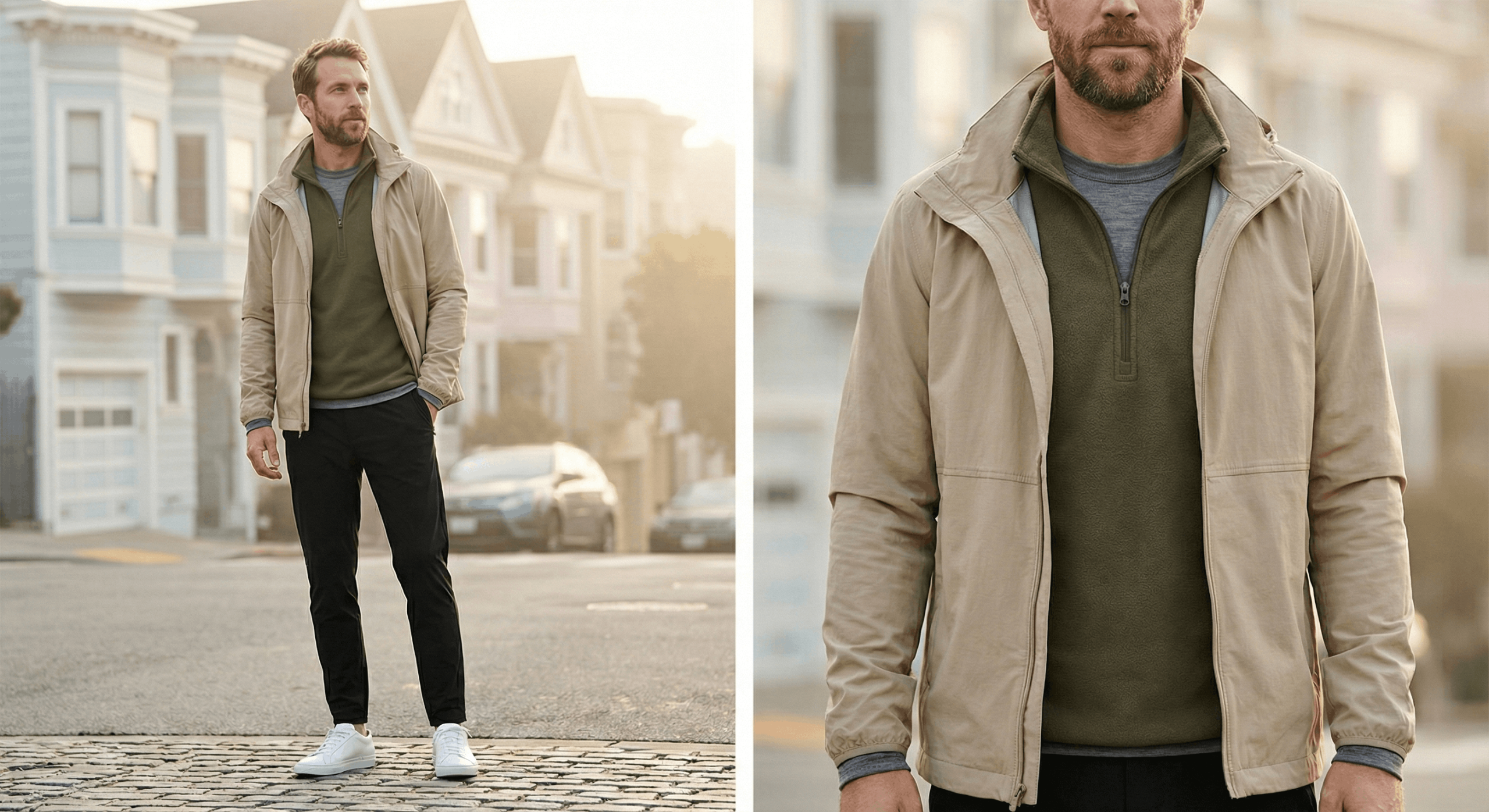
A proper San Francisco layering guide for foggy days has to solve one specific problem: you cannot predict the wind.
You stepped outside this morning, felt the chill, and grabbed a thick sweater. But by 2:00 PM, you are carrying it. You are sweating, or worse, you left it at a coffee shop. This is the San Francisco trap. It isn’t the cold that gets you. It is the range.
Standard advice tells you to wear a jacket. That approach fails because it treats the weather as static. In reality, San Francisco operates on a 20-degree swing, often within the same hour.
This guide teaches you the 3-Tier Microclimate System. It focuses on what to wear, how to take it off, and how to carry it when the fog returns.
Why Summer in SF Feels Like Winter
The fog, nicknamed Karl, is not just a weather event. It is a marine layer. When this layer rolls over the Twin Peaks, it rapidly drops the temperature. This is not a gentle mist. It is dense, wet air that cuts through cotton.
However, move ten blocks south or east out of the wind tunnel, and the sun is hot. So you are not dressing for one city. You are dressing for the coastal wind and the inland sun simultaneously.
The goal is not warmth but adaptability.
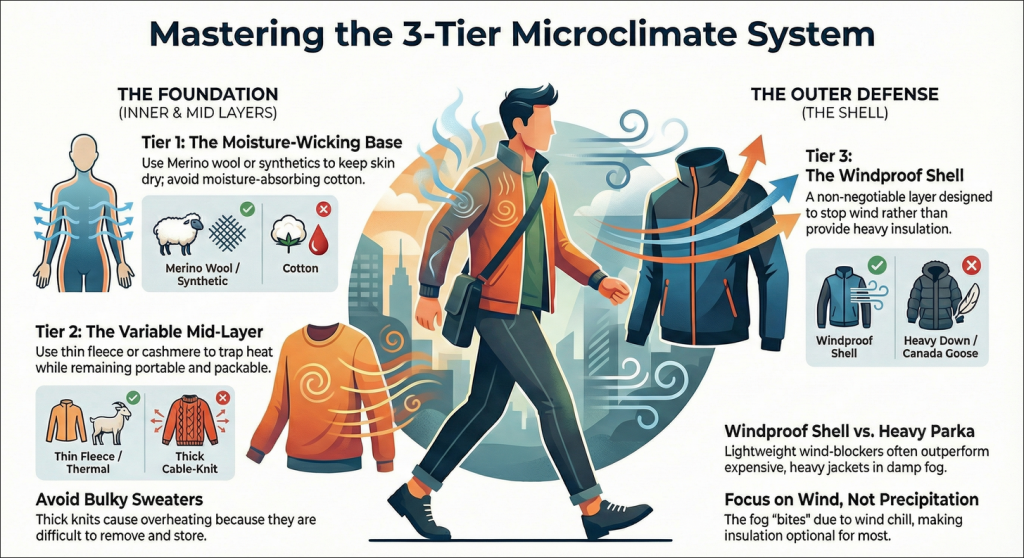
The 3-Tier Microclimate System
Forget the “T-Shirt + Heavy Jacket” model. That setup creates too much bulk and too little flexibility.
Instead, you need three distinct layers that breathe independently.
Tier 1: The Base (The Dry Layer)
This layer isn’t for heat. It is for moisture management.
- What to use: Merino wool or synthetic blend. No cotton.
- Why: Cotton absorbs the fog. It gets wet, stays wet, and then chills your core.
- US Context: Uniqlo Airism or Smartwool shirts work well. They dry fast if the fog seeps through your outer layer.
Tier 2: The Mid (The Variable Layer)
This is the layer you will add and remove most frequently.
- What to use: A quarter-zip fleece, a thin cashmere crewneck, or a long-sleeve thermal top.
- Why: It traps body heat but is thin enough to stuff into a tote bag.
- Common Mistake: Wearing a thick, cable-knit sweater. It is too bulky to remove comfortably, so you keep it on and eventually overheat.
Tier 3: The Shell (The Wind Layer)
This is non-negotiable in San Francisco.
- What to use: A windproof shell. Insulation is optional.
- Why: The fog bites because of wind, not precipitation. For instance, a thin $40 Uniqlo Blocktech parka often beats a heavy $800 Canada Goose jacket. It stops the wind without adding pounds.
- Nuance: If you run hot, skip the puffy jacket. A hard shell over a fleece is usually sufficient until December.
Step-by-Step: How to Build the Outfit
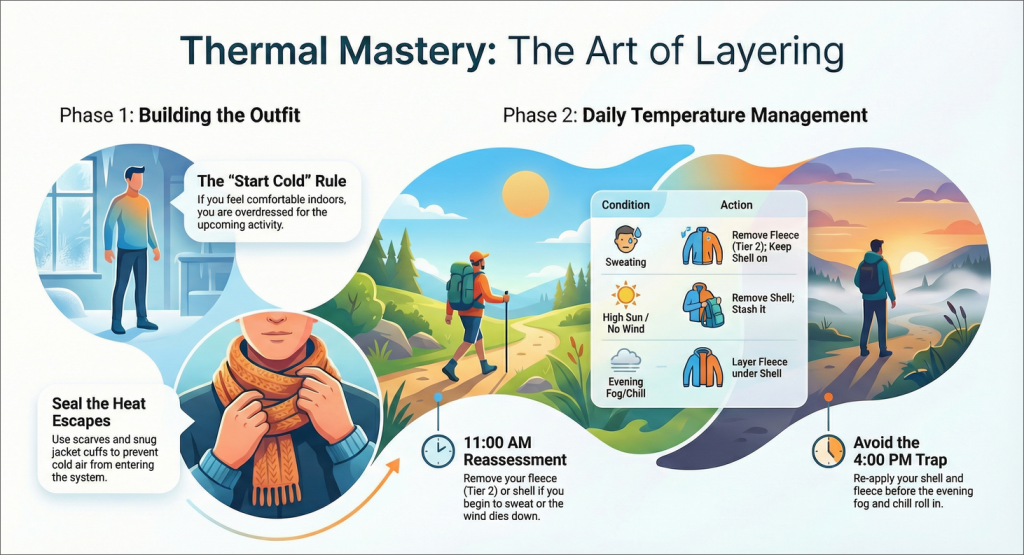
Step 1: Start cold.
Most visitors make their first mistake indoors. If you are comfortable standing in your living room, you are overdressed. You should feel slightly cool. You will warm up the second you start walking up a hill.
Step 2: Seal the wrists and neck.
Heat escapes from openings.
- Wear a scarf. Here, it is not a fashion accessory. It is a thermostat.
- Check your jacket cuffs. They need to be snug. Cold air rushing up your sleeve ruins the entire system.
Then, at 11:00 AM, reassess.
- Are you sweating? Remove the fleece (Tier 2). Keep the shell on.
- Is the sun high and the wind dead? Remove the shell. Stash it.
Finally, watch for the 4:00 PM trap.
The fog rolls back in aggressively around this time.
- If you packed your shell, put it back on before you feel the chill.
- If you packed your fleece, layer it under the shell.
The “What Do I Do With This Jacket?” Solution
This is the gap competitors ignore.
At 1:00 PM, you are holding a jacket. You don’t want to wear it. And you certainly don’t want to lose it.
The Rule: Your bag must fit the shell.
Consequently, do not buy a jacket that doesn’t stuff into its own pocket or fit in your crossbody.
- For men: A canvas tote or a small backpack is standard. Do not clip it to your belt loop. It will swing and annoy you.
- For women: If you use a small purse, you need a packable puffy. Brands like Patagonia (Nano Puff) and Cotopaxi make jackets that compress to the size of a water bottle.
4 Common Mistakes That Ruin Your Day
1. Assuming the Mission is the Sunset.
Do not dress based solely on the weather at your hotel.
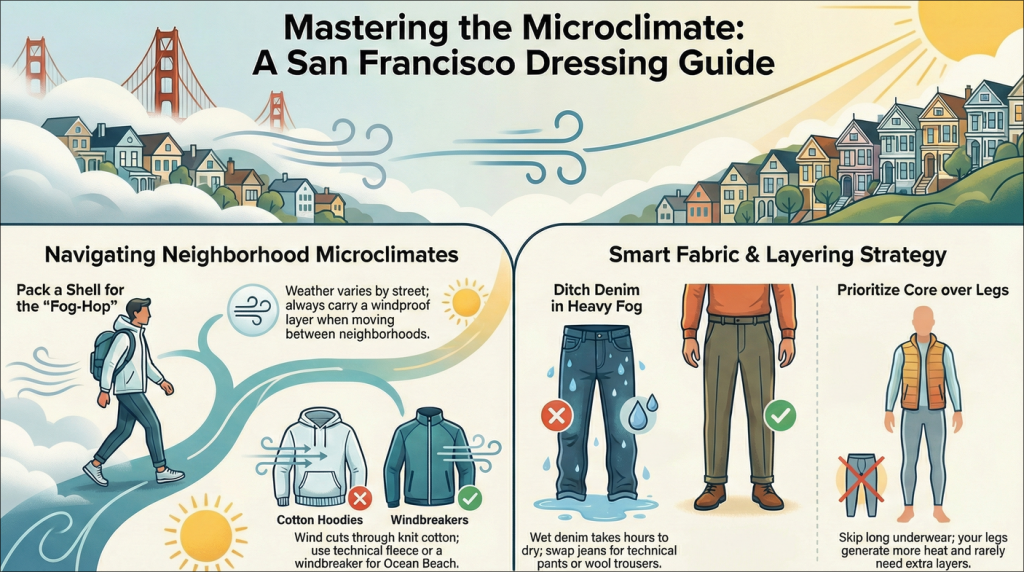
- If you are starting in North Beach (sunny) and going to Outer Sunset (fog), you must pack the shell. This holds even if you don’t wear it out the door.
- USA Specific: This challenge is unique to coastal cities. In NYC, the weather is relatively consistent borough-to-borough. In SF, however, it varies by street.
2. The “Just a Hoodie” Fallacy.
A cotton hoodie feels comfortable in the shop. Yet it fails at Ocean Beach. The wind cuts through the knit fabric immediately. You need a windbreaker over the hoodie, or a technical fleece hoodie with wind resistance.
3. Denim on Denim.
Jeans are fine. But wet denim takes hours to dry. If the fog is heavy, your jeans soak up moisture. For this reason, swap them for technical pants (Prana, Lululemon) or a looser wool trouser.
4. Over-layering the legs.
Long underwear is rarely needed in the summer. Your legs generate more heat than your core. Unless you are standing still on a ferry for 30 minutes, standard pants are sufficient.
Decision Checklist: What to Buy
Use this checklist if you are shopping before your trip or updating your closet.
- Is the outer layer windproof? (Hold it up to your mouth and blow. Can you feel the air? If yes, it fails.)
- Can the mid-layer compress? (Does it fit in a 10L bag?)
- Is the base layer non-cotton? (Merino or Polyester only.)
- Do you have neck coverage? (Scarf or high collar.)
- Are your shoes water-resistant? (Not waterproof, but the sidewalks get slick. Suede is risky in the Avenues.)
When to Break the Rules
The 3-Tier system works for 90% of SF summer days. However, there is a safety valve.
If you are hiking Land’s End at 7:00 AM or taking a sunset sailboat cruise, you need to stop improvising. In these specific cases:
- Swap the wind shell for a waterproof breathable jacket (Gore-Tex).
- Add a thermal base layer on the legs.
When to stop: If you are shivering while wearing three layers, you aren’t underdressed. Instead, you are likely standing still too long. Walk faster, or get a hot coffee. The system relies on your body generating the heat.
FAQ: San Francisco Layering
It depends on the lining. Unlined fashion leather jackets cut the wind poorly and offer zero stretch. A lined leather jacket with a zipper is fine for the evening, but it is heavy to carry during the day.
Locals have acclimated and understand they will be moving. They accept 30 seconds of cold shock for all-day mobility. That said, it is not recommended for visitors.
Yes. August is the heart of fog season. A thin cotton or silk scarf traps a pocket of warm air against your chest. Plus, it is easily removed.
Leave your sneakers at your desk. Carry your work shoes in a bag. Walk the hills in trainers, then change. This prevents wet feet and ruined soles.
Conclusion
San Francisco style is not about looking expensive. It is about being prepared without looking burdened. The person who looks comfortable here is not the one in the heavy parka. Rather, it is the one wearing the thin shell, the light fleece, and the scarf. That person is warm on the hill and cool in the cafe. They aren’t carrying a bag of bulky clothes. They are simply wearing the right system.
Disclaimer: This article reflects general styling preferences and regional dressing habits, not professional fashion design or technical outdoor survival advice. Individual fit, comfort, and warmth vary by body type, activity level, and brand sizing. Always try on garments when possible and adjust layers based on your personal needs.