

You’ve seen it everywhere. The perfectly worn-in leather jacket. The impeccably draped wool coat in a neutral tone. The absence of logos, the presence of confidence. It’s called “Quiet Luxury”—an aesthetic defined not by flashy branding, but by exceptional quality, timeless design, and subtle sophistication. But achieving quiet luxury on a budget is the very challenge we’re here to tackle.
But if you’ve tried to replicate the look, you’ve likely hit a wall. The standard advice often points you toward $1,200 cashmere sweaters and $3,000 investment handbags. It can feel like a club with a cover charge most of us can’t afford. The good news? That advice is missing the point. Quiet luxury was never about the price tag; the price tag is just a side effect of the principles involved.
This article solves that problem. We are going to deconstruct the mechanics of the quiet luxury aesthetic and show you how to build a wardrobe that whispers class—without screaming debt.
What Quiet Luxury Actually Means
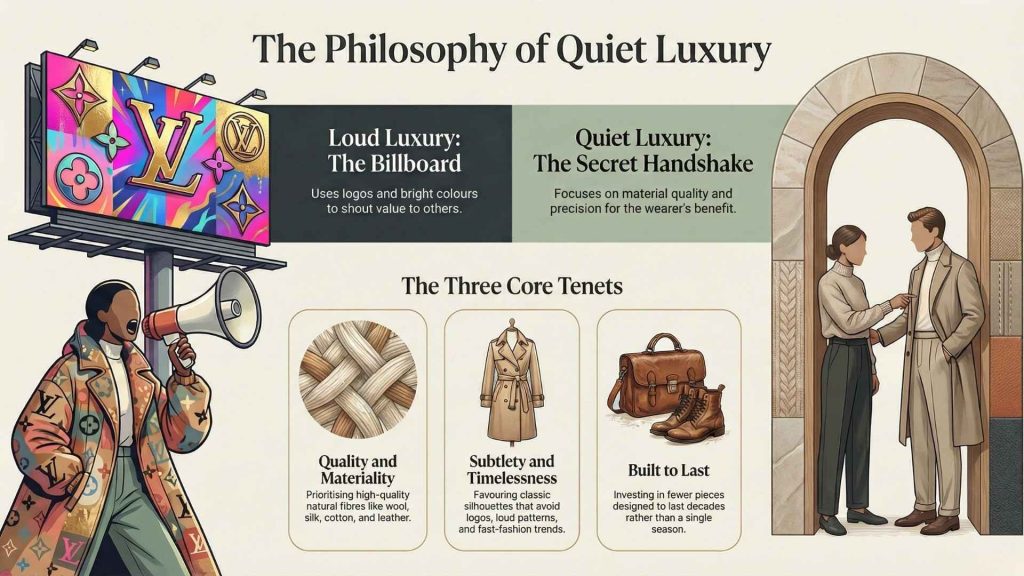
Before we talk about shopping on a budget, we have to strip away the hype. Quiet luxury is often conflated with “old money,” which implies a generational wealth most of us don’t have. In reality, quiet luxury is a design philosophy, not a bank statement.
Think of it this way: Loud luxury is a billboard. It uses logos, bright colors, and trendy silhouettes to shout its value to everyone who passes by. Quiet luxury is a secret handshake. The value is in the quality of the materials, the precision of the cut, and the timelessness of the design. It’s for the person wearing it, not the person looking at it.
The core tenets are:
- Subtlety: No logos, no loud patterns.
- Quality over Quantity: Fewer items, each built to last a decade, not a season.
- Timelessness: Classic silhouettes that don’t succumb to fast-fashion trends.
- Materiality: A focus on natural, high-quality fibers (wool, silk, cotton, leather).
Understanding this is the first step. It moves the goalpost from “How much does it cost?” to “How well was it made?”
Why Quiet Luxury Is the Ultimate Power Move (A Complete Guide)
How to Start Building a Quiet Luxury Wardrobe Without Breaking the Bank
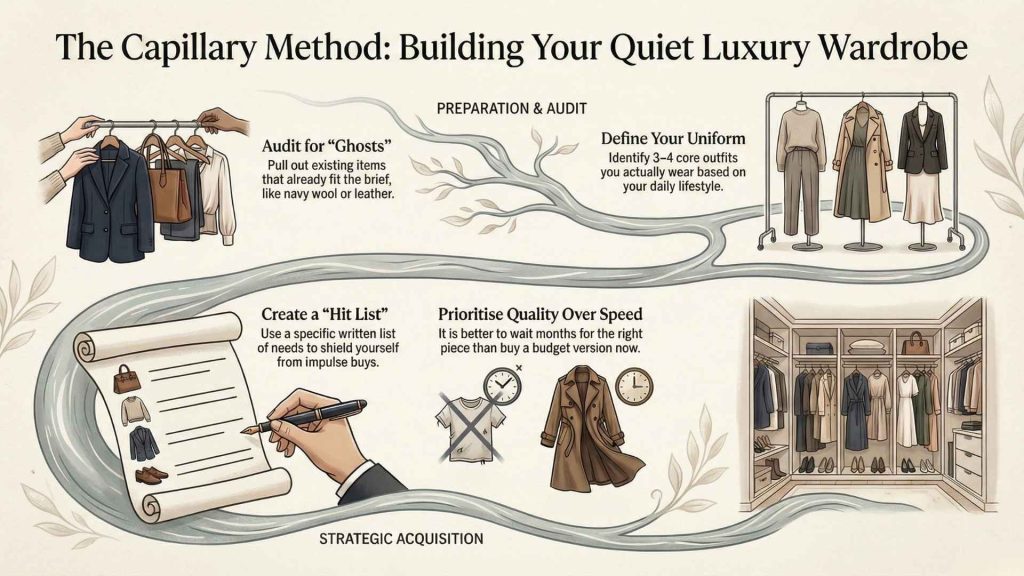
The biggest mistake people make is trying to buy everything at once. They attempt to build an “old money” wardrobe in a single weekend, and they either go broke or end up with a closet full of cheap approximations that fall apart.
The Solution: The “Capillary” Method.
Instead of a flood, think of building your wardrobe like a slow, steady drip. Start with a foundation and build piece by piece over time.
Step 1: Audit Your Current Closet.
Pull out everything that fits well and feels good to wear. You’re looking for “ghosts”—items that already fit the quiet luxury brief. That solid navy merino wool sweater from a brand you forgot? That’s a keeper. The well-worn leather belt? Perfect. You likely have more of a foundation than you realize.
Step 2: Define Your “Uniform.”
Quiet luxury is often about simplicity. What do you actually wear? If you work from home, you don’t need three tailored blazers right away. If you work in an office, you need fewer weekends-wear pieces. Pick 3-4 core outfits you love and identify what’s missing to make them perfect.
Step 3: Create a “Hit List.”
Don’t go shopping. Go on a search. Write down exactly what you need: “A heavyweight, 100% cotton, white oxford shirt,” or “A pair of straight-leg, non-distressed dark wash jeans.” This list is your shield against impulse buys.
Common Mistake: Buying a “budget” version of something just to have it now. A cheap version of a tailored coat will look and feel cheap, ruining the entire aesthetic. It’s better to wait six months and buy the right piece than to buy the wrong piece today.
The Best Places to Shop When You’re Working With a Real Budget
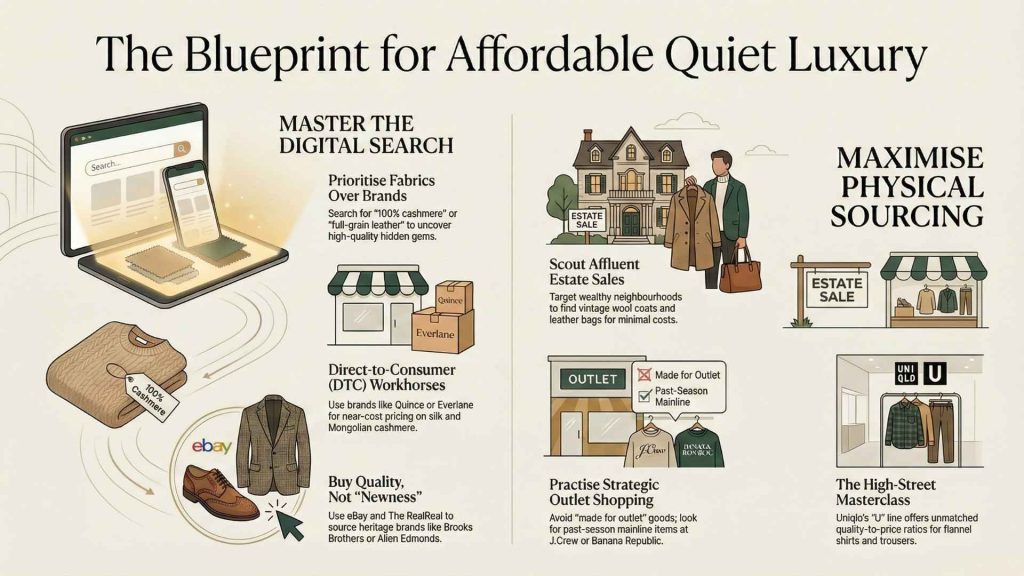
Forget the luxury department stores for a moment. The quiet luxury aesthetic lives in the details, and those details can be found everywhere if you know how to look.
1. The Digital Goldmine: eBay, Poshmark, and The RealReal
This is the single most effective way to build a quiet luxury wardrobe on a budget. You are buying the quality, but you aren’t paying for the “newness.”
- The Strategy: Search for heritage brands known for their quality, not their trendiness. Think: Brooks Brothers (for oxford cloth shirts), LL Bean (for outerwear and knits), ** vintage 100% wool blazers**, and *Allen Edmonds* (for shoes that can be re-soled).
- The Hack: Filter for fabrics. Search for “100% cashmere sweater” or “full-grain leather jacket” rather than specific brand names. This uncovers hidden gems.
2. The Outlet Malls (With a Caveat)
Be careful: many outlet stores sell “made for outlet” goods that are lower quality. However, you can sometimes find past-season mainline items. Stick to brands like J.Crew and Banana Republic for their essential, non-logo items like cashmere-blend sweaters and classic chinos.
3. The Unsung Heroes: Uniqlo, Quince, and Everlane
These brands are the modern workhorses of accessible quality.
- Uniqlo: Their “U” line, designed by Christophe Lemaire, is a masterclass in quiet luxury design. Look for their lambswool sweaters, flannel shirts, and wide-leg trousers. The quality-to-price ratio is unmatched.
- Quince & Everlane: These brands focus on “direct-to-consumer” pricing for better materials. Quince is excellent for Mongolian cashmere and silk tops at near-cost prices. Everlane is great for denim and leather goods.
4. The Physical Thrill: Estate Sales and Higher-End Thrift Stores
In affluent neighborhoods, estate sales are where quiet luxury goes to be reborn. You can find incredible cashmere, vintage leather bags, and wool coats for pennies on the dollar. This requires patience, but the payoff is immense.
Best Leather Jacket For Men 2026 Guide | Expert Buyers Advice
Why Quiet Luxury Has Nothing to Do With How Much You Spend
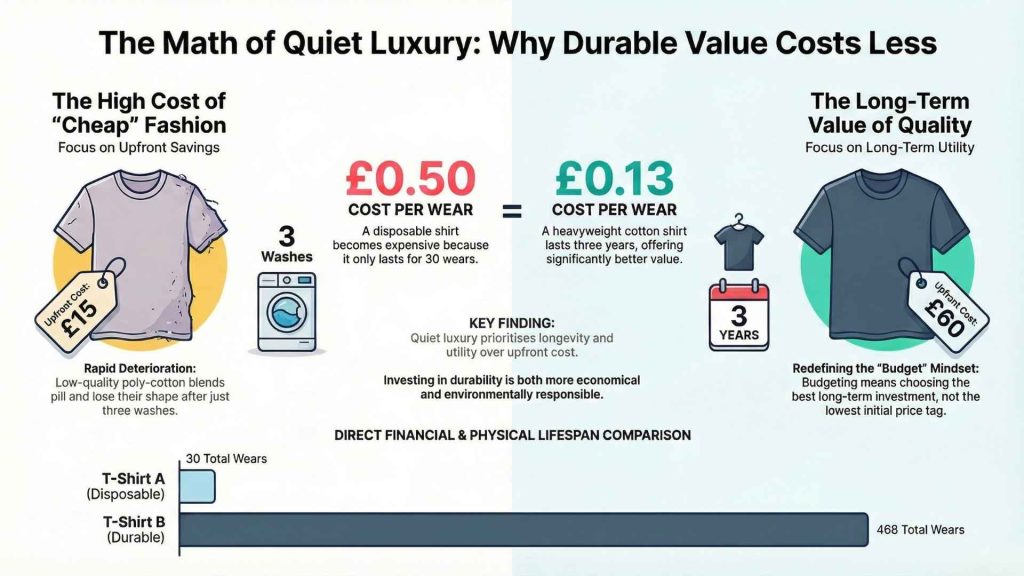
This is the psychological shift that changes everything. The price is just a number; the value is in the utility and longevity.
Consider two t-shirts:
- T-Shirt A: Costs $15. It’s a thin poly-cotton blend. It pills after three washes, loses its shape, and develops holes by the end of the year. You throw it away. Cost per wear: $15 / 30 wears = $0.50.
- T-Shirt B: Costs $60. It’s 100% heavyweight cotton. It holds its shape, the stitching is tight. You wear it for three years, at least once a week. Cost per wear: $60 / 468 wears = $0.13.
T-Shirt B is technically cheaper. It’s also better for the environment and looks significantly better on your body. Quiet luxury is simply the practice of buying T-Shirt B. It’s a rejection of fast fashion’s disposability. When you internalize this, “budget” stops meaning “cheapest upfront cost” and starts meaning “best long-term investment.”
Learning to Dress in One Color Family (and Why It Works So Well)
Take a look at any image associated with quiet luxury—Gwyneth Paltrow in a courtroom, a Danish design magazine, a photo of the Kennedys. What do you notice? The palette is restrained. It’s almost always a harmony of neutrals.
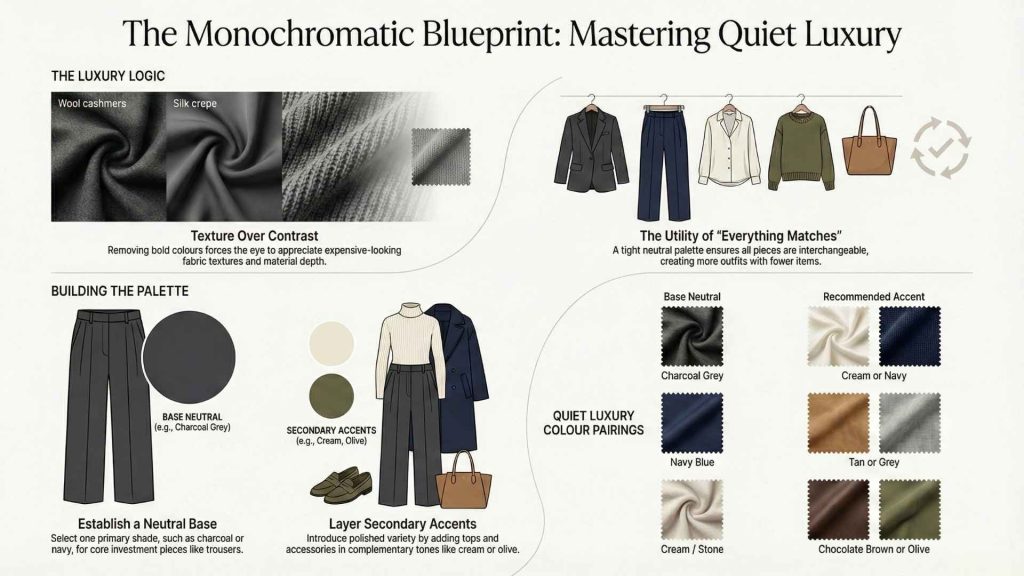
Dressing in one color family (monochromatic dressing) or a tight palette of complementary neutrals (cream, tan, chocolate brown, charcoal, navy) creates an instant illusion of wealth and sophistication. Here’s why it works so well on a budget:
- It Creates a “Rich” Visual Texture: When you remove contrasting colors, the eye is forced to notice the texture of the fabrics. A cream cable-knit cashmere sweater with cream silk trousers looks expensive because the contrast is in the material, not the color. This elevates even mid-range items.
- Everything Matches: If 80% of your wardrobe is in a palette of navy, grey, cream, and olive, you can get dressed in the dark. You don’t need a lot of pieces to have a lot of outfits. This is the definition of utility.
- How to Start: Pick one neutral as your base (say, charcoal grey). Buy your trousers and a blazer in that shade. Then, add tops and accents in a secondary neutral (cream or navy). It simplifies decision-making and looks incredibly polished.
Fit Will Always Matter More Than the Label on Your Clothes
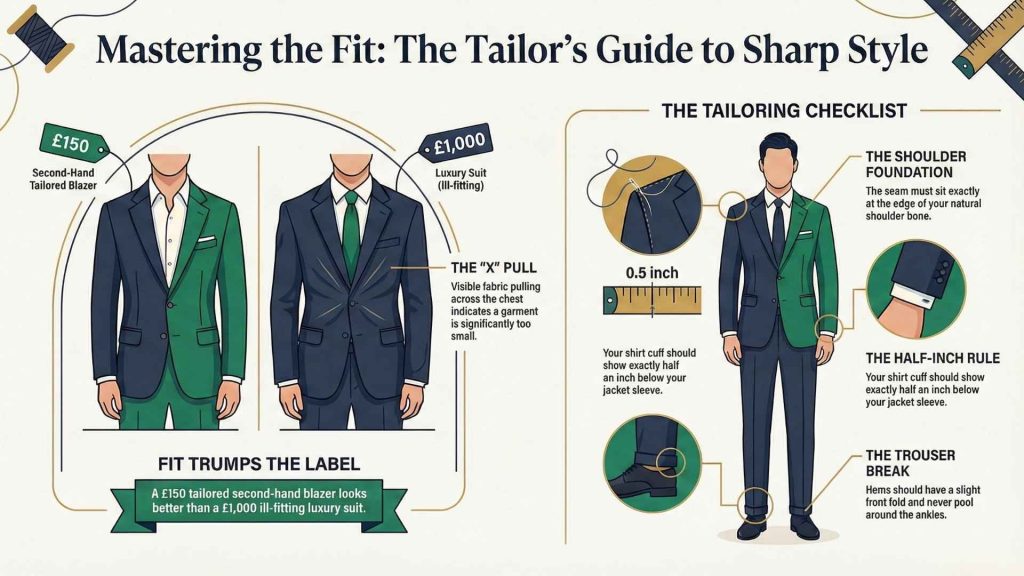
You can spend $1,000 on a suit, but if the shoulders are too wide and the pants are too long, you will look like you’re wearing a costume. Conversely, you can spend $100 on a second-hand blazer, spend $50 on tailoring, and look like a million bucks.
The Non-Negotiables of Fit:
- Shoulders: The seam of the shoulder should sit exactly at the edge of your natural shoulder bone. Not hanging off, not digging in. This is the hardest and most expensive thing to alter, so it must be right when you buy it.
- Sleeves: Your shirt cuff should show about half an inch below your jacket sleeve. Your jacket sleeve should end at your wrist bone.
- Trousers: The hem should have a slight break (a small fold) at the front, and angle down slightly to be longer in the back. They should never pool around your ankles.
- Torso: There should be no pulling at the buttons of a shirt or blazer. If you see an “X” of fabric pulling across the chest, it’s too small.
Learning to assess these points is a skill that will save you thousands. It allows you to see the potential in a garment that doesn’t fit perfectly yet, which is how you win at thrifting.
How to Choose the Best White Sneakers for Men: The 2026 Guide
Why a Good Tailor Might Be the Smartest Money You Ever Spend
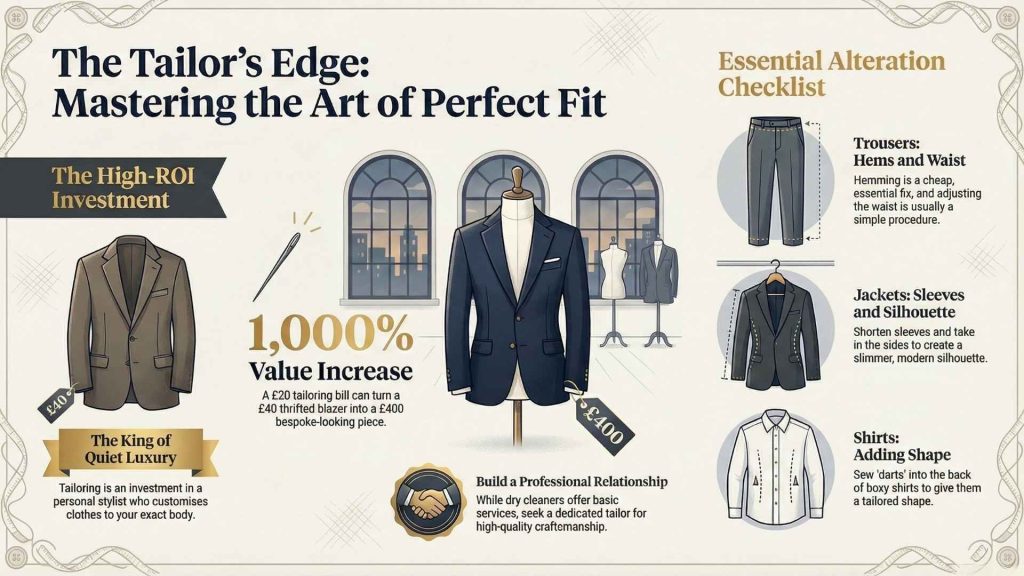
If fit is the king of quiet luxury, the tailor is the kingmaker. Think of a tailor not as an expense, but as a personal stylist who customizes your clothes to your exact body.
What to take to a tailor:
- Trousers: Hemming is cheap and essential. Taking in a waist is also usually simple.
- Jackets and Blazers: Sleeve shortening is standard. Taking in the sides to slim the silhouette is a game-changer for vintage finds.
- Shirts: “Darts” can be sewn into the back of a boxy shirt to give it shape.
The Cost/Benefit: A $20 tailoring bill can turn a $40 thrifted blazer into a $400 bespoke-looking piece. It is the highest-ROI action you can take in fashion. Find a tailor in your city (dry cleaners often offer basic alteration services, but look for a dedicated tailor for better work) and build a relationship.
What to Look for in Fabric and Cut Before You Buy Anything
Before you hand over your credit card, run this mental checklist. This is your shield against marketing hype and cheap construction.
The Fabric Checklist:
- Fiber Content: Ignore the brand, look at the tag. You want high percentages of natural fibers. Wool, cotton, linen, silk, and cashmere breathe better, drape better, and last longer than polyester, nylon, and acrylic.
- Weight and Hand-Feel: Does the fabric feel substantial? A “heavyweight” cotton t-shirt is a sign of quality. Does it feel soft and smooth? Scratchy synthetics are a red flag.
- The “Scrunch Test”: Scrunch the fabric in your fist for a few seconds. Does it release with deep wrinkles? That’s linen—it’s supposed to do that. Does it release with almost no wrinkles? That’s a high-quality wool or a synthetic blend. Does it hold a weird, crinkled pattern? That’s a cheap synthetic to avoid.
The Cut Checklist:
- Seams: Are they straight? Are they finished neatly (serged or French seams on nicer garments)? Loose threads are a sign of poor quality control.
- Lining: Is a jacket or coat lined? A full lining (often in rayon, cupro, or silk) helps the garment drape properly and last longer.
- Buttons: Are they plastic or are they natural materials (mother of pearl, horn, wood)? Cheap plastic buttons are an easy tell and a quick fix, but they signal a cheaper garment.
The One Thing Most People Overlook: Taking Care of Yourself
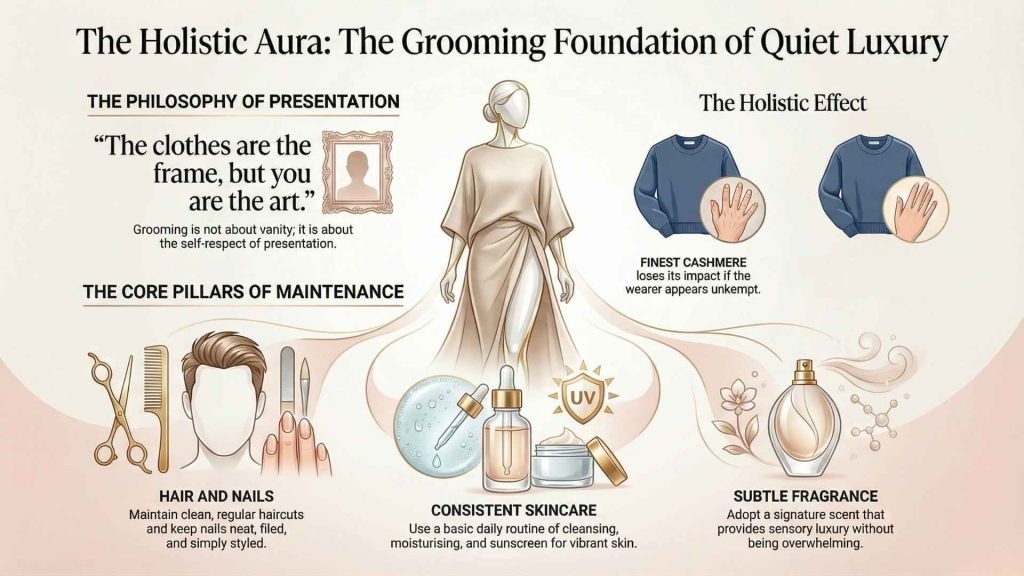
This is the final, non-negotiable piece of the puzzle. You can be wearing a perfectly tailored, 100% cashmere sweater, but if your hair is unkempt, your nails are dirty, and you look tired, the effect is lost. Quiet luxury is holistic. It’s an aura of self-respect.
The “Grooming” Factor:
- Well-maintained hair: A simple, clean haircut that you maintain regularly.
- Neat nails: Clean, filed nails. For men, this is a huge signal. For women, a simple, classic manicure (or no polish) works best.
- Healthy skin: A basic skincare routine (cleanse, moisturize, sunscreen) makes you look vibrant. You don’t need a 10-step routine, just consistency.
- Subtle Fragrance: A signature scent that isn’t overwhelming adds a layer of sensory luxury.
This isn’t about vanity; it’s about presentation. The goal is to look like a person who has it together. The clothes are the frame, but you are the art.
Your Questions Answered
Not at all. It’s about restraint, not absence of style. The interest comes from texture, silhouette, and the way the light hits a high-quality fabric. It’s a canvas for your personality, not the entire painting.
Absolutely. The key is the jean. Avoid distressed styles, acid washes, or overly trendy cuts. Look for a dark wash, straight-leg, or slim-straight fit in 100% cotton or a sturdy cotton blend. Pair it with a fine knit sweater and a clean white sneaker or a loafer.
Focus on a neutral palette. Think: Navy, charcoal, heather grey, cream, off-white, olive green, chocolate brown, and tan. These colors are timeless and mix effortlessly.
Play with texture and accessories. Pair a chunky cable-knit sweater with smooth tailored trousers. Add a silk scarf, a quality leather watch, or a simple necklace. The combination of textures prevents monotony.
This is a tricky one. High-quality vegan leather can look good, but cheap pleather will crack and peel quickly, which looks the opposite of luxurious. If you’re on a strict budget, it’s often better to look for well-maintained vintage real leather (which can be cheaper) than new faux leather.
Conclusion
Mastering quiet luxury on a budget isn’t about hunting for dupes of famous handbags. It’s about changing your entire philosophy toward clothing. It’s the patience to wait for the right piece, the knowledge to identify quality in a sea of fast fashion, and the wisdom to spend a little extra to make that piece fit you perfectly.
Start small. Get one shirt tailored. Save up for one great pair of shoes. Audit your closet. The goal isn’t to look rich; it’s to look like you have better things to spend your money on—because now, you do.
Disclaimer: This article is for informational purposes only and contains general advice on style and shopping. Individual results may vary based on body type, location, and market availability. Always assess the quality and fit of a garment for yourself before purchasing.